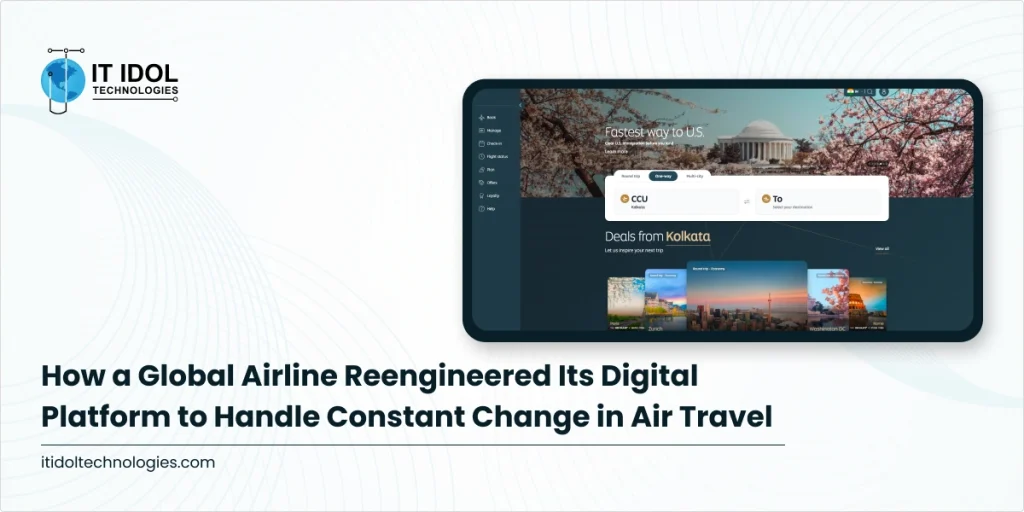
A leading global airline modernized its digital platform to better manage frequent flight changes, cancellations, and refunds.
The transformation ensured core booking systems remained stable and unaffected during post-booking updates.
The airline partnered with IT IDOL Technologies to redesign backend services.
The new architecture was built on microservices aligned with real operational workflows.
Scalability improved, allowing the platform to handle higher transaction volumes efficiently.
Self-service reliability increased, giving passengers smoother control over travel modifications.
The platform became more adaptable to continuous operational and industry changes.
Airline digital platforms were originally built for a simpler travel environment. A passenger searched for a flight, booked a seat, and arrived at the airport as planned. Today, that journey rarely follows a predictable path.
Flights are rescheduled. Travel plans shift with little notice. Regulatory requirements vary by destination. Passengers now expect refunds to process instantly, travel documents to be validated digitally, and most interactions to be self-managed. For airlines operating across international markets, this shift has exposed structural limitations in how traditional airline platforms are designed.
One leading global airline encountered this challenge not as a sudden disruption, but as a gradual build-up of operational complexity across its digital ecosystem.
When Booking Works but Everything Else Becomes Fragile
The airline’s website functioned as far more than a booking interface. It served as the primary digital gateway, supporting flight searches, reservations, online check-ins, travel planning, and customer self-service across multiple regions and languages.
While booking flows remained stable and reliable, significant strain began to emerge in processes that occurred after ticket issuance. Flight exchanges, order modifications, cancellations, refunds, document verification, and ancillary service management introduced layers of operational dependencies that legacy architectures struggled to support.
Each customer request touched multiple interconnected systems such as inventory, pricing engines, order fulfillment platforms, and downstream service integrations. These systems were tightly coupled, meaning a change in one area often triggered unintended consequences elsewhere. As platform traffic increased, even small updates began introducing significant operational risk.
A refund policy modification could disrupt fulfillment logic. Updates to document validation rules could affect check-in services. Over time, system stability depended more on avoiding change rather than supporting it.
This pattern is common across airline platforms but becomes particularly critical for carriers managing large-scale international operations.
Why Flexibility Became a Platform Requirement
Passenger expectations evolved faster than the underlying digital infrastructure. Customers no longer viewed flight changes or cancellations as unusual situations. They expected these processes to be as seamless and reliable as booking a flight.
For the airline, the challenge extended beyond launching new features. The organization needed an architectural model capable of absorbing continuous operational changes without compromising system stability. The platform had to support frequent updates, regional regulatory variations, and high volumes of post-booking transactions while maintaining uninterrupted service during global demand surges.
Addressing this challenge required rethinking platform architecture rather than simply expanding existing capabilities.
Moving from Feature Expansion to Architectural Clarity
IT IDOL Technologies partnered with the airline by first analyzing how real-world airline operations functioned, rather than applying a generic modernization template.
Instead of layering new features onto an already complex system, the platform was reorganized around independent operational workflows. Booking, modification requests, cancellations, refunds, fulfillment processes, and ancillary services were treated as distinct business capabilities, each with separate lifecycle and scaling requirements.
This transformation introduced a microservices-based architecture in which each service operated with clearly defined responsibilities.
Flight exchange functionality was separated from availability search, allowing rebooking logic to evolve independently. Order modification services handled post-purchase changes without interfering with core booking systems.
Cancellation and refund services automated policy-based decision-making that previously relied heavily on manual processing. Cancel-fulfilment services ensured consistency across downstream systems even when travel journeys were interrupted.
Additional services, including shuttle booking and digital document scanning, were implemented as independent modules. This allowed the airline to expand self-service capabilities without increasing interdependencies across the platform.
How the Technology Stack Enabled This Shift
The new architectural design was supported by a modern enterprise-grade technology stack selected for performance reliability and scalability rather than trend adoption.
Angular powered the frontend experience, enabling modular interface development aligned with backend service boundaries. On the server side, Node.js, NestJS, and Java using Spring Boot frameworks were used to build independent services capable of scaling based on workload demands.
Redis played a vital role in improving performance and minimizing load on core transactional systems, particularly during peak booking and travel seasons. Deployment on Microsoft Azure delivered the elasticity, global availability, and infrastructure resilience required for a large international airline.
Equally important was maintaining discipline across development and delivery practices. Service interactions were mapped and documented through detailed sequence diagrams to maintain architectural clarity. Continuous code quality and security monitoring were implemented using Sonar. Collaboration and cross-functional visibility were maintained through Jira and Confluence, ensuring operational alignment as the platform evolved.
Together, these practices enabled faster development cycles while maintaining enterprise-level reliability and system governance.
What Changed in Practice for the Airline
The most noticeable improvements emerged in post-booking operations.
Processes that previously required coordination across multiple backend systems became localized within specific service modules. Updates and feature enhancements could be released without triggering extensive platform-wide regression testing. When service disruptions occurred, failures were isolated instead of cascading across the entire system.
Passengers gained significantly improved self-service capabilities for modifying flights, managing cancellations, and requesting refunds. Operational teams experienced reduced reliance on manual workflows, allowing them to focus on higher-value customer engagement activities.
Most importantly, the platform evolved into an adaptable environment capable of responding quickly to policy updates, route changes, and shifting passenger expectations without requiring large-scale structural redevelopment.
Rather than attempting to eliminate complexity, the airline’s digital platform was redesigned to manage complexity in a structured and scalable way.
What This Means Beyond One Airline
This transformation reflects a broader industry reality. Many airline platforms that struggle operationally are not lacking in features. Instead, they are constrained by architectural models that cannot evolve safely under continuous change.
Flight booking itself has largely become a solved technological problem. Managing post-booking changes at global scale remains a major operational challenge.
By aligning platform design with real airline workflows and introducing microservices in areas where operational independence is critical, airlines can regain control over system complexity instead of being restricted by it.
For this global carrier, the transformation was not solely a technology initiative. It represented a strategic move to ensure its digital platform could support modern air travel realities while remaining adaptable as passenger expectations and industry requirements continue to evolve.
FAQ’s
1. Why do airline digital platforms struggle with booking changes?
Most airline systems were originally designed to support ticket bookings rather than frequent post-booking modifications. When changes involve multiple interconnected systems, tightly coupled architectures become unstable under heavy demand.
2. What operational challenges do global airlines typically face?
Airlines often experience growing complexity around flight exchanges, cancellations, refund processing, document verification, and fulfillment coordination as self-service demand increases globally.
3. How do microservices improve airline platform flexibility?
Microservices separate core workflows such as booking, changes, cancellations, and fulfillment into independent services that can scale, update, and evolve without disrupting each other.
4. What role did IT IDOL Technologies play in this transformation?
IT IDOL Technologies helped design and implement a microservices architecture aligned with actual airline operational workflows instead of relying on conventional system boundaries.
5. Which airline workflows were modularized during modernization?
Key workflows included flight exchanges, order modifications, cancellation and refund management, cancel-fulfillment synchronization, shuttle service booking, and digital document scanning.
6. What technologies supported the new platform architecture?
The solution incorporated Angular for frontend development, Node.js and Java (Spring Boot and NestJS) for backend services, Redis for caching, and Azure cloud infrastructure for scalability.
7. How did this transformation improve passenger experience?
Passengers gained faster, more reliable self-service tools for managing travel changes, resulting in reduced processing delays and fewer service disruptions during high-demand periods.
8. Did modernization reduce reliance on manual customer support?
Yes. Automation across post-booking workflows reduced manual intervention requirements and improved operational efficiency for customer support teams.
9. How does service isolation improve platform stability?
Isolated microservices limit the impact of system failures, allowing updates and fixes to be deployed without causing widespread outages.
10. What lessons can other airlines apply from this transformation?
Airlines must design platforms that accommodate constant operational change rather than focusing solely on booking efficiency. Aligning architecture with real operational workflows is essential for long-term digital resilience.
Parth Inamdar is a Content Writer at IT IDOL Technologies, specializing in AI, ML, data engineering, and digital product development. With 5+ years in tech content, he turns complex systems into clear, actionable insights. At IT IDOL, he also contributes to content strategy—aligning narratives with business goals and emerging trends. Off the clock, he enjoys exploring prompt engineering and systems design.