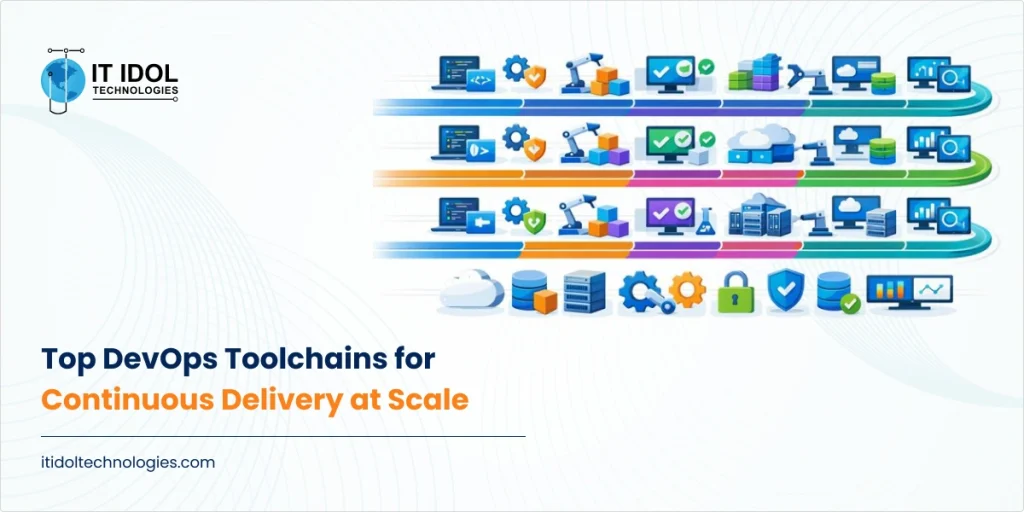
Continuous delivery at scale helps enterprises release software faster and more reliably.
Integrated DevOps toolchains enable automation, collaboration, and observability across the delivery lifecycle.
Key challenges include tool integration, scalability, cultural adoption, and compliance requirements.
Strategic tool selection and process optimization help overcome these barriers.
Emerging trends like GitOps, AI-driven analytics, cloud-native platforms, and DevSecOps are shaping the future of scalable continuous delivery.
In today’s fast-paced digital landscape, businesses are under constant pressure to deliver software faster, more reliably, and with fewer errors.
Continuous delivery (CD) has evolved from a technical aspiration into a strategic imperative for enterprises that aim to maintain competitive advantage while driving operational efficiency.
For IT leaders, the challenge is not just about implementing CD but doing so at scale across multiple teams, diverse technology stacks, and complex regulatory environments.
The ability to deploy updates seamlessly, respond to market demands, and maintain operational stability has become a defining factor for long-term business success.
DevOps toolchains form the backbone of this capability. They are not just a collection of software tools but a coordinated ecosystem that enables automation, collaboration, and visibility across the software lifecycle.
When orchestrated effectively, a DevOps toolchain reduces manual intervention, accelerates release cycles, and ensures consistent quality across deployments.
From source control and automated testing to deployment orchestration and monitoring, every component of the toolchain contributes to reducing risk while improving speed-to-market.
For enterprise leaders, the stakes are high. According to industry research, organizations with mature DevOps practices can deploy code 46 times more frequently and recover from failures 96 times faster than those with traditional software delivery processes (DORA State of DevOps Report).
These figures underscore a strategic reality: continuous delivery at scale is not merely an operational concern; it directly influences revenue growth, customer experience, and market responsiveness.
Yet, achieving this at scale introduces complexity. Enterprises often contend with fragmented tools, legacy systems, and multi-cloud environments, all of which demand an integrated, flexible approach to toolchain selection.
The choice of DevOps tools, their interoperability, and the ability to support evolving organizational needs can define whether CD initiatives succeed or stall.
Beyond technical functionality, leaders must also consider adoption readiness, team skills, governance frameworks, and security compliance.
This article explores the top DevOps toolchains that empower continuous delivery at scale. It offers insights into tool capabilities, integration strategies, operational trade-offs, and strategic considerations.
By grounding the discussion in real-world examples and industry data, the objective is to provide IT and business leaders with a practical framework for selecting, implementing, and optimizing DevOps toolchains that drive measurable business impact.
Key Insights & Subtopics
1. Source Control and Version Management
At the foundation of any DevOps toolchain lies source control. Robust version management is critical for ensuring that code changes are tracked, auditable, and revertible.
Tools such as Git, Bitbucket, and Azure Repos dominate the landscape, offering distributed version control that supports collaboration across geographically dispersed teams.
Git’s branching and merging capabilities enable parallel development, allowing multiple teams to work on features, bug fixes, and experiments simultaneously.
Enterprises with complex release cycles benefit from Git workflows like GitFlow or trunk-based development, which define branching strategies aligned with continuous delivery goals.
From a strategic standpoint, the choice of source control influences the broader DevOps ecosystem. Integration with CI/CD platforms, automated testing pipelines, and artifact repositories ensures that code moves smoothly from development to production.
In practice, organizations adopting centralized versioning with integrated pipelines report 30–40% faster cycle times in feature deployment, reducing the bottlenecks that often accompany manual code merges.
Security is another critical consideration. Modern enterprises need source control systems that support role-based access controls, audit logs, and integration with secret management systems.
This is particularly important in regulated industries, where compliance with standards like SOC 2, ISO 27001, or HIPAA can dictate toolchain choices.
2. Continuous Integration: Automating Builds and Tests
Continuous Integration (CI) is the bridge between source control and continuous delivery. CI tools automatically build, test, and validate code whenever changes are committed, ensuring early detection of defects and preventing integration issues from escalating.
Popular CI tools include Jenkins, GitLab CI/CD, CircleCI, and TeamCity.
Automation at this stage reduces human error and accelerates release velocity. For example, Jenkins pipelines allow teams to define multi-stage workflows, incorporating unit tests, static code analysis, and security scans before code reaches staging environments.
GitLab CI/CD extends this by providing integrated issue tracking, container registry, and deployment orchestration within a single platform, which can simplify toolchain management for large enterprises.
Operationally, CI also supports test-driven development (TDD) and continuous testing practices. Enterprises implementing automated test suites across every commit report 50–70% reduction in production defects, significantly lowering remediation costs and improving customer satisfaction.
Beyond technical efficiency, CI fosters a culture of accountability: developers receive immediate feedback, encouraging better code quality and faster iterations.
Strategically, leaders must evaluate CI tools for scalability, integration, and pipeline visibility. Enterprises with hundreds of microservices often need CI solutions that can parallelize builds and intelligently manage dependencies, preventing bottlenecks and maintaining a predictable delivery cadence.
3. Artifact Management and Repository Systems
Once code is built and tested, artifacts compiled binaries, container images, or libraries must be stored and versioned in a reliable repository.
Tools like JFrog Artifactory, Nexus Repository, and Azure Artifacts provide centralized artifact management, enabling traceability and reproducibility of deployments.
Artifact repositories serve as a critical bridge between CI and CD, ensuring that production deployments are consistent with what was validated in testing.
They also allow immutable storage, where every build is preserved and can be redeployed, which is essential for rollback strategies and regulatory compliance.
From a business perspective, effective artifact management minimizes deployment risk. Enterprises dealing with distributed teams and hybrid environments rely on repository systems to control dependencies, prevent conflicts, and support multi-version deployments.
For example, financial institutions handling sensitive software releases use artifact repositories to enforce strict access controls and integrate vulnerability scanning, mitigating potential security threats before deployment.
4. Configuration Management and Infrastructure as Code
Infrastructure as Code (IaC) has become a cornerstone of scalable CD practices. Tools such as Terraform, Ansible, Chef, and Puppet enable teams to define infrastructure declaratively, ensuring that environments are consistent, reproducible, and version-controlled.
IaC allows enterprises to provision servers, network configurations, and cloud resources programmatically, reducing manual intervention and operational drift.
For instance, deploying the same configuration to development, staging, and production environments reduces “it works on my machine” issues, a common source of deployment failures.
Strategically, configuration management also supports multi-cloud strategies. Enterprises adopting hybrid or multi-cloud infrastructures leverage IaC to maintain consistent configurations across providers, ensuring compliance, security, and operational reliability.
Real-world adoption shows that organizations using IaC achieve up to 80% reduction in configuration-related outages, translating directly to improved uptime and customer trust.
Beyond technical benefits, IaC facilitates auditable change management, providing a clear history of infrastructure modifications.
This is particularly valuable in regulated sectors, where every change may need to be documented and validated for compliance.
5. Continuous Delivery Orchestration
Continuous Delivery is the process of deploying validated code into production or production-like environments with minimal manual intervention. Orchestration tools such as Argo CD, Spinnaker, and Octopus Deploy manage the release pipelines, enabling automated deployments, approvals, and rollback mechanisms.
At scale, CD orchestration handles complex workflows involving multiple microservices, feature flags, and dynamic environments.
For example, Argo CD enables GitOps practices, where the desired state of applications is defined in Git repositories, and the system continuously reconciles live environments with these definitions.
This approach enhances consistency and reduces deployment errors, especially in Kubernetes-heavy environments.
Operationally, orchestration also improves observability. Automated pipelines can log deployment events, monitor success/failure rates, and trigger alerts for anomalies, providing leaders with actionable insights on release health.
This transparency supports risk management, allowing organizations to confidently accelerate deployment frequency without compromising stability.
6. Monitoring, Logging, and Feedback Loops
Continuous delivery at scale is incomplete without robust monitoring and feedback mechanisms. Tools such as Prometheus, Grafana, Datadog, and ELK Stack (Elasticsearch, Logstash, Kibana) provide real-time insights into application performance, system health, and security posture.
Monitoring systems feed back into the DevOps loop, enabling proactive issue resolution and data-driven optimization.
For instance, if a newly deployed feature causes latency spikes, automated alerts can trigger rollback or remediation workflows, minimizing business impact.
Enterprises that implement integrated monitoring pipelines experience up to 60% faster incident response times, reducing downtime and operational costs.
From a strategic perspective, observability also supports continuous improvement. By analyzing metrics such as deployment frequency, mean time to recovery (MTTR), and error rates, business and IT leaders can identify bottlenecks, optimize pipelines, and make informed investment decisions in automation or skill development.
7. Security and Compliance Integration
As CD pipelines accelerate, security must keep pace. DevSecOps integrates security checks directly into the toolchain, ensuring that vulnerabilities are detected early in the lifecycle.
Tools like Snyk, SonarQube, and Checkmarx scan code, containers, and dependencies automatically, embedding compliance and security into everyday workflows.
Strategically, integrating security into CI/CD pipelines prevents bottlenecks often caused by late-stage audits or vulnerability remediation. Enterprises that embrace DevSecOps practices report significant reductions in post-deployment security incidents, preserving brand reputation and avoiding costly breaches.
Additionally, automation of compliance checks ensures adherence to industry standards without slowing release cadence.
Challenges, Trade-offs & Considerations
While the benefits of continuous delivery are well-documented, implementing DevOps toolchains at scale is far from straightforward. Organizations face a series of technical, operational, and strategic challenges that require careful planning and informed decision-making.
Understanding these limitations is essential for IT leaders and business executives aiming to maximize the impact of CD initiatives.
1. Toolchain Complexity and Integration
One of the primary challenges is the complexity inherent in assembling a DevOps toolchain. Modern CD pipelines often involve multiple tools for version control, CI/CD, artifact management, infrastructure provisioning, orchestration, monitoring, and security.
While each tool excels in its niche, integrating them seamlessly can be difficult.
Enterprises with heterogeneous technology stacks, legacy applications, and multi-cloud environments often struggle with interoperability.
Mismatched APIs, inconsistent configuration standards, and disparate data formats can create friction that slows down deployment pipelines.
Organizations must balance the desire for best-of-breed tools with the operational overhead of maintaining integrations.
Strategically, the trade-off is between flexibility and manageability. Consolidated platforms like GitLab or Azure DevOps reduce integration overhead but may not offer the same depth of functionality as specialized tools such as JFrog Artifactory or Argo CD.
Decision-makers must evaluate whether standardization or modularity better aligns with their operational goals and team capabilities.
2. Scalability and Performance Considerations
Scaling DevOps toolchains to support large teams, multiple environments, and high-frequency deployments introduces performance considerations.
CI/CD pipelines can become bottlenecks if build servers, container registries, or orchestration tools cannot handle concurrent workloads efficiently.
For example, Jenkins pipelines can slow down significantly with hundreds of microservices building simultaneously, while container registries may experience latency when serving artifacts across regions.
Enterprises must invest in scalable infrastructure, parallelized pipelines, and distributed caching mechanisms to maintain consistent performance.
The trade-off often involves cost versus speed. High-performance infrastructure and cloud-based CI/CD services provide scalability but come at a premium.
Leaders must assess whether the investment aligns with business priorities and whether bottlenecks in the delivery pipeline could materially impact revenue or customer satisfaction.
3. Cultural and Organizational Challenges
Technical adoption alone does not guarantee success in continuous delivery. Organizational culture plays a decisive role.
DevOps requires cross-functional collaboration, shared accountability, and a willingness to embrace automation. Teams resistant to change may underutilize tools or circumvent established processes, undermining CD objectives.
Enterprises often encounter friction between development and operations teams. Siloed responsibilities, unclear ownership of production issues, and differing priorities can slow release cycles and reduce pipeline reliability.
Leadership must actively foster a culture of collaboration, provide training on tool usage, and define clear metrics for success to ensure the toolchain delivers value.
A common approach is the establishment of DevOps Centers of Excellence (CoEs), which standardize practices, provide governance, and act as a knowledge hub.
This mitigates adoption challenges while ensuring that strategic goals such as faster delivery, higher quality, and operational resilience are consistently met across teams.
4. Security, Compliance, and Governance Trade-offs
Integrating security and compliance into CD pipelines introduces its own set of trade-offs. While DevSecOps practices reduce risk, they can also slow down deployments if not implemented thoughtfully.
For instance, heavy-handed vulnerability scans or mandatory approvals for every commit may introduce delays, frustrating developers and reducing the speed benefits of CD.
Enterprises must strike a balance between risk mitigation and delivery velocity. Tools that automate security testing and integrate with CI/CD pipelines, such as Snyk or Checkmarx, allow organizations to maintain speed while ensuring compliance.
Governance frameworks should define which checks are mandatory and which can be executed asynchronously, preserving agility without compromising standards.
Moreover, regulated industries face additional constraints. Financial services, healthcare, and government organizations must comply with strict auditing, retention, and traceability requirements.
Implementing CD at scale in these contexts often demands additional documentation, approval workflows, and segregation of duties, all of which increase operational complexity.
5. Monitoring, Observability, and Feedback Loops
While monitoring tools provide crucial feedback, their effectiveness depends on proper integration and actionable insights. Inadequate observability can leave teams blind to deployment failures, performance bottlenecks, or security vulnerabilities.
Enterprises often struggle to correlate data across disparate systems or extract meaningful insights from vast volumes of telemetry.
This challenge introduces a trade-off between visibility and noise. Excessive alerts can overwhelm teams, while insufficient monitoring increases risk exposure.
Strategic implementation involves defining key performance indicators (KPIs), establishing alert thresholds, and leveraging analytics to identify actionable trends rather than reacting to every anomaly.
Enterprises that invest in intelligent observability frameworks can improve mean time to detection (MTTD) and mean time to recovery (MTTR), creating a feedback loop that continuously enhances pipeline efficiency and product quality.
6. Cost and Resource Management
Finally, implementing and maintaining DevOps toolchains at scale requires investment, not just in software, but in personnel, training, and infrastructure. Organizations must consider licensing costs, cloud resource usage, and the overhead of maintaining integrations.
Trade-offs here involve balancing operational efficiency against budget constraints. High-cost tools or additional cloud resources may accelerate delivery, but ROI must be demonstrable.
Enterprises often adopt hybrid approaches, using open-source tools for standard workflows while reserving commercial solutions for critical components requiring enterprise-grade reliability, support, or compliance features.
By understanding these challenges and trade-offs, enterprises can make informed decisions about tool selection, integration strategy, cultural change management, and operational investment.
Strategic clarity, combined with realistic expectations of complexity and cost, ensures that continuous delivery initiatives at scale are sustainable and deliver measurable business impact.
Future Outlook & Strategic Recommendations
The landscape of DevOps toolchains is evolving rapidly. Advances in cloud-native technologies, automation, and AI-driven analytics are shaping how enterprises approach continuous delivery at scale.
For business and IT leaders, understanding emerging trends and their strategic implications is essential for maintaining competitive advantage.
1. Shift Toward GitOps and Declarative Deployment
GitOps, the practice of managing infrastructure and application delivery declaratively via Git, is gaining traction as the preferred approach for continuous delivery.
By defining the desired state of applications and infrastructure in version-controlled repositories, GitOps enables automated reconciliation of live environments with the source of truth.
Tools such as Argo CD and Flux are leading this transformation, providing automated rollbacks, auditability, and improved consistency across complex multi-cluster deployments.
Strategically, GitOps simplifies scaling by reducing manual interventions and standardizing operational practices. Enterprises adopting GitOps report enhanced reproducibility, lower configuration drift, and faster onboarding of new teams.
The approach also aligns with regulatory requirements by providing a fully auditable history of changes, crucial in finance, healthcare, and government sectors.
2. Increasing Role of AI and Machine Learning
Artificial intelligence and machine learning are beginning to transform DevOps toolchains. Predictive analytics, anomaly detection, and intelligent pipeline optimization can reduce downtime, improve deployment success rates, and enhance system reliability.
For example, AI-driven insights from tools like Dynatrace or Harness can identify potential bottlenecks in pipelines, suggest optimizations, and even automate remediation before issues impact production.
For strategic leaders, this signals a shift from reactive monitoring to proactive delivery management. AI can analyze historical deployment data to forecast failures, recommend optimal deployment windows, and optimize resource allocation.
As CD pipelines become more complex with microservices, serverless architectures, and multi-cloud deployments, AI-enabled toolchains will increasingly be indispensable for maintaining efficiency and quality.
3. Expansion of Security-First DevOps Practices
The adoption of DevSecOps will continue to accelerate, with security becoming more tightly integrated into every stage of the pipeline.
Future toolchains will embed automated security scans, compliance verification, and risk assessment into CI/CD workflows seamlessly.
This “security by design” approach minimizes human intervention while maintaining high standards of protection.
For enterprises, integrating security as a core component of CD pipelines reduces vulnerability exposure and accelerates compliance processes.
In the future, we can expect security policies to be codified as infrastructure rules, allowing automatic enforcement across environments and improving audit readiness without slowing release velocity.
4. Cloud-Native and Serverless Toolchain Evolution
The ongoing shift toward cloud-native and serverless architectures is influencing DevOps toolchain design. Tools that support Kubernetes, container orchestration, and serverless deployments are increasingly critical.
Platforms like Kubernetes, OpenShift, and AWS Lambda integrate with CI/CD pipelines to enable rapid, scalable, and resilient delivery.
Strategically, this allows enterprises to optimize cost, reduce operational overhead, and scale services dynamically.
Multi-cloud strategies will require toolchains that are not only platform-agnostic but also capable of handling heterogeneous environments with consistent observability, governance, and performance monitoring.
5. Strategic Recommendations for Leaders
1.Adopt a Modular Toolchain Architecture: While all-in-one platforms simplify management, modular architectures allow enterprises to select best-of-breed tools tailored to their unique workflows. Ensuring interoperability and standard APIs is crucial for long-term flexibility.
2. Prioritize Automation Across the Pipeline: From testing and builds to deployment and monitoring, automation reduces errors, accelerates delivery, and frees teams for higher-value work. Leaders should identify bottlenecks and implement automation iteratively.
3. Invest in Observability and Feedback Loops: Monitoring and analytics are no longer optional. Establish end-to-end observability across applications, infrastructure, and pipelines, using metrics and AI-driven insights to continuously optimize performance.
4. Embed Security and Compliance Early: Shift-left security practices ensure vulnerabilities are addressed before production deployment. Codifying policies and integrating security checks into pipelines maintains regulatory compliance without slowing delivery.
5. Cultivate a DevOps Culture: Tool adoption alone is insufficient. Leaders must foster cross-functional collaboration, provide training, and define metrics that incentivize quality, speed, and accountability. Cultural readiness is often the differentiator between successful CD initiatives and stalled implementations.
6. Plan for Scalability and Resilience: As enterprises scale, pipelines must handle high concurrency, distributed teams, and multi-cloud environments. Investing in cloud infrastructure, IaC, and container orchestration ensures CD pipelines remain reliable and performant under increasing load.
The future of DevOps toolchains points toward more intelligent, automated, secure, and scalable pipelines, with strategic leadership guiding adoption, integration, and cultural alignment.
Enterprises that proactively embrace these trends will not only improve delivery speed and reliability but also strengthen operational resilience and competitive positioning.
Conclusion
Continuous delivery at scale is no longer a niche capability; it is a strategic imperative for enterprises aiming to remain competitive in a rapidly evolving digital landscape.
DevOps toolchains form the backbone of this capability, providing the automation, visibility, and control necessary to deploy software efficiently, securely, and reliably.
From version control and CI/CD pipelines to artifact management, infrastructure as code, and monitoring, each component plays a critical role in ensuring that software moves from development to production with minimal friction.
For business and IT leaders, the value of mature toolchains extends beyond speed. Effective adoption translates into higher software quality, reduced operational risk, improved regulatory compliance, and measurable cost efficiencies.
It enables organizations to respond rapidly to market demands, innovate faster, and maintain resilience in the face of complex, distributed environments. Strategic decisions around tool selection, integration, automation, and governance are therefore pivotal, as they define the effectiveness of CD initiatives at scale.
Looking ahead, the evolution of DevOps toolchains, including GitOps, AI-driven analytics, cloud-native architectures, and integrated security practices, offers enterprises unprecedented opportunities to optimize delivery pipelines.
However, realizing these benefits requires a holistic approach: investing in scalable infrastructure, fostering a collaborative culture, embedding security and compliance, and continuously refining processes based on actionable feedback.
In essence, scaling continuous delivery is as much about people and strategy as it is about technology. Enterprises that balance technical rigor with cultural readiness, operational clarity, and strategic foresight will position themselves to deliver software at pace without compromising quality or resilience.
By taking a thoughtful, consultative approach to DevOps toolchains, leaders can transform CD from a technical practice into a driver of sustainable business growth.
FAQ’s
1. What is a DevOps toolchain?
A DevOps toolchain is a set of integrated tools that support the software delivery lifecycle, from development and testing to deployment and monitoring. It enables automation, collaboration, and visibility across teams.
2. Why is continuous delivery important at scale?
Continuous delivery ensures that software can be reliably deployed to production frequently and safely, which is critical for large enterprises handling complex systems and multiple teams.
3. What are the top tools for version control in DevOps?
Git, Bitbucket, and Azure Repos are widely used for distributed version control, supporting collaboration, branching strategies, and integration with CI/CD pipelines.
4. Which CI/CD tools are recommended for enterprises?
Jenkins, GitLab CI/CD, CircleCI, and TeamCity are popular for automating builds, tests, and deployments at scale, offering pipeline parallelization and integration flexibility.
5. What role does Infrastructure as Code play in continuous delivery?
IaC tools like Terraform, Ansible, Chef, and Puppet allow teams to define and manage infrastructure programmatically, ensuring consistent, reproducible environments across development, staging, and production.
6. How do artifact repositories support CD pipelines?
Artifact repositories such as JFrog Artifactory, Nexus Repository, and Azure Artifacts store and version built components, ensuring reproducibility and enabling safe rollbacks.
7. What is GitOps and why is it gaining popularity?
GitOps uses Git as the source of truth for infrastructure and application deployments, enabling automated reconciliation of live environments with declarative definitions. It improves consistency, auditability, and automation.
8. How can DevSecOps be integrated into CD pipelines?
Security tools like Snyk, SonarQube, and Checkmarx can be embedded into CI/CD pipelines to scan code, containers, and dependencies, ensuring vulnerabilities are detected and mitigated early.
9. What are common challenges in scaling DevOps toolchains?
Key challenges include tool integration complexity, pipeline bottlenecks, cultural resistance, compliance and security requirements, and monitoring large, distributed environments.
10. What are future trends shaping DevOps toolchains?
Trends include AI-driven pipeline optimization, cloud-native and serverless deployment support, GitOps adoption, enhanced observability, and tighter integration of security and compliance checks.
Parth Inamdar is a Content Writer at IT IDOL Technologies, specializing in AI, ML, data engineering, and digital product development. With 5+ years in tech content, he turns complex systems into clear, actionable insights. At IT IDOL, he also contributes to content strategy—aligning narratives with business goals and emerging trends. Off the clock, he enjoys exploring prompt engineering and systems design.