In the fast-paced world of software development, teams often make trade-offs by shipping features quickly to meet market demands, sometimes at the expense of code quality or architectural purity.
These trade-offs accumulate over time as technical debt (also known as “tech debt”), a burden that can handicap a product’s scalability, maintainability, and long-term value.
With the advent of modern artificial intelligence (AI), especially in software engineering, a compelling question emerges: Can AI help organizations reduce or manage technical debt more effectively? The short answer is: yes, but only when applied strategically, with human oversight, and as part of a broader debt-management culture.
This article offers a research-backed, actionable deep dive into how AI is reshaping the fight against tech debt, what’s possible today, where it works best, the limitations, and how you can integrate AI into your technical debt strategy.
Understanding Technical Debt: Scope, Costs, and Consequences
Before exploring how AI can help, it’s essential to revisit what technical debt means and why it matters.
What is Technical Debt?
Definition: In software engineering, technical debt refers to the implied cost of additional rework caused by opting for quick, suboptimal solutions instead of robust, clean, long-term ones.
Origin of term: The concept was popularized by Ward Cunningham, who likened “shipping first-time code” to taking on debt: short-term gains, but payback required in the future with interest (additional maintenance).
Breadth of debt: While originally focused on code quality, technical debt now extends beyond code, including system architecture, infrastructure, outdated dependencies, poor documentation, suboptimal DevOps practices, and more.
The Costs and Risks of Accumulating Debt
Maintenance overhead: According to a report, up to 33 % of engineers’ time on a software team might be spent dealing with technical debt and maintenance rather than building new features.
Budget diversion: Some organizations report diverting 10–20 % of their technology budgets (intended for new products) just to address technical debt.
Opportunity cost: For a mid-sized engineering team (say 50 people), this can translate into high monetary and innovation costs, money and time that could otherwise fund new features, R&D, or competitive differentiation.
Reduced agility and reliability: As debt accumulates, codebases become fragile, convoluted, and risky to modify. Even minor changes can trigger bugs or regressions, slowing down development cycles, increasing debugging time, and amplifying risk.
Organizational impact: High debt often leads to developer frustration, burnout, decreased productivity, and even attrition, undermining team morale and retention.
Takeaway for leaders: Technical debt isn’t just a code-quality problem; it’s a strategic risk. Left unchecked, it erodes innovation capacity, inflates costs, and compromises scalability.
Why Traditional Debt-Reduction Strategies Fall Short
Organizations have long tried to manage technical debt using classic techniques: code reviews, refactoring sprints, better documentation, and rigorous testing processes. While these remain critical, they have limitations.
1.Manual Review Bottlenecks: Code reviews and refactoring rely heavily on humans. As codebases grow, scalability becomes a problem: reviewers get overloaded, inconsistent standards creep in, and fatigue can lead to missed issues.
2. Reactive rather than proactive: Traditional approaches often deal with debt after it has already accumulated (e.g., refactoring old modules, addressing bugs). By then, the debt has “accumulated interest,” making it more costly to pay off.
3. Lack of visibility at scale: For large systems with millions of lines of code, it’s hard to manually track where debt lies: code smells, architectural anti-patterns, outdated dependencies, untested modules. Managers may rely on anecdotal evidence instead of data-driven insights.
4.Cost and resource constraints: Refactoring and rework sprints can interfere with feature development schedules and business priorities. Stakeholders often deprioritize them in favor of delivering new features.
Given these constraints, businesses need a scalable, reliable, and data-driven way to manage technical debt and this is where AI begins to shine.
How AI Helps: Mechanisms & Use Cases
AI, particularly modern machine-learning (ML) and natural language processing (NLP) techniques, can significantly enhance and scale debt-reduction efforts. Below are the key ways AI is being used today.
1. Automated Debt Detection & Measurement
One of the first steps in managing technical debt is knowing where it lies. AI can automate this discovery by analyzing codebases, version histories, issue trackers, and architecture diagrams to flag risky or debt-prone areas.
Code Quality Metrics & “Debt Hotspots”: AI-driven static analysis tools go beyond rule-based linters. They can learn from large code repositories to identify subtle “code smells”, deeply nested logic, overly complex methods, duplicate code, inconsistent naming, unused modules, and more.
Historical Data & Predictive Risk Analysis: By leveraging commit histories, bug logs, and usage metrics, AI models can predict which modules or components are likely to cause future problems, enabling preemptive refactoring.
Architecture & Dependency Graph Analysis: Some advanced tools inspect overall system architecture dependencies, coupling, cyclic references, and outdated libraries to highlight structural debt, not just code-level issues.
Why it matters: Detection and measurement are often the biggest hurdles in debt management to become scalable and continuous. Instead of ad-hoc assessments, you get a panoramic, data-driven view of code health.
Actionable insight: Start by integrating AI-based code-quality analysis into your CI/CD pipeline. Use it to generate a technical-debt “map”: which modules need urgent attention, which are stable, and where to prioritize refactoring first.
Beyond detection, some AI tools can propose, or even implement, code refactoring to improve structure, readability, and maintainability, all without changing external behaviour.
AI Refactoring Efficiency: A recent academic study using Graph Neural Networks (GNNs) applied on abstract syntax trees (ASTs) showed that AI-driven refactoring reduced cyclomatic complexity by ~35% and module coupling by ~33%, outperforming traditional static-analysis tools.
Maintainability & Consistency: AI can enforce coding standards across teams, unify coding style, reorganize modules, rename variables/methods, eliminate dead code or redundant paths vital for large or multi-team codebases.
Scalability: For legacy systems or applications with thousands or hundreds of thousands of lines, manual refactoring is impractical. AI enables scalable refactoring across many modules with less human effort.
Why it matters: Refactoring becomes less of a painful sprint and more of an incremental, continuous activity frictionless, widespread, and consistent.
Actionable insight: Incorporate AI-driven refactoring tools into regular maintenance cycles not just large “rewrite sprints.” Consider scheduling small but frequent refactoring waves (e.g., every few sprints) to gradually clean up the codebase without disrupting feature delivery.
3. Automated and Smarter Code Reviews
Code review is one of the most labor-intensive phases in software development. AI can transform it from a slow manual bottleneck into a rapid, consistent, and high-quality process.
Speed & Coverage: AI tools can scan thousands of lines of code in seconds, catching potential issues from simple style violations to complex concurrency bugs or memory leaks far faster than a human reviewer.
Consistency & Objectivity: Human reviewers vary in experience, attention, and coding style. AI reviews apply the same standards uniformly, reducing human bias and oversight.
Contextual Feedback & Learning: Advanced AI review tools now offer contextual suggestions (e.g., better naming, modularization, documentation prompts), making them educational tools for developers, especially beneficial for junior or mid-level engineers.
Empirical Efficiency Gains: In experimental settings, AI-assisted review has reduced per-line-of-code review durations significantly, cutting down cycle times while maintaining (or improving) code quality.
Why it matters: Faster reviews mean quicker merge cycles, less backlog, and more frequent deliveries without sacrificing code quality. Over time, this helps prevent the accumulation of new technical debt.
Actionable insight: Adopt an “AI-first” code review step in your PR workflows. Use AI to catch common issues automatically; reserve human reviewers for architecture, domain logic, and business-critical decisions.
4. Automated Testing, Documentation, and Better Maintainability
Tech debt is not only about messy code; insufficient testing and poor documentation are major sources too. AI helps here as well.
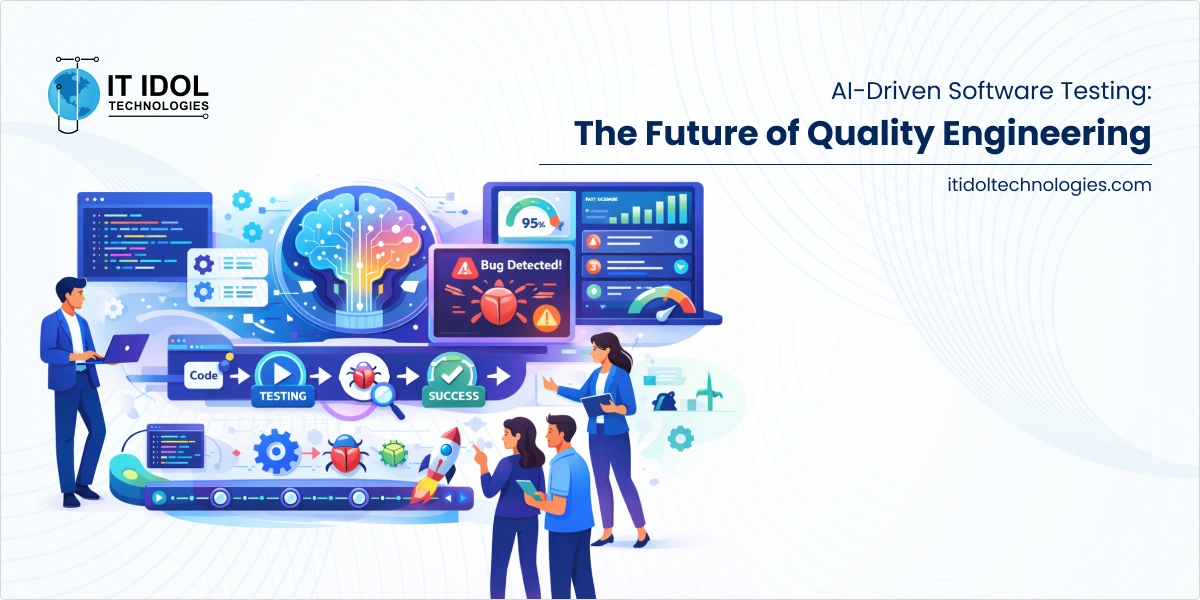
Test Generation & Bug Prediction: AI systems can generate unit tests, integration tests, and edge-case tests automatically; they can also predict code sections liable to fail based on historical bug and commit data. This improves code reliability and reduces future debugging workloads.
Automated Documentation: AI can help auto-generate or update documentation, e.g., method explanations, API docs, and internal technical documents reflecting the current state of the codebase. This reduces reliance on manual documentation efforts, which often fall behind.
Consistent Standards & Onboarding: With well-documented, clean code and consistent patterns, onboarding new developers becomes easier, reducing “ramp-up debt” and improving long-term maintainability.
Why it matters: Well-tested, well-documented, and maintainable code ensures new features can be added without major friction, preventing new debt while making legacy code accessible and safe to change.
Actionable insight: Combine AI-based test generation and documentation tools into your release pipelines. Ensure that every new feature or refactor triggers automated tests and documentation updates, making your codebase self-healing and self-documenting over time.
Real-World Impact: What Research & Industry Shows
The theoretical benefits of AI for tech-debt reduction are compelling. But what does real-world evidence say?
Empirical Study on GNN-based Refactoring (2025): As mentioned earlier, AI-driven refactoring using Graph Neural Networks on a large corpus of code resulted in up to 35 % reduction in complexity and 33% reduction in coupling, yielding a cleaner, more maintainable codebase.
Organizational Gains: According to industry reports, firms using AI-assisted development have observed up to 50 % productivity improvement and a 33 % reduction in project cost, along with significant improvements in code quality.
Improved Developer Focus and Velocity: By automating repetitive maintenance tasks (refactoring, test generation, code reviews), AI enables developers to focus on core product features, innovation, and architectural improvements rather than constant firefighting.
Reduced Maintenance Burden: Organizations report sustained reduction in bug rates, improved scalability, and faster addition of new features after adopting AI-driven debt-reduction processes.
Caveat (what research warns about): Even with sophisticated AI, human oversight remains critical. A recent empirical analysis comparing popular AI code-generation tools (e.g., GitHub Copilot, Amazon CodeWhisperer, ChatGPT) found that while these tools produce valid code in many cases, a significant proportion of generated code still fails correctness, maintainability, or security benchmarks.
This signals that AI is not magic, but, when used responsibly, it becomes a powerful assistant in reducing and managing technical debt at scale.
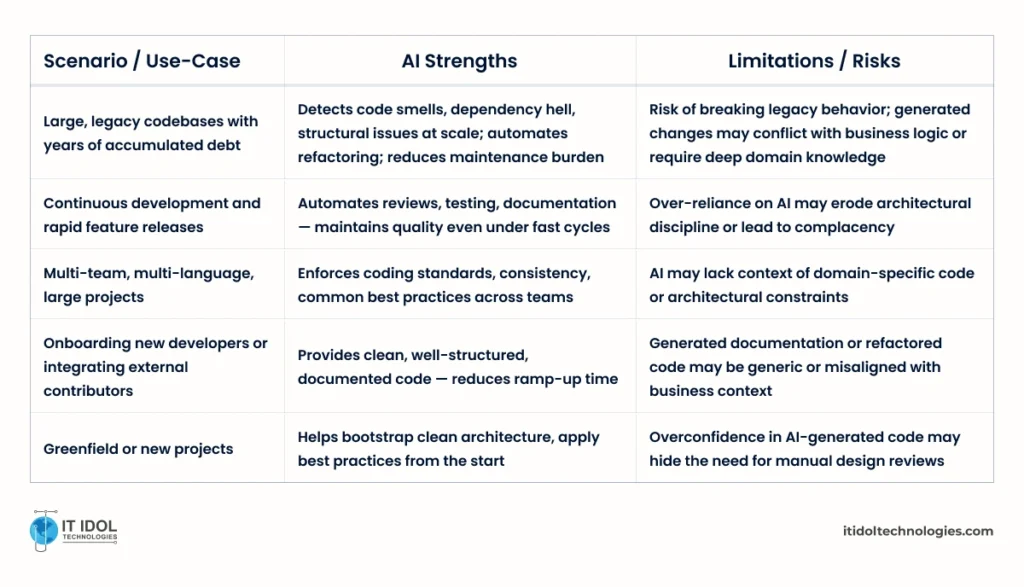
Where AI Adds Maximum Value and Where It Doesn’t
Based on current research and industry experience, here’s a strategic breakdown of when AI is most effective and where limitations remain.
Key insight: AI is most powerful when dealing with scale, repetition, and consistency, and weakest where business logic, domain-specific constraints, or architectural judgment are required.
Therefore, the best results come when AI augments human expertise, not replaces it.
A Strategic Framework for Integrating AI into Your Technical Debt Strategy
If you’re a tech leader looking to harness AI to tackle technical debt, here’s a practical framework to follow:
1. Baseline Debt: Measure & Map
Use AI-based code analysis tools to scan the entire codebase periodically (quarterly or biannually).
Generate a technical-debt heatmap highlighting high-risk modules, complexity hotspots, outdated dependencies, and code smell clusters.
Prioritize modules based on impact (critical business logic, performance-sensitive areas, frequently modified code).
2. Continuous Refactoring & Maintenance
Schedule small, regular refactoring cycles rather than large “big bang” rewrites.
Integrate AI-driven refactoring into CI/CD pipelines; run refactors automatically (with human approval) as part of every major release.
Combine refactoring with automated test generation and documentation updates to ensure quality and maintainability.
3. Automated Code Review & Testing
Integrate AI code review as the first step in pull request (PR) pipelines, flagging potential issues early.
Auto-generate unit, integration, and edge-case tests for new or changed code; require passing tests before merge.
Use AI to enforce consistent coding standards and naming conventions across teams.
4. Governance & Human Oversight
Establish a review board, senior architects, or experienced engineers to vet AI-driven refactoring suggestions, especially for critical modules.
Maintain strict version control and change-approval policies to avoid unintended behavioral changes.
Retain domain knowledge and manual code reviews for business logic, architecture decisions, and system-level design.
Use these metrics to measure the ROI of AI-driven debt reduction (e.g., maintenance time saved, features delivered, bug reductions).
Adjust AI tools, configurations, and workflows based on feedback and results.
Takeaway: Think of AI not as a one-off “clean-up tool,” but as an ongoing, integrated partner in your development lifecycle, like a “health monitor” for your codebase.
Common Pitfalls & How to Avoid Them
Implementing AI for tech debt reduction isn’t without challenges. Here are common pitfalls and strategies to avoid them.
Pitfall 1: Over-reliance on AI for critical logic
Risk: AI-generated refactoring or code might break domain-specific logic or introduce unpredictable side effects.
Mitigation: Always pair AI suggestions with human review, especially for business-critical modules. Maintain strong version control, automated tests, and require manual sign-off for major changes.
Pitfall 2: Ignoring architectural or domain context
Risk: AI might optimize for code-level metrics (e.g., complexity, coupling) while missing domain-specific design constraints or architectural goals (e.g., performance, data consistency, regulatory compliance).
Mitigation: Define architectural patterns and constraints upfront. Use AI for “safe bets” (refactorings, style, repetitive code), and reserve architecture reviews for human experts.
Pitfall 3: Thinking AI will eliminate the need for discipline
Risk: Teams may assume AI handles all code quality aspects, leading to lax standards, weaker documentation, or neglect of tests.
Mitigation: Use AI as a support, not a substitute for discipline. Embed code standards, testing guidelines, documentation policies, and human oversight into your workflows.
Pitfall 4: Lack of measurement & feedback
Risk: Without metrics, you won’t know if AI adoption is helping or maybe even hurting code health, productivity, or maintainability.
Mitigation: Define and track meaningful metrics (complexity, bug frequency, mean time to fix, feature velocity, technical debt backlog) and review them regularly to inform decisions.
The Bigger Picture: Culture, Strategy, and Long-Term Value
AI’s role in reducing technical debt is not just about tools, it’s about reshaping how organizations think about code, quality, and sustainability.
From One-Time Fix to Continuous Health Maintenance
In traditional development, debt reduction is often a painful, episodic task (“We need a refactoring sprint”). With AI, you can shift to continuous maintenance debt detection, refactoring, testing, and documentation as part of the everyday workflow. This reduces backlog, mitigates risk, and keeps the codebase healthy over time.
Empowering Developers: Let Them Build, Not Bandage
By automating tedious, repetitive tasks (boilerplate code, formatting, style, minor refactors, tests), developers can focus on architectural design, usability, features, and innovation. This improves job satisfaction, accelerates delivery, and helps retain talent.
Building Trust with Stakeholders
One of the biggest barriers to prioritizing technical debt is business stakeholders who often view refactoring as “time wasted.” But with AI and data-driven measurement, you can present clear ROI metrics: less maintenance overhead, fewer bugs, faster feature rollout, reduced risk. This helps build a stronger case for ongoing investment in code health.
Future-Proofing for Scale & Complexity
As systems grow more features, more integrations, more contributors, manual maintenance becomes untenable. AI enables you to scale maintenance, uphold quality, and avoid the spiraling costs many legacy systems face.
Conclusion
AI represents a powerful, scalable, and increasingly mature set of capabilities that can transform how organizations understand, manage, and reduce technical debt. From automated detection to refactoring, from code reviews to testing and documentation, AI can significantly reduce the overhead of maintenance, improve code quality, and help teams focus on innovation.
However, and this is critical, AI should not be viewed as a silver bullet. It cannot replace human judgment, domain knowledge, and architectural sense. Without proper governance, human oversight, and a culture of continuous improvement, AI-driven changes can introduce new risks, behavioral inconsistencies, or even new debt.
The real value of AI lies in bringing routine maintenance, scaling code hygiene, and enforcing consistency across teams, freeing human engineers to tackle what truly matters: design, features, business logic, and long-term architecture.
For engineering leaders, the strategic bet is clear: integrate AI-driven debt management deeply into your development lifecycle, adopt data-driven metrics, and build human-in-the-loop governance. That way, your codebase becomes not just leaner but stronger, more adaptable, and future-ready.
TL;DR
AI offers scalable, automated ways to detect, measure, and reduce technical debt from identifying messy code and architectural smells to refactoring, generating tests, and ensuring consistent documentation. Organizations using AI in code reviews and maintenance reports improved code quality, achieved significant cost savings, and faster feature delivery.
But AI isn’t a magic bullet: combining AI with human oversight, governance, and continuous measurement is essential for long-term success. When done right, AI transforms technical debt from a legacy burden into manageable, ongoing code-base health.
FAQ’s
1. What exactly counts as “technical debt”?
Technical debt includes any suboptimal technical decisions made for short-term expediency: messy or complex code, lack of documentation, insufficient tests, outdated dependencies, poor architecture, weak DevOps practices, and other legacy artifacts that slow down future development or increase maintenance costs.
2. Can AI eliminate technical debt?
No, AI cannot fully eliminate technical debt. It excels at identifying, cleaning, refactoring, and enforcing standards at scale. But human judgment remains necessary, especially for architecture, domain logic, business constraints, and complex design decisions. AI reduces and manages debt; it doesn’t eliminate the need for sound engineering discipline.
3. Are there measurable benefits when using AI for debt reduction?
Yes. Research and real-world reports show significant gains: e.g., AI-driven refactoring reduced code complexity and coupling by ~35 % and ~33 % respectively, on large codebases. Other sources report up to 50 % productivity improvements anda 33 % reduction in project costs when AI is integrated systematically.
4. Which parts of the software lifecycle benefit most from AI?
Key areas include code review, static analysis, refactoring, test generation, documentation, and architecture-level dependency analysis. Repetitive, scale-heavy, or consistency-critical tasks benefit most.
5. What are the risks or downsides of AI-based code refactoring?
Risks include unintended changes in behavior, conflicts with existing architectural patterns, loss of domain-specific context, over-reliance leading to erosion of engineering discipline, and potential introduction of subtle bugs if human oversight is neglected.
6. How should a team start using AI to manage tech debt?
Begin by integrating AI-based static analysis and code quality tools into your CI/CD pipeline. Use them to build a technical-debt heatmap and prioritize refactoring. Combine this with periodic refactoring cycles, automated testing and documentation, and human governance for critical code.
7. Does AI replace code reviews?
Not entirely. AI is highly effective at catching common issues, enforcing style, detecting code smells, and generating preliminary feedback. But for architecture decisions, domain logic, design reviews, and business-critical code, human reviewers remain essential.
8. Is AI-driven test generation reliable enough for production code?
AI-generated tests can significantly improve coverage and catch many common issues, especially boilerplate or edge cases. However, automatically generated tests may miss domain-specific edge cases or complex business logic manual test design and review is still important.
9. What kinds of organizations benefit most from using AI for tech debt?
Organizations with large, mature, or legacy codebases; multi-team or distributed engineering groups; projects with rapid release cycles; or any setup where manual maintenance is costly. Greenfield projects also benefit by avoiding debt from the outset.
10. How does using AI for debt reduction impact developer productivity and satisfaction?
By automating repetitive, tedious tasks (refactoring, formatting, test writing), AI frees developers to focus on meaningful work architectural design, new features, innovation which improves job satisfaction. At the same time, it reduces burnout caused by constant bug-fixing or navigating messy legacy code.
Parth Inamdar is a Content Writer at IT IDOL Technologies, specializing in AI, ML, data engineering, and digital product development. With 5+ years in tech content, he turns complex systems into clear, actionable insights. At IT IDOL, he also contributes to content strategy—aligning narratives with business goals and emerging trends. Off the clock, he enjoys exploring prompt engineering and systems design.