Impact areas: efficiency, risk management, growth, and scalable operations.
Challenges include data quality, interpretability, and operational integration.
Strategic oversight ensures models drive measurable business value.
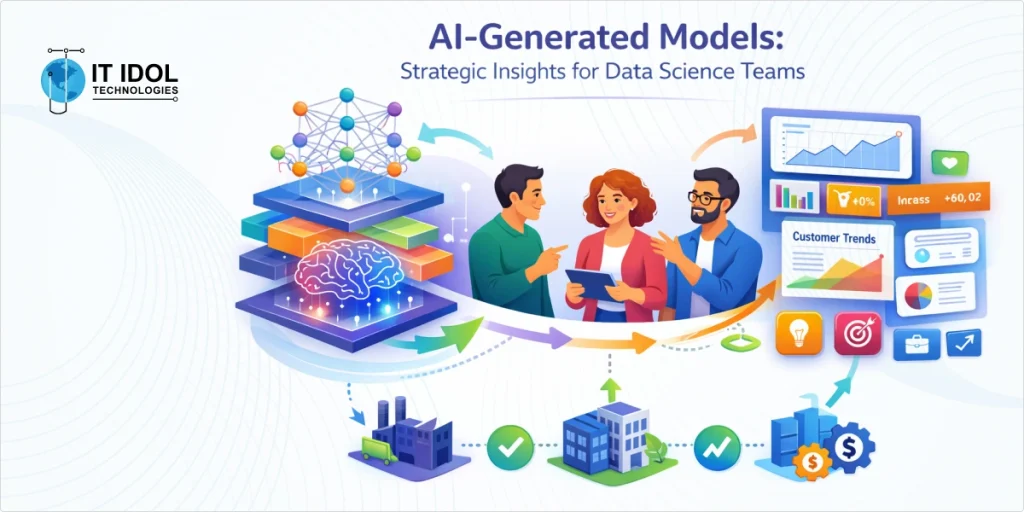
Data science teams are navigating a fast-evolving landscape where AI-generated models are no longer theoretical tools; they are becoming operational realities. Yet many business and IT leaders misinterpret these models as “black box” replacements for traditional analytics or assume they automatically deliver results without strategic oversight. This misconception can lead to misaligned investments, unrealistic expectations, and stalled adoption.
The rise of AI-generated models matters because the speed and scale at which they can create predictive or prescriptive insights outpace manual model development. Enterprises face increasing pressure to leverage data more efficiently, reduce time-to-insight, and remain competitive in markets where rapid adaptation is critical. Understanding how these models work, what they can realistically achieve, and where they fall short is essential for making informed decisions on resource allocation, risk management, and operational integration.
For data science teams, the challenge is not simply mastering AI tools; it is embedding them strategically into workflows, ensuring they produce actionable, verifiable, and business-relevant outputs. Leaders who grasp this distinction can extract measurable value while avoiding common pitfalls of over-reliance or misapplication.
What the Topic Really Means
AI-generated models are often discussed in broad terms, but at their core, they are algorithms that automatically construct predictive or prescriptive frameworks from structured and unstructured data. Unlike manually coded models, they can identify patterns, optimize hyperparameters, and generate insights without exhaustive human intervention. However, this does not mean they replace human judgment; rather, they augment it by handling complexity and scale that traditional approaches cannot efficiently manage.
The practical significance lies in understanding the scope and limitations of these models. For example, generative AI approaches can produce model variants or simulate multiple scenarios quickly, but they rely heavily on the quality and representativeness of the input data. Teams that treat outputs as final answers without validation risk introducing bias, overfitting, or operational errors.
Reframing the conversation helps: AI-generated models are tools for decision acceleration, not decision automation. They reduce repetitive analytical work, expose hidden correlations, and enable scenario planning at a speed that would otherwise require extensive human resources. For enterprise leaders, this means models can inform strategy, forecast outcomes, and optimize resource allocation, but they do not replace accountability, domain expertise, or governance.
Another key distinction is adaptability. Traditional models often require manual redevelopment when conditions change, whereas AI-generated models can recalibrate faster, providing near-real-time insights in dynamic environments. Understanding these nuances allows data science teams to focus on monitoring, tuning, and interpreting results rather than spending disproportionate time on coding or parameter selection.
Ultimately, grasping what AI-generated models really do is about balancing speed, accuracy, and interpretability. It is about aligning outputs to business objectives and operational constraints, rather than chasing the novelty of automated modeling for its own sake.
Where It Delivers Real Value
AI-generated models show their strength when applied to scenarios that demand scale, speed, and precision beyond human or traditional model capabilities.
1. Predictive Maintenance in Manufacturing
Complex machinery produces vast streams of sensor data. AI-generated models can process these signals in real time, identifying patterns that predict failures. The result is reduced downtime, optimized maintenance schedules, and lower operational costs, allowing leaders to allocate capital more efficiently.
2. Personalized Customer Engagement
In retail and finance, models can analyze customer behavior across channels and generate insights for targeted offers or dynamic pricing. The actionable outputs help marketing and product teams make data-driven decisions, improving conversion and retention rates.
3. Risk and Fraud Detection
Financial institutions can deploy AI-generated models to continuously monitor transactions, flag anomalies, and adapt thresholds as patterns evolve. This accelerates detection without overwhelming compliance teams, balancing risk mitigation with operational agility.
4. Scenario Simulation for Strategic Planning
Enterprises facing supply chain disruption, regulatory shifts, or market volatility can leverage AI-generated models to simulate multiple scenarios quickly. Leaders gain foresight into potential outcomes, enabling proactive rather than reactive decision-making.
Across these use cases, the value is less about automation for its own sake and more about enabling teams to act decisively with confidence. The speed of model generation, combined with the ability to iterate and refine, transforms how businesses respond to uncertainty and complexity.
Business Impact and Strategic Implications
AI-generated models influence business outcomes along four strategic dimensions: efficiency, risk, growth, and scalability.
Efficiency
By automating repetitive modeling tasks, data science teams redirect effort from coding to interpretation and strategy. Model generation time can drop from weeks to hours, accelerating project cycles and freeing resources for higher-value analytical work.
Risk Management
These models provide a framework for identifying anomalies, assessing scenario probabilities, and quantifying uncertainty. For instance, in finance, real-time model updates reduce exposure to emerging threats while maintaining compliance standards. Leaders must, however, implement governance protocols to ensure outputs remain reliable, explainable, and auditable.
Growth Enablement
Faster insights support market expansion, personalized offerings, and operational optimization. Teams can experiment with new strategies safely, backed by data simulations that guide investment decisions. In essence, AI-generated models act as an amplifier for strategic experimentation.
Scalability
Organizations often struggle to scale analytics across diverse business units. AI-generated models allow centralized methodology to propagate efficiently while accommodating localized variables. This uniformity accelerates enterprise-wide adoption without sacrificing contextual relevance.
Strategically, leaders must rethink how they integrate AI-generated models. Instead of building monolithic, rigid analytics pipelines, they need flexible infrastructures and cross-functional collaboration between data science, IT, and business units. Decision-making shifts from reactive problem-solving to proactive opportunity exploration.
In short, AI-generated models are not a tool for incremental improvement; they are a lever for rethinking operations, enhancing foresight, and enabling more confident strategic decisions. The real advantage comes when enterprises treat model generation as part of a broader decision ecosystem rather than a standalone technology experiment.
Key Challenges
AI-generated models are powerful, but they are not without limitations.
Data Dependency
Quality, completeness, and representativeness of data determine accuracy. Poor data can amplify errors, bias, or misleading insights.
Interpretability
Models that optimize autonomously may produce outputs that are difficult to explain to stakeholders, raising trust and compliance concerns. Teams must invest in monitoring and explainability tools.
Operational Integration
Seamlessly embedding generated models into existing workflows requires coordination across IT, analytics, and business units. Misalignment can undermine effectiveness.
Resource Considerations
While model generation reduces manual coding, it still demands skilled oversight, validation, and infrastructure capacity. Assuming “plug-and-play” deployment risks underperformance.
These challenges are not blockers; they are decision criteria. Awareness allows leaders to plan governance, quality checks, and integration processes that maximize benefit while managing risk.
Closing Insight
AI-generated models are reshaping the way data science teams deliver value. They enable faster, more scalable, and flexible analytics, but their true impact depends on strategic integration rather than technological novelty. Leaders who approach these models with a focus on outcomes, efficiency, risk management, growth, and scalability can turn raw capability into a measurable business advantage.
The future of enterprise analytics is not fully automated decision-making; it is augmented intelligence where human judgment and AI-generated insights work in tandem. Teams that treat models as strategic accelerators, rather than replacement tools, create an ecosystem where experimentation, foresight, and operational agility are all enhanced.
Forward-looking organizations will prioritize governance, interpretability, and integration, ensuring AI-generated models reinforce decision confidence rather than complicate it. They will also recognize the need for continuous monitoring, as models are only as robust as the data and assumptions that feed them.
Ultimately, understanding AI-generated models is less about mastering algorithms and more about aligning their outputs with business priorities. Decision-makers who internalize this perspective position their organizations to move faster, respond more effectively, and scale insights without scaling risk. In a competitive landscape defined by data-driven strategy, this balance between speed, reliability, and human oversight becomes the differentiator.
FAQ’s
1. What is an AI-generated model?
A model automatically created using AI to analyze data and predict outcomes, reducing manual coding effort.
2. Do AI-generated models replace data scientists?
No, they augment human expertise, allowing teams to focus on interpretation and strategic decisions.
3. Which business areas benefit most?
High-volume, complex, or dynamic domains like finance, manufacturing, retail, and supply chain.
4. What are the main risks?
Data bias, poor interpretability, and operational misalignment are common challenges.
5.How fast can models be generated?
Depending on complexity, models can be built in hours instead of weeks.
6. Are these models scalable?
Yes, they can be adapted for enterprise-wide use while accommodating local variables.
7. Do AI-generated models require special infrastructure?
They benefit from cloud or high-performance computing resources for real-time analytics.
8. How do you ensure model reliability?
Through validation, monitoring, and governance processes integrated into workflows.
9. Can they simulate business scenarios?
Yes, scenario generation allows leaders to anticipate outcomes and make proactive decisions.
10. What’s the key takeaway for leaders?
Treat AI-generated models as strategic accelerators, not standalone solutions, and align them to business objectives.
Parth Inamdar is a Content Writer at IT IDOL Technologies, specializing in AI, ML, data engineering, and digital product development. With 5+ years in tech content, he turns complex systems into clear, actionable insights. At IT IDOL, he also contributes to content strategy—aligning narratives with business goals and emerging trends. Off the clock, he enjoys exploring prompt engineering and systems design.