The Enterprise Imperative for Instant Intelligence
Enterprise decision-making has undergone a structural shift. For decades, organizations built intelligence architectures around centralized computing first through data centers, then through cloud platforms, and later through hyperscale analytics environments.
While cloud-first models unlocked unprecedented scalability, they simultaneously introduced latency, bandwidth dependency, and operational bottlenecks that increasingly conflict with real-time enterprise execution demands.
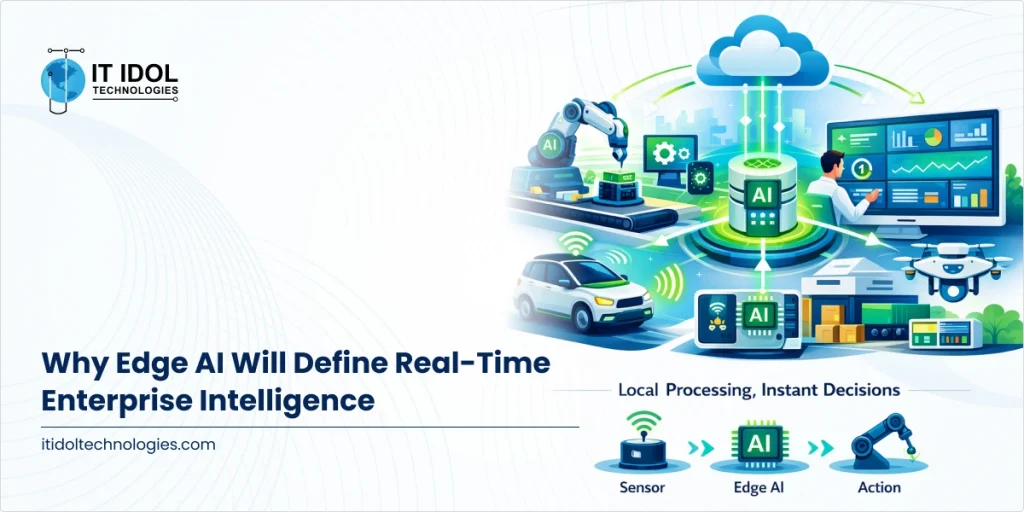
The rise of Edge AI marks a fundamental architectural evolution where intelligence moves closer to data generation points, manufacturing lines, industrial sensors, retail environments, healthcare monitoring systems, connected vehicles, and critical infrastructure networks.
Instead of routing every signal to centralized analytics environments, organizations now embed artificial intelligence capabilities directly within edge devices, gateways, and distributed processing nodes.
This transition is not merely a performance optimization strategy. It represents a shift toward distributed enterprise cognition where organizations operate with localized, context-aware decision frameworks capable of responding within milliseconds.
The scale of this transformation is already measurable. According to IDC, global spending on edge computing is projected to reach $317 billion by 2026, reflecting enterprise prioritization of low-latency intelligence and distributed automation.
As enterprise systems expand across hybrid infrastructure, real-time intelligence is becoming an operational necessity rather than a competitive differentiator.
Industries managing high-frequency events such as predictive maintenance, fraud detection, smart logistics orchestration, and patient monitoring cannot tolerate delays associated with centralized AI inference pipelines.
Edge AI enables organizations to convert raw sensor and operational data into immediate, actionable intelligence. More importantly, it aligns intelligence deployment with enterprise operational velocity, risk management expectations, and cost optimization strategies, redefining how enterprises design digital transformation roadmaps.
Why Cloud-Centric AI Architectures Are Reaching Operational Limits
Cloud computing remains foundational for enterprise analytics, model training, and large-scale data aggregation. However, enterprise adoption patterns reveal clear limitations when cloud architectures attempt to support time-critical operational intelligence.
Latency represents the most immediate constraint. For example, autonomous manufacturing environments and industrial robotics require decision response times measured in milliseconds.
Routing sensor data to cloud platforms introduces network delays, transmission overhead, and unpredictable performance variability. Even minor delays can cascade into equipment downtime, quality control failures, or safety risks.
Bandwidth costs and data transmission inefficiencies present another operational barrier. McKinsey highlights that industrial IoT deployments generate enormous data volumes, estimating that connected industrial assets produce up to 79.4 zettabytes of data annually.
Transmitting all this data to centralized environments is neither economically viable nor operationally efficient.
Data sovereignty and compliance requirements further complicate centralized AI deployment. Regulatory frameworks increasingly mandate localized data processing, particularly in healthcare, financial services, and government sectors. Processing sensitive data at the edge supports compliance while reducing exposure risks.
From an enterprise architecture perspective, cloud AI often introduces single points of failure. Distributed edge intelligence enhances resilience by ensuring operational continuity even during network disruptions.
This does not signal the decline of cloud AI. Instead, enterprises are transitioning toward hybrid intelligence architectures where centralized platforms handle model training and large-scale analytics, while edge nodes execute real-time inference and localized decision-making.
Understanding Edge AI as a Distributed Enterprise Intelligence Layer
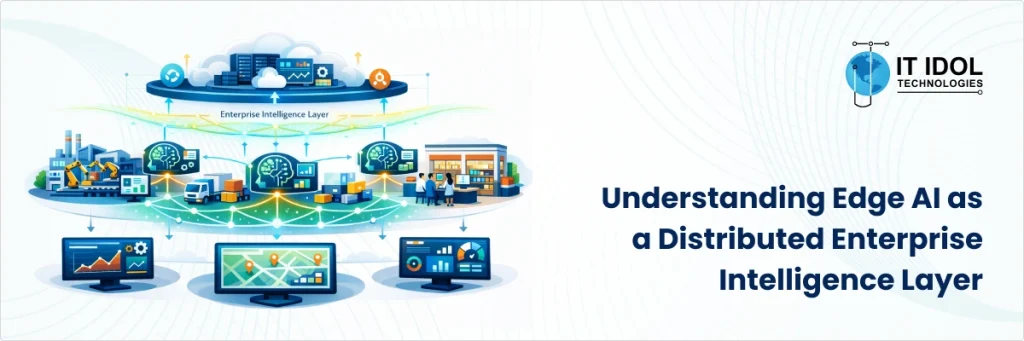
Edge AI operates as a distributed intelligence fabric embedded across enterprise operational ecosystems. It integrates AI inference engines with data acquisition devices, edge gateways, and localized compute infrastructure to create decision-capable environments that operate independently from centralized systems.
From an architectural standpoint, Edge AI typically involves three functional layers:
1. Data Acquisition Layer – Sensors, IoT devices, cameras, and operational systems generate raw data streams.
2. Edge Processing Layer – Embedded processors or edge gateways execute machine learning inference, filtering, aggregating, and analyzing data in real time.
3. Cloud and Enterprise Integration Layer – Centralized platforms manage model training, orchestration, analytics correlation, and long-term storage.
This distributed architecture dramatically reduces response times and network dependency while enabling context-aware decision automation.
Gartner predicts that by 2025, over 75% of enterprise-generated data will be processed outside traditional data centers or cloud environments, underscoring the shift toward decentralized intelligence models.
Enterprises deploying Edge AI are effectively transforming operational systems into autonomous decision ecosystems capable of predictive and adaptive execution.
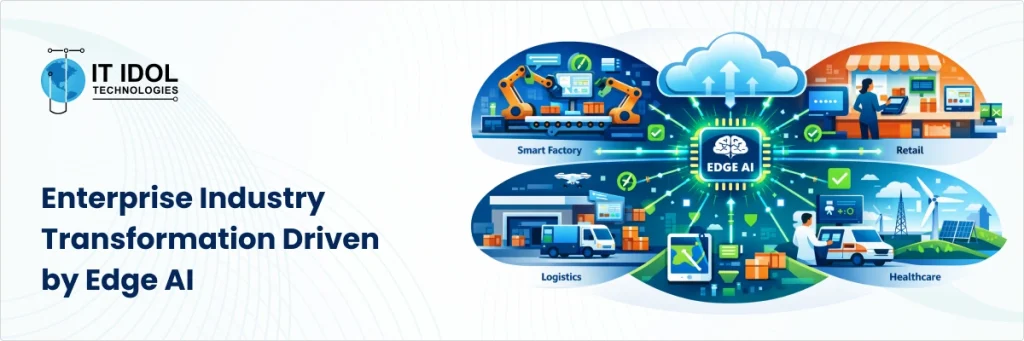
Enterprise Industry Transformation Driven by Edge AI
Manufacturing and Industrial Automation
Manufacturing environments rely heavily on machine telemetry, process monitoring, and quality inspection. Edge AI enables real-time defect detection, predictive maintenance, and autonomous process optimization without interrupting production cycles.
Deloitte reports that predictive maintenance enabled by AI can reduce maintenance costs by 10-40% while reducing equipment downtime by up to 50%. Deploying inference models directly on industrial controllers allows enterprises to detect anomalies instantly, preventing costly production disruptions.
Implementation insight: Enterprises often deploy computer vision models on edge GPUs integrated into manufacturing inspection lines, allowing sub-second quality validation while maintaining production throughput.
Healthcare and Remote Patient Monitoring
Healthcare providers are increasingly adopting edge-based medical monitoring systems to support real-time clinical intervention and patient safety. Wearable monitoring devices and smart diagnostic equipment can process physiological signals locally, enabling immediate alerts and reducing dependency on centralized analytics systems.
A study published by the National Institutes of Health highlights that real-time remote monitoring improves early detection of patient deterioration and significantly enhances clinical response outcomes (NIH research).
Operational insight: Healthcare organizations deploy edge AI in intensive care units and telemedicine platforms to maintain continuous patient analytics while ensuring compliance with healthcare data protection standards.
Retail and Customer Experience Intelligence
Retail enterprises increasingly depend on real-time behavioral analytics to optimize store operations, inventory management, and customer engagement. Edge AI supports automated checkout systems, dynamic pricing engines, and in-store personalization platforms.
According to Forrester, organizations implementing real-time customer analytics can achieve measurable improvements in conversion rates and customer experience optimization (Forrester Customer Analytics Research).
Implementation insight: Retailers deploy computer vision inference models on edge devices integrated with surveillance systems to analyze shopper behavior while minimizing privacy risks through local data processing.
Smart Infrastructure and Transportation
Connected transportation ecosystems rely on real-time environmental awareness and traffic analytics. Edge AI enables autonomous vehicles, smart traffic management, and predictive infrastructure maintenance.
The U.S. Department of Transportation identifies real-time traffic analytics and connected infrastructure as foundational for reducing congestion and improving urban mobility outcomes (U.S. DOT Connected Vehicles Program).
Edge AI Enterprise Architecture Integration Patterns
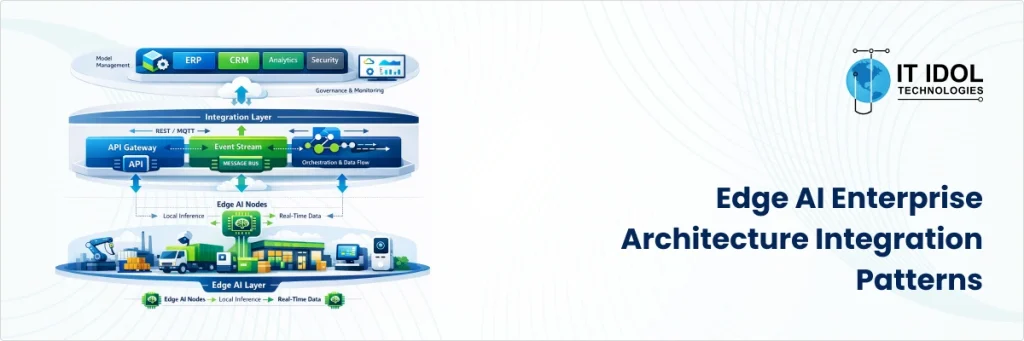
Edge AI deployment requires rethinking enterprise integration frameworks. Organizations rarely deploy standalone edge systems; instead, they integrate edge intelligence into existing enterprise architecture landscapes.
Common enterprise integration models include:
1. Hub-and-Spoke Edge Integration
Edge devices operate as localized inference hubs connected to centralized orchestration platforms. This model supports scalability while maintaining centralized governance control.
2. Federated Edge Intelligence Model
Multiple distributed edge clusters collaborate through federated learning frameworks. This enables enterprises to train AI models using decentralized datasets while maintaining data sovereignty.
3. Event-Driven Edge Architecture
Edge AI integrates with enterprise event streaming platforms such as Kafka or cloud event buses, enabling real-time decision workflows across distributed operational systems.
From an enterprise architecture governance perspective, these integration patterns support interoperability between edge intelligence and enterprise ERP, MES, CRM, and analytics platforms.
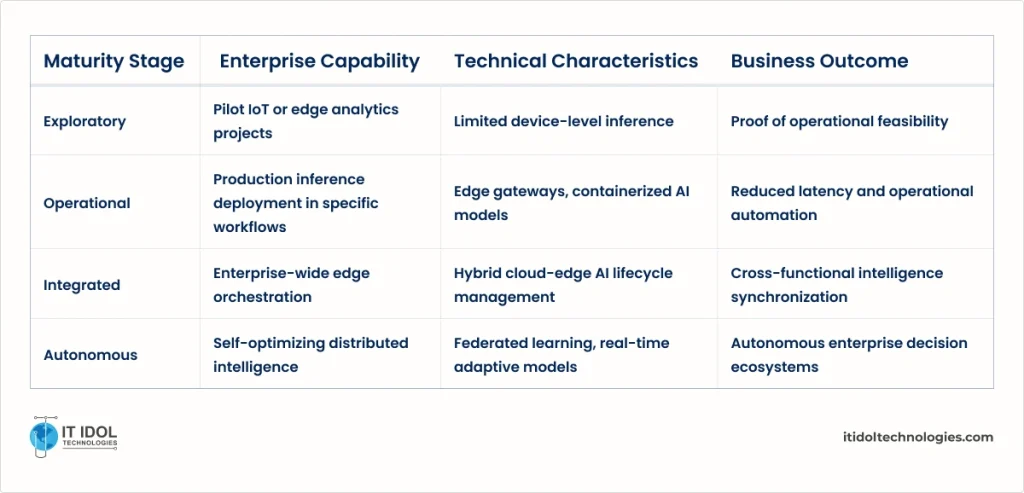
Implementation Maturity Model for Edge AI Adoption
Enterprises typically transition through these stages over multi-year digital transformation initiatives. The maturity journey requires investment in device infrastructure, data governance, AI model lifecycle management, and cross-platform orchestration frameworks.
Governance, Security, and Compliance Considerations in Edge AI Deployments
While Edge AI introduces performance benefits, it also expands enterprise attack surfaces. Distributed intelligence nodes create new cybersecurity challenges requiring robust governance frameworks.
Key enterprise governance considerations include:
Device Identity and Access Control: Ensuring secure authentication of edge nodes
Model Integrity Protection: Preventing model tampering or adversarial AI attacks
Data Privacy Compliance: Maintaining local data processing policies aligned with regulatory mandates
Lifecycle Management: Managing AI model updates across thousands of distributed endpoints
According to IBM’s Cost of a Data Breach report, the global average cost of a data breach reached $4.45 million, emphasizing the financial implications of inadequate security governance in distributed systems.
Enterprises deploying Edge AI often implement zero-trust security models combined with hardware-level encryption and secure boot architectures to mitigate distributed infrastructure risks.
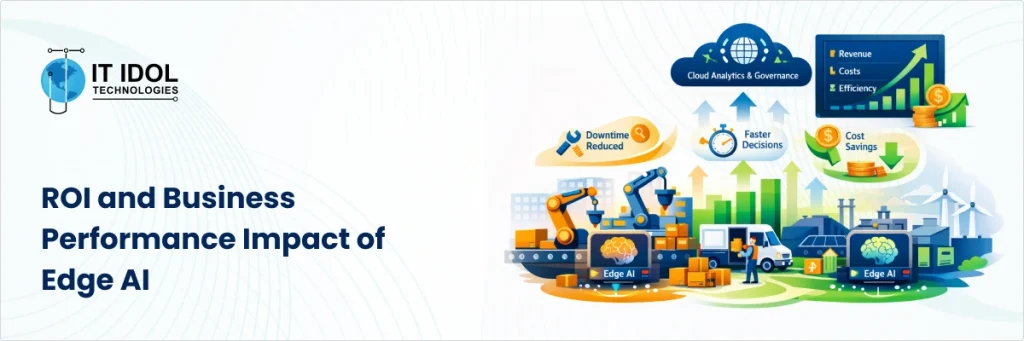
ROI and Business Performance Impact of Edge AI
Edge AI investment decisions are typically evaluated through multi-dimensional ROI frameworks that combine operational efficiency, risk reduction, and customer experience enhancement.
Cost Efficiency
Local data processing reduces cloud data transfer expenses and network infrastructure costs. Organizations managing high-frequency sensor networks often achieve significant bandwidth cost reductions through localized inference.
Operational Productivity
Real-time automation reduces manual intervention and improves operational uptime. For instance, predictive maintenance and anomaly detection significantly reduce equipment failure rates.
Customer Experience Optimization
Real-time personalization engines enhance engagement and customer satisfaction, directly impacting revenue growth and retention.
Accenture research indicates that organizations implementing advanced AI-driven automation can achieve productivity gains of up to 40% across operational workflows.
From an enterprise transformation perspective, Edge AI delivers both immediate performance improvements and long-term digital capability development.
Scaling Edge AI Across Enterprise Ecosystems
Scaling Edge AI requires addressing several architectural and operational challenges.
Model Deployment Complexity: Enterprises must manage AI models across thousands of distributed devices, requiring robust MLOps frameworks and automated deployment pipelines.
Infrastructure Standardization: Edge environments often involve heterogeneous hardware ecosystems. Standardizing runtime environments using containerization technologies improves deployment consistency.
Operational Monitoring: Enterprises must implement distributed observability platforms capable of monitoring performance, security, and inference accuracy across edge nodes.
Successful enterprise deployments often rely on centralized orchestration platforms that manage distributed intelligence while maintaining governance and performance consistency.
Future Outlook: Edge AI as the Foundation of Autonomous Enterprises
Edge AI represents the convergence of artificial intelligence, IoT, distributed computing, and enterprise automation. As digital ecosystems expand, enterprises increasingly require localized intelligence capable of supporting autonomous operations.
Future enterprise trends include:
AI-driven operational autonomy across supply chains
Real-time digital twins synchronized with edge data streams
Federated enterprise intelligence networks enabling collaborative AI learning
Integration of 5G and next-generation connectivity to enhance distributed inference performance
The evolution toward autonomous enterprises will rely heavily on edge intelligence architectures that support decentralized decision-making while maintaining centralized governance oversight.
Conclusion
Edge AI is redefining enterprise intelligence by shifting AI execution closer to operational data sources, enabling real-time decision-making, reducing infrastructure latency, and supporting distributed automation strategies. As enterprises expand digital ecosystems across connected devices, cloud-centric intelligence models alone cannot sustain operational velocity or scalability requirements.
Organizations adopting Edge AI are not simply implementing new technology, they are redesigning enterprise architecture frameworks to support distributed cognition, localized automation, and adaptive operational intelligence. Industry research consistently demonstrates that enterprises leveraging real-time analytics and predictive automation achieve measurable gains in productivity, cost efficiency, and operational resilience.
The transition toward edge-enabled intelligence ecosystems requires structured implementation maturity models, hybrid architecture integration strategies, and governance frameworks that balance performance with security and compliance.
Enterprises that strategically adopt Edge AI will be positioned to build autonomous operational systems capable of responding to dynamic business environments with unprecedented speed and precision.
Edge AI requires enterprises to shift from centralized data lake dominance toward hybrid data mesh architectures that support distributed data processing, localized analytics, and real-time decision pipelines while maintaining centralized governance oversight.
Enterprises should prioritize Edge AI when operational latency, data sovereignty requirements, network reliability constraints, or high-frequency data generation demand localized intelligence execution.
Organizations implement MLOps frameworks that support automated model deployment, version control, remote monitoring, and continuous performance validation across distributed device infrastructures.
Integration challenges include protocol incompatibility, data normalization complexity, legacy system latency limitations, and the need for middleware orchestration frameworks to synchronize distributed intelligence with core enterprise platforms.
By processing sensitive data locally, Edge AI reduces data exposure risks, supports jurisdiction-specific data processing mandates, and enables granular data governance enforcement.
Enterprises invest in edge computing hardware, containerized runtime environments, distributed orchestration platforms, AI model management systems, and secure connectivity infrastructure.
Federated learning enables enterprises to train AI models across distributed datasets without transferring sensitive data, improving model accuracy while maintaining compliance and data privacy.
Enterprises typically implement zero-trust security models, AI lifecycle governance frameworks, device identity management protocols, and enterprise-wide observability strategies to maintain scalable and secure edge intelligence ecosystems.
Deval Rathod
Founder & CEO
|
Deval Rathod is the Founder and CEO of IT IDOL Technologies, a custom software development company. With over a decade of experience in software engineering, solution architecture, and technology leadership, she has worked across custom software development, enterprise applications, AI & ML, and digital transformation. Her expertise includes guiding technology teams, designing scalable software solutions, and helping businesses evaluate and implement emerging technologies. She contributes insights on software engineering, artificial intelligence, enterprise technology, and digital transformation.