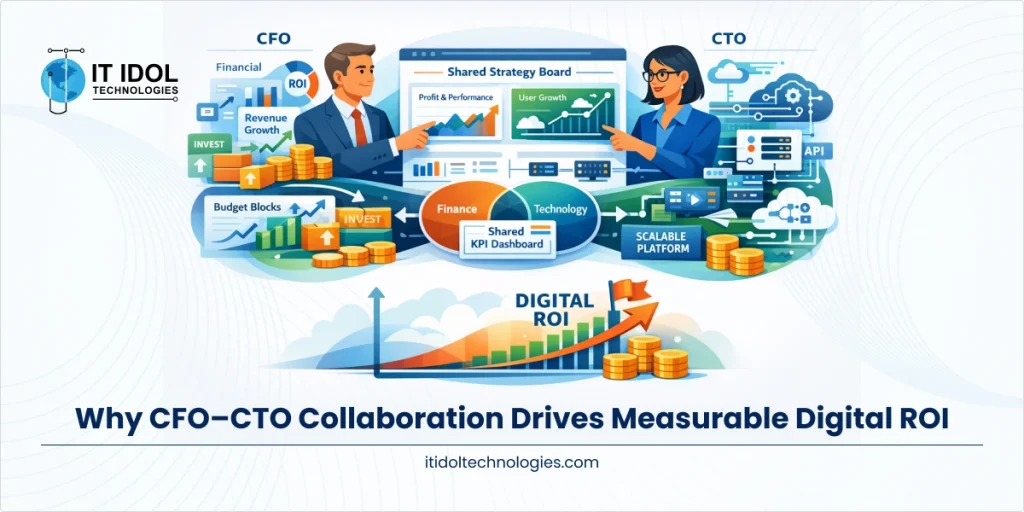
Digital ROI fails when finance and technology operate in silos with mismatched value definitions.
CFO-CTO collaboration enables structured measurement across efficiency, growth, risk mitigation, and strategic optionality.
Probabilistic modeling and risk-adjusted frameworks are essential for AI, data, and platform investments.
Institutionalized governance and shared accountability turn digital spending into disciplined capital deployment.
The Digital Investment Accountability Gap
Digital transformation has moved from experimentation to obligation. Cloud migration, data platforms, AI pilots, automation programs, cybersecurity modernization, customer experience redesign, ERP consolidation. For most enterprises, these are no longer optional bets; they are survival infrastructure. Yet, in boardrooms across industries, a familiar question keeps resurfacing:
Are we actually seeing measurable returns from these investments?
The uncomfortable truth is that many organizations cannot answer this with confidence. Budgets are approved. Programs are launched. Roadmaps are celebrated. But when quarterly reviews begin, the conversation shifts from strategic ambition to financial ambiguity. Costs are visible. Returns are interpreted. Attribution is debated. This gap is not primarily a technology issue. It is not a funding issue. It is a leadership alignment issue.
More specifically, it is a gap between the CFO and the CTO.
The Structural Misalignment Behind Digital ROI Confusion
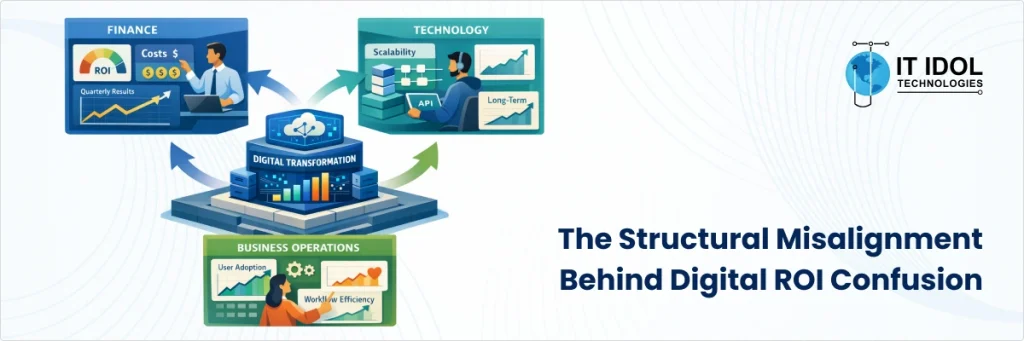
CFOs and CTOs operate under fundamentally different operating logics.
The CFO is accountable for capital efficiency, risk exposure, margin protection, and cash flow resilience. Their lens is temporal and financial. Investments must justify themselves within measurable windows. Variance is monitored. Forecasts are revised. Capital allocation is constantly optimized.
The CTO operates within a systems architecture lens. Their focus is scalability, resilience, technical debt reduction, security posture, and long-term platform capability. They manage interdependencies, vendor ecosystems, integration complexity, and evolving regulatory constraints. Success is often measured in reliability, speed of deployment, and technical capability uplift.
Neither perspective is wrong. Both are necessary.
The problem emerges when digital initiatives are initiated under technical rationale but evaluated under financial scrutiny without a shared measurement framework. The CTO may argue that a cloud migration reduces long-term infrastructure risk and increases deployment velocity.
The CFO may respond that operating expenses have increased and projected savings are unclear. Both statements can be accurate at the same time. Without structured collaboration, digital ROI becomes a subjective interpretation rather than a disciplined measurement.
Why Traditional ROI Models Fail in Digital Programs
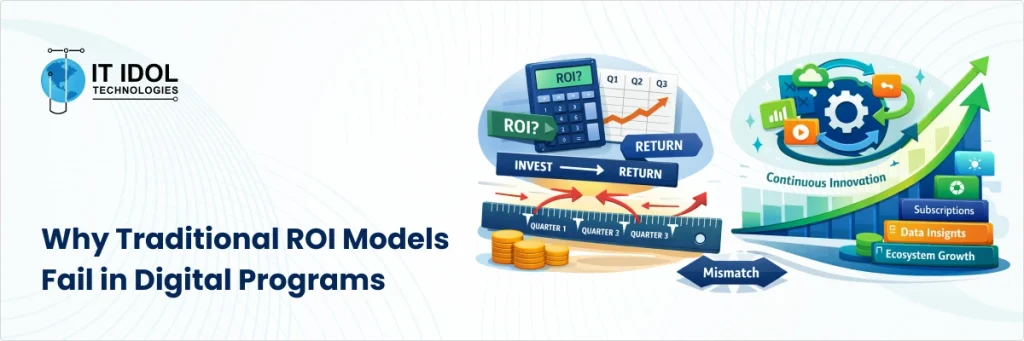
Classic ROI calculations assume linear cause and effect. Invest X. Generate Y. Measure delta. Calculate return. Digital investments rarely behave this way.
Consider a data platform modernization initiative. The benefits may include:
Faster reporting cycles
Reduced manual reconciliation
Improved compliance visibility
More accurate forecasting inputs
Better customer segmentation
Shorter product development loops
Each of these outcomes influences revenue, cost, or risk. But they rarely produce an immediate, isolated financial line item. The financial impact is distributed across functions and time horizons. CFOs are trained to demand clarity. CTOs are trained to think in systems.
When ROI is forced into narrow quarterly accounting frames, digital value often appears diluted or invisible. This is not because value does not exist. It is because measurement frameworks are misaligned with the nature of digital transformation.
Traditional ROI models handle the first category reasonably well. They struggle with the second. They almost ignore the third.
Yet, in many industries, risk avoidance carries financial weight equivalent to revenue growth. A single compliance failure or data breach can erase years of incremental gains. Without CFO involvement in defining risk-adjusted value, digital initiatives are evaluated through an incomplete lens.
The Capital Allocation Pressure Is Intensifying
Digital investment scrutiny has increased significantly over the past few years. Rising capital costs, inflationary pressure, geopolitical instability, and supply chain volatility have tightened executive tolerance for ambiguous returns.
Boards are asking sharper questions:
What is the payback period?
Which initiatives directly impact margin?
How does this program improve resilience?
What is the downside risk if we delay?
Are we funding capability or simply upgrading technology?
CTOs often respond with architectural explanations. CFOs respond with capital prioritization models. If these conversations occur sequentially rather than collaboratively, misalignment compounds.
For example:
A CTO may prioritize replacing legacy systems due to escalating technical debt and vendor obsolescence. The CFO may deprioritize the investment because current systems are “functioning” and the revenue impact appears indirect.
Six months later, system instability leads to operational disruption. Emergency funding is approved at a premium. What could have been a strategic capital allocation becomes reactive spending. Digital ROI is not only about measuring upside. It is also about quantifying the cost of inaction.
That quantification requires financial modeling discipline combined with technical scenario analysis. No single function can perform that task in isolation.
The Hidden Cost of Siloed Accountability
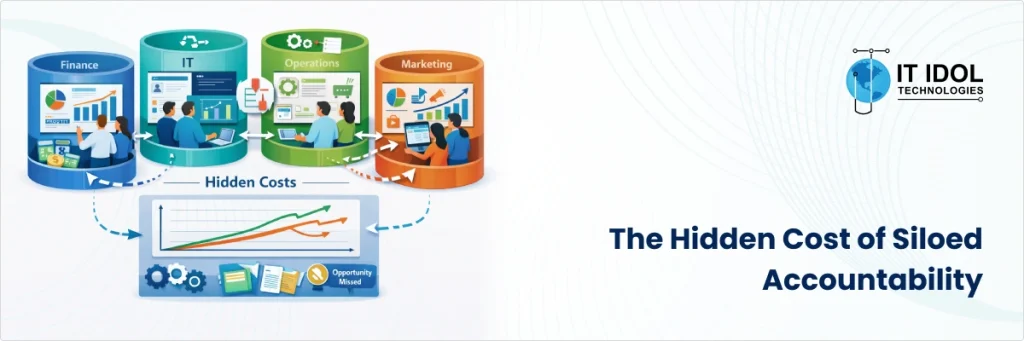
When CFOs and CTOs operate independently on digital investments, three systemic risks emerge.
1. Underestimated Total Cost of Ownership
CTOs may focus on building and deployment costs. CFOs may focus on capital approval thresholds. But without joint modeling, lifecycle costs are often underestimated. Cloud programs are a common example. Initial migration may reduce capital expenditure, but operational costs can escalate without disciplined usage governance. Licensing structures, integration dependencies, data egress charges, and support models add complexity.
If finance is not embedded early in technical design decisions, cost curves can drift. By the time variance is detected, architectural choices are already locked.
2. Misaligned Incentives
Technology teams may be rewarded for delivery milestones. Finance teams may be rewarded for cost containment. When success metrics diverge, subtle friction develops. Delivery speed increases without clear financial baselines. Cost optimization becomes reactive rather than strategic. Digital ROI requires shared metrics. Otherwise, both functions can achieve their targets while the enterprise underperforms.
3. Fragmented Value Narratives to the Board
Boards increasingly expect technology strategy to translate into measurable enterprise performance. If the CTO presents technical transformation metrics and the CFO presents financial outcomes without explicit linkage, the narrative feels disconnected. Investors and board members interpret this disconnect as uncertainty. That perception alone can influence valuation confidence.
A unified ROI framework strengthens governance credibility.
Digital Transformation Is Now a Balance Sheet Issue
For many enterprises, digital assets represent a growing proportion of capital deployment. Software platforms, cloud contracts, data assets, cybersecurity investments, and AI infrastructure are not peripheral expenses. They shape operational capacity.
Yet digital assets often sit in accounting categories that obscure strategic intent. Some are capitalized. Others are treated as operating expenses. Some generate immediate financial impact. Others produce optionality.
Without structured collaboration between finance and technology leadership, enterprises struggle to answer foundational questions:
What portion of our capital base is digitally driven?
How resilient is our digital cost structure?
Which platforms create compounding value?
Where are we accumulating hidden liabilities in the form of technical debt?
These are not purely technical or purely financial questions.
They sit at the intersection of architecture and capital discipline.
From Budget Approval to Value Realization
Many organizations treat digital ROI as a post-implementation exercise. A business case is approved. Funding is released. Measurement occurs months later. This sequencing is flawed.
ROI discipline must begin before architectural design decisions are finalized. Consider a hypothetical enterprise evaluating an AI-driven demand forecasting system. If the CTO designs the solution primarily for predictive accuracy, they may prioritize model complexity and data integration depth. If the CFO is not involved in defining acceptable cost thresholds and measurable business impact, the solution may overshoot financial viability.
Conversely, if the CFO defines ROI expectations without understanding data maturity constraints, targets may be unrealistic.
Joint design conversations change the trajectory.
They shift the question from “Can we build this?” to “What business outcome are we optimizing for, and what financial evidence will validate it?”
This reframing forces clarity on:
Baseline performance metrics
Target improvement thresholds
Time-to-value expectations
Risk tolerance levels
Sensitivity scenarios
Without that clarity, digital investments drift into abstract strategic intent.
The Emerging Expectation: Finance-Led Digital Discipline
An interesting shift is occurring in high-performing enterprises.
Finance is no longer simply approving digital budgets. It is participating in transformation design.
Leading CFOs are building capabilities in:
Technology cost analytics
Data-driven performance measurement
Risk-adjusted capital modeling
Scenario-based investment evaluation
At the same time, forward-looking CTOs are strengthening financial literacy within their teams.
This mutual upskilling signals recognition of a deeper reality: digital transformation is a capital allocation strategy expressed through technology. The more digitally dependent a business becomes, the less sustainable it is for finance and technology to operate in parallel tracks.
The Core Thesis
Digital ROI measurement cannot be retrofitted after implementation. It must be co-designed.
CFOs bring capital discipline, risk quantification, and performance governance. CTOs bring architectural foresight, systems thinking, and operational feasibility insight. Without collaboration, digital initiatives oscillate between over-optimism and over-skepticism. With collaboration, digital investments become structured bets with defined outcomes, measurable thresholds, and transparent trade-offs.
The rest of this discussion will examine:
How CFO-CTO alignment can be operationalized
What shared ROI frameworks should include
How to measure intangible and risk-adjusted value
Governance models that sustain collaboration beyond individual projects
The stakes are no longer experimental budgets. They are enterprise competitiveness and capital resilience.
Digital transformation has matured. Measurement discipline must mature with it.
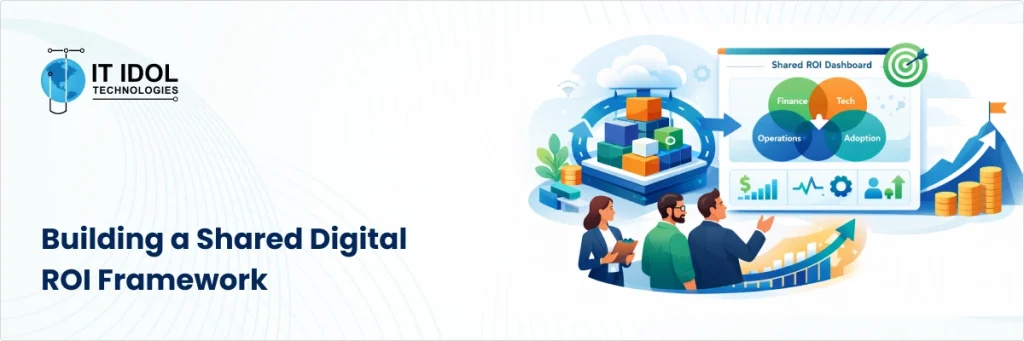
Building a Shared Digital ROI Framework
If collaboration between CFOs and CTOs is the requirement, the next logical question is practical: What does structured collaboration actually look like?
Alignment cannot rely on informal conversations or quarterly review debates. It requires a shared framework for defining, tracking, and validating digital value. Without structure, even well-intentioned leaders default to their functional instincts.
A durable ROI framework rests on three foundations:
1. A common definition of value
2. A jointly agreed measurement architecture
3. Governance that sustains accountability beyond project launch
Each of these requires deliberate design.
Step One: Agree on What “Value” Means
Digital programs are often justified using broad language: agility, innovation, modernization, and transformation. These terms are strategically valid but financially ambiguous. CFOs require quantification. CTOs require feasibility. The starting point must be a shared categorization of value that both sides recognize as legitimate.
A practical model distinguishes four value dimensions:
1. Efficiency Value
Operational cost reduction, productivity improvement, and resource optimization.
Efficiency value is typically the easiest to model because it links directly to expense reduction or capacity reallocation.
2. Growth Enablement Value
Revenue expansion potential created by new capabilities.
This includes:
Faster product launches
Improved personalization driving conversion rates
Data-driven pricing optimization
Growth enablement is probabilistic rather than deterministic. It influences revenue rather than guarantees it. The CFO’s role here is to define reasonable attribution assumptions and confidence intervals rather than demand precision that digital systems cannot provide.
3. Risk Mitigation Value
Reduction in downside exposure.
This may involve:
Cybersecurity enhancements
Regulatory compliance automation
Business continuity architecture
Risk mitigation is frequently undervalued because it does not generate visible revenue. Yet avoided losses carry real financial weight. CFOs are uniquely positioned to model expected loss scenarios and assign probabilistic cost avoidance values. CTOs contribute by quantifying likelihood and system vulnerability exposure.
Optionality is difficult to quantify in the short term. But ignoring it results in chronic underinvestment in foundational platforms. Jointly defining how optionality will be evaluated prevents it from becoming a vague justification mechanism.
By explicitly classifying digital investments across these dimensions, CFOs and CTOs shift the conversation from abstract aspiration to structured value mapping.
Step Two: Define Baselines Before Spending Begins
One of the most common failures in digital ROI measurement is the absence of pre-investment baselines. Organizations often implement technology and then attempt to measure improvement without clearly documenting starting conditions. The result is interpretive debate.
For instance, if an enterprise implements workflow automation but never establishes the average cycle time, error rate, or labor allocation before deployment, improvement claims become anecdotal.
Joint baseline definition solves this.
Before funding approval, the CFO and CTO teams should agree on:
Current performance metrics
Current cost structure
Current risk exposure estimates
Current revenue performance related to the targeted capability
This baseline becomes the reference point for ROI evaluation.
It may seem procedural, but it forces disciplined thinking. It also surfaces hidden complexities early. In many cases, teams discover that measurement systems themselves require upgrading before transformation begins.
That insight alone can reshape project scope.
Step Three: Design Measurement Into the Architecture
Digital ROI is not a reporting layer added after implementation. It must be embedded within the system architecture. If a company deploys a customer analytics platform but fails to design tracking mechanisms that connect analytics usage to revenue behaviour, attribution will remain speculative.
Measurement design should address:
What data will validate success?
Where will that data be captured?
Who owns data integrity?
How frequently will performance be reviewed?
What thresholds trigger corrective action?
This is where CFO and CTO collaboration becomes operational rather than philosophical.
CTOs ensure systems generate the necessary telemetry. CFOs ensure that telemetry connects to financial interpretation models.
Without architectural alignment, financial reporting and technical reporting operate on parallel tracks.
Addressing Attribution Complexity
A recurring tension in digital ROI discussions is attribution. Suppose a company invests in a digital customer portal. Over the next year, customer retention improves. Revenue per customer rises. Support costs decline.
How much of that performance improvement should be attributed to the portal versus broader market conditions, pricing strategy adjustments, or operational changes? CFOs often resist overstated attribution. CTOs may feel defensive when benefits are discounted. The solution lies in scenario-based modeling rather than absolute claims.
A disciplined attribution framework may include:
Controlled pilot groups
Before-and-after performance comparisons
Sensitivity analysis
Incremental contribution estimates rather than full attribution
Finance teams are skilled in variance analysis and forecasting. Technology teams understand usage patterns and behavioral shifts. When combined, these competencies create a more credible ROI narrative.
Perfection is unrealistic. Transparency is not.
Boards rarely expect flawless attribution. They expect reasoned logic supported by data.
Time Horizon Alignment
Digital investments rarely conform to quarterly return cycles. Yet financial reporting remains quarterly. This structural mismatch creates pressure. Short-term financial optics may discourage long-term platform investment. Conversely, open-ended transformation programs can drift without interim validation checkpoints.
CFO-CTO collaboration should explicitly define:
Short-term milestone indicators
Medium-term performance inflection points
Long-term strategic payoff expectations
For example:
A multi-year ERP modernization may not generate immediate cost savings. However, interim indicators could include process standardization rates, data accuracy improvement, and reduction in reconciliation effort. By agreeing on staged value recognition, leaders avoid binary judgments of success or failure. This layered time horizon approach also protects strategic investments from premature cancellation due to short-term noise.
Software licensing tiers change. Data storage scales unpredictably. Integration maintenance grows as systems interconnect. Vendor contracts evolve. CFOs are accustomed to lifecycle cost modeling in capital-intensive industries. Applying similar discipline to digital programs is critical.
A shared total cost of ownership model should include:
Equally important, CFOs gain visibility into architectural trade-offs. A higher upfront cost may reduce long-term operational volatility. Without cross-functional modeling, these nuances remain hidden.
Integrating Risk-Adjusted ROI
Traditional ROI focuses on expected returns. Digital investments often reduce variance rather than increase returns. For example, a cybersecurity upgrade may not increase revenue. It may reduce the probability of catastrophic loss. In such cases, expected value modeling becomes relevant.
CFOs can apply probabilistic risk frameworks:
Estimate the likelihood of adverse events
Model financial impact scenarios
Compare the expected loss under the current state versus the improved state
CTOs contribute technical probability inputs based on vulnerability assessments and threat intelligence. The resulting ROI calculation may show modest average benefit but a significant reduction in tail risk exposure. In industries such as financial services, healthcare, and critical infrastructure, tail risk reduction carries strategic weight far beyond average performance gains.
Digital ROI must therefore expand beyond deterministic return calculations.
Establishing Governance Beyond Launch
Even well-designed ROI frameworks fail without sustained governance.
Transformation fatigue is real. After initial deployment, attention shifts to the next initiative. Measurement becomes sporadic. Value claims remain unvalidated.
Effective governance includes:
Regular joint review sessions between finance and technology
Transparent reporting dashboards accessible to executive leadership
Clear accountability for benefit realization, not just project delivery
Mechanisms for course correction if projected returns diverge
Importantly, accountability should not be punitive. Digital transformation inherently involves uncertainty. The objective is disciplined learning, not blame assignment. When CFOs and CTOs review performance together, organizational signal shifts. Digital value becomes a shared enterprise objective rather than a functional metric.
Cultural Barriers to Overcome
Frameworks alone are insufficient if cultural friction persists.
Common cultural barriers include:
Finance skepticism toward technical projections
Technology resistance to financial scrutiny
Differing communication styles
Asymmetric understanding of constraints
Addressing this requires deliberate effort.
CFOs benefit from understanding system architecture complexity and technical debt implications. CTOs benefit from exposure to capital markets expectations and balance sheet dynamics. Cross-functional education programs, rotational leadership initiatives, and shared strategic off-sites can reduce perception gaps.
In high-performing organizations, finance and technology leaders develop a shared vocabulary. Over time, this vocabulary reduces negotiation friction and accelerates decision cycles.
From Cost Center to Capital Multiplier
One of the most significant shifts enabled by CFO-CTO collaboration is the repositioning of technology from a cost center to a capital multiplier. When digital investments are measured with rigor, validated through disciplined baselines, and linked explicitly to enterprise outcomes, they cease to be discretionary spending lines. They become structured growth and resilience levers. This transition requires mutual trust. Trust built not on optimism, but on shared evidence and transparent modeling.
The conversation changes from:
“Why is IT spending increasing?”
to
“How are we optimizing digital capital deployment?”
That distinction is not semantic. It is strategic.
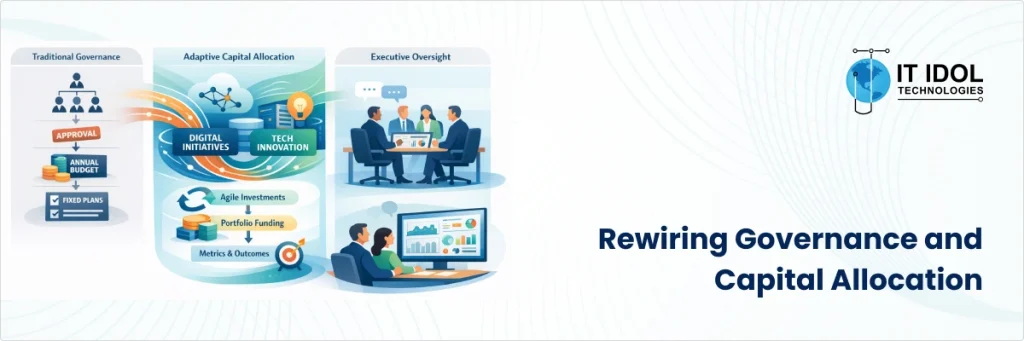
Rewiring Governance and Capital Allocation
Once a shared ROI framework is in place, the deeper shift begins. Measurement alignment changes how capital is allocated, how priorities are set, and how accountability flows through the organization. Digital transformation is not just a portfolio of projects. It is a reconfiguration of enterprise capability. That makes governance design central to ROI realization.
If CFOs and CTOs collaborate only at the project approval stage, the structural misalignment returns. Sustainable ROI discipline requires governance embedded into decision cycles, portfolio management, and executive oversight.
From Project-Based Funding to Capability-Based Investment
Many organizations still fund digital initiatives as isolated projects. A team submits a business case. Finance reviews projected costs and benefits. Funding is approved. The project delivers against milestones. Benefits are assumed to follow. This model works for discrete, well-defined upgrades. It fails when digital investments form interconnected capability layers.
Consider a customer experience transformation program:
CRM modernization
Data platform integration
Marketing automation tools
AI-based personalization
Omnichannel interface redesign
Individually, each component may show modest ROI. Collectively, they may reshape customer lifetime value and retention economics. If funding decisions are evaluated in isolation, the strategic synergy is undervalued.
CFO-CTO collaboration should shift the lens from “project ROI” to “capability ROI.” Instead of asking, “What return will this CRM upgrade deliver?” the better question becomes, “What is the financial impact of building an integrated customer data capability over three years?”
This reframing alters capital allocation logic. Investments are sequenced based on capability maturity rather than short-term payback alone.
Portfolio-Level ROI Discipline
Digital transformation portfolios contain a mix of:
Core system modernization
Efficiency automation
Innovation experiments
Risk and compliance initiatives
Growth enablement platforms
Each category carries a different risk-return profile.
A mature governance model recognizes this heterogeneity. CFOs are accustomed to portfolio diversification in financial contexts. That same thinking can apply to digital capital deployment.
For example:
Core modernization projects may offer lower upside but reduce operational fragility.
Innovation initiatives may carry higher variance but create breakthrough growth potential.
Automation programs may provide predictable efficiency gains.
Instead of evaluating each initiative against a uniform hurdle rate, leaders can define portfolio balance targets. This avoids the common trap of over-funding incremental efficiency projects while underinvesting in foundational modernization because short-term ROI appears clearer.
Governance becomes fragile when decision rights are unclear.
Questions such as these often generate friction:
Who has the authority to terminate an underperforming digital initiative?
Who approves scope expansion when additional investment appears necessary?
Who determines when expected benefits are unlikely to materialize?
If technology leaders retain unilateral decision authority, financial discipline weakens. If finance leaders exercise control without a technical context, innovation slows.
Clear, jointly defined decision thresholds reduce ambiguity.
For example:
Variance beyond a defined cost threshold triggers joint review.
Benefit realization falling below projected targets for two consecutive cycles prompts scenario reassessment.
Strategic pivots require board-level visibility if capital exposure exceeds predefined limits.
These mechanisms convert abstract alignment into operational accountability.
Importantly, escalation should not imply failure. In digital programs, recalibration is often rational. Governance structures should support adaptive correction rather than rigid adherence to outdated projections.
Integrating Digital ROI into Enterprise Planning Cycles
Annual budgeting processes often operate separately from digital strategy roadmaps.
Finance may finalize capital allocation envelopes before technology roadmaps are fully validated. Technology teams may develop multi-year transformation plans that exceed available capital.
This sequencing produces tension.
Stronger alignment requires synchronizing:
Enterprise strategy formulation
Capital planning cycles
Technology roadmapping
Risk assessment reviews
In practice, this means CFO and CTO offices collaborating during early-stage strategic planning, not after strategic priorities are announced.
For instance:
If the enterprise strategy emphasizes geographic expansion, technology capability requirements should be modeled simultaneously. Infrastructure scalability, regulatory compliance, and localization capability must be costed early. Waiting until the execution phase to align budgets increases reactive adjustments and erodes ROI credibility.
Joint planning creates visibility into trade-offs before commitments are made.
Linking Digital Metrics to Financial Reporting
A persistent obstacle in digital ROI validation is metric fragmentation.
Technology dashboards may track:
System uptime
Deployment frequency
Code release velocity
API performance
Data latency
Finance dashboards track:
Operating margin
Revenue growth
Cash flow
Capital expenditure
Cost variance
Without explicit bridges between these domains, executives struggle to interpret causality.
Deployment frequency improvements linked to reduced time-to-market for revenue-generating products.
Improved system uptime correlated with decreased revenue leakage due to service interruptions.
Reduced data latency associated with faster decision cycles in supply chain management.
This linkage requires joint analytics capability. It also demands intellectual honesty. Not every technical improvement translates directly into financial gain.
But when linkage is credible and data-backed, board-level confidence strengthens.
Addressing the Incentive Structure
Digital ROI discipline collapses if incentives remain misaligned.
If CTO performance evaluation emphasizes innovation velocity and system modernization without reference to financial outcomes, cost discipline may weaken.
If the CFO evaluation emphasizes cost reduction without recognizing strategic investment necessity, long-term competitiveness may erode.
Aligning incentives does not mean forcing identical metrics. It means ensuring shared exposure to digital value realization.
Possible approaches include:
Joint accountability metrics in executive scorecards
Shared targets for benefit realization across finance and technology
Board-level evaluation of digital capital efficiency
When executive incentives reflect shared outcomes, collaboration shifts from voluntary to structural.
Handling Underperformance Without Political Fallout
Not all digital investments succeed as expected.
Markets shift. Adoption rates disappoint. Technical complexity exceeds projections. Integration friction slows value realization. In organizations lacking CFO–CTO alignment, underperformance often triggers defensive behavior. Technology teams may defend projections. Finance teams may question competence. Trust erodes. A more mature model treats variance as analytical input rather than political ammunition.
Joint post-implementation reviews should examine:
Which assumptions proved inaccurate
Whether baseline metrics were flawed
How external variables influenced results
What corrective action is feasible
The objective is not retrospective blame. It is forward-looking capital discipline.
Enterprises that institutionalize learning loops improve forecasting accuracy over time. Digital ROI becomes progressively more predictable because assumptions are refined with experience.
The Board’s Perspective
Board members increasingly expect clarity around digital capital deployment.
They want to understand:
How much of the total capital is committed to digital programs
How digital investment aligns with enterprise risk posture
Whether expected returns justify exposure
How management monitors benefit realization
If CFO and CTO narratives diverge at the board level, confidence weakens.
Unified reporting strengthens credibility.
For example, presenting a consolidated digital investment dashboard that includes:
Capital deployed
Value realization status
Risk exposure changes
Portfolio balance assessment
This approach signals that digital transformation is governed with the same rigour as major acquisitions or capital-intensive projects.
That perception influences investor trust and valuation resilience.
Digital Capital as a Strategic Asset Class
In advanced enterprises, digital investment is treated as a strategic asset class. Just as companies manage physical assets, financial assets, and human capital, digital capital is actively optimized.
This includes:
Periodic reassessment of platform relevance
Decommissioning underperforming systems
Reallocation of funds from low-impact initiatives to high-potential capabilities
Ongoing measurement of return on digital capital employed
CFO-CTO collaboration is foundational to this shift.
Without financial discipline, digital sprawl increases. Without architectural insight, capital optimization becomes shortsighted. Treating digital capability as a managed asset class elevates transformation from tactical upgrades to sustained strategic leverage.
When Collaboration Breaks Down
It is worth acknowledging that alignment is not automatic.
Breakdowns often occur when:
Finance is introduced too late in the transformation design
Technology is excluded from the capital planning strategy
The data required for measurement is incomplete or unreliable
Recognizing these failure modes allows leadership to intervene early.
Transparent communication, shared data visibility, and regular executive alignment sessions reduce the likelihood of misinterpretation.
Ultimately, the collaboration is not about functional harmony. It is about enterprise durability.
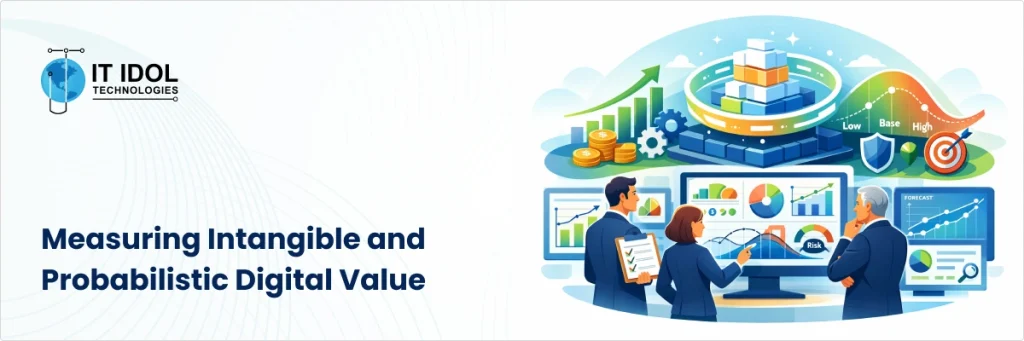
Measuring Intangible and Probabilistic Digital Value
As digital maturity increases, the nature of investment shifts.
Early transformation efforts often focus on visible modernization: migrating infrastructure, replacing legacy systems, automating manual workflows. These projects carry measurable cost and performance baselines. But over time, investment emphasis moves toward data platforms, AI models, advanced analytics, ecosystem integrations, and digital experience layers.
The value here is less tangible. It unfolds through improved decisions, faster response cycles, and enhanced optionality. This is where CFO-CTO collaboration becomes most critical. Without structured evaluation, these initiatives are either over-celebrated as innovation breakthroughs or underfunded due to measurement discomfort.
Neither outcome is sustainable.
The Challenge of Intangible Assets
Traditional accounting frameworks struggle to capture the value of internally developed digital capabilities. Data assets, proprietary algorithms, integrated platforms, and AI models often sit awkwardly between operating expense and capital asset classifications.
From a finance perspective, this creates tension. Significant spending may appear as an expense without a visible asset base expansion. From a technology perspective, these investments may represent foundational capabilities that determine competitive positioning for years.
The disconnect is structural.
Intangible digital assets generate value in at least three ways:
1. Improving decision quality
2. Accelerating operational responsiveness
3. Enabling new business models
These outcomes are rarely visible as direct line items. They influence margin, revenue, and risk through intermediate mechanisms. For example, a predictive maintenance AI model does not “create revenue” in isolation. It reduces equipment downtime, extends asset life, and improves capacity utilization. The financial impact emerges through avoided losses and efficiency gains.
Without disciplined mapping of cause and effect, value remains abstract.
Moving from Deterministic ROI to Expected Value Thinking
Many digital initiatives, particularly those involving AI and analytics, produce probabilistic outcomes. An AI-driven fraud detection system may reduce fraud rates by a projected percentage range, not a fixed number. A recommendation engine may increase average order value depending on customer behavior variance.
In such cases, binary ROI models fail.
CFOs are familiar with expected value calculations in areas such as insurance, risk modeling, and capital budgeting under uncertainty. Applying similar techniques to digital investments increases rigor.
A structured approach might include:
Defining multiple performance scenarios
Estimating probability weights for each scenario
Modeling financial outcomes under each condition
Calculating weighted expected return
CTOs provide insight into model accuracy ranges, data maturity constraints, and technical performance variance. CFOs translate these inputs into financial impact distributions. This collaborative modeling produces more nuanced board-level discussions. Instead of presenting single-point forecasts, leadership presents probability-adjusted return profiles.
In volatile markets, this sophistication enhances credibility.
Quantifying Decision Velocity
One of the most undervalued digital outcomes is improved decision velocity.
When data pipelines are automated, dashboards updated in real time, and analytics embedded into workflows, management decisions accelerate. Pricing adjustments occur faster. Inventory rebalancing improves. Customer issues are resolved earlier.
The financial impact of speed is indirect but material.
For example:
Faster pricing adjustments may reduce margin erosion during cost spikes.
Accelerated demand sensing may prevent excess inventory accumulation.
Rapid issue detection may prevent regulatory penalties.
Measuring this requires baseline comparison of pre- and post-implementation decision cycles.
CFO-CTO collaboration can identify:
Average time from signal detection to executive action
Financial exposure during delay periods
Margin sensitivity to response speed
Even modest improvements in response time can compound into significant financial resilience over multi-year horizons.
This is not speculative optimism. It is a structured operational analysis.
AI Investment Evaluation: Beyond Pilot Success
AI pilots often demonstrate technical feasibility. Models perform well in controlled environments. Accuracy metrics exceed expectations. Yet pilot success does not guarantee enterprise ROI.
The real questions are:
Can the model scale across business units?
Is the data governance robust enough to sustain performance?
Will operational teams trust and adopt AI-driven recommendations?
Does the infrastructure support ongoing model retraining?
CFO involvement in early AI evaluation ensures that scaling costs, adoption risks, and maintenance requirements are included in ROI projections.
For instance, an AI demand forecasting model may require:
Continuous data cleansing
Dedicated data science resources
Cloud computing capacity scaling
Change management investment
If these elements are excluded from initial ROI projections, financial variance emerges later.
CTOs must articulate full lifecycle requirements. CFOs must model total exposure and expected value over multi-year horizons.
Together, they transform AI from experimental spending to structured capital deployment.
Measuring Platform Ecosystem Value
Modern enterprises increasingly participate in digital ecosystems through APIs, platform integrations, and strategic partnerships.
Platform investments rarely generate direct revenue immediately. Instead, they enable:
Partner integrations
Marketplace expansion
Third-party data access
Network effects
The financial value emerges gradually as ecosystem participation grows.
CFO-CTO collaboration should define ecosystem value indicators such as:
Number of active integrations
Revenue derived from partner channels
Cost reduction from shared infrastructure
Speed of onboarding new partners
Mapping ecosystem participation to financial outcomes requires careful tracking.
If left undefined, ecosystem initiatives risk becoming perpetual investments without accountability. If evaluated too narrowly, they risk premature termination before network effects materialize.
Balanced modeling recognizes staged value realization curves.
Data as a Managed Financial Asset
Data platforms represent a significant investment. Storage, governance, analytics tooling, security frameworks, and integration pipelines require ongoing funding. Yet many enterprises treat data as operational infrastructure rather than as a strategic asset. A more disciplined approach treats data capability as a yield-generating asset class.
CFO-CTO collaboration can be defined:
Data monetization opportunities
Revenue uplift attributable to improved segmentation
Cost savings from reduced duplication and reconciliation
Risk reduction from enhanced auditability
By assigning financial relevance to data utilization metrics, enterprises avoid the trap of building expansive data lakes without measurable yield.
This does not imply direct monetization in every case. Often, the value lies in internal optimization. But explicit linkage clarifies whether data investment intensity aligns with enterprise return.
Optionality and Strategic Agility
One of the hardest categories to measure is strategic optionality. Cloud-native infrastructure, modular architectures, and API ecosystems enable rapid pivots. Entering new markets becomes easier. Acquisitions integrate faster. Regulatory adaptation accelerates. Optionality rarely produces immediate cash flow. It reduces friction when strategic shifts occur.
CFO skepticism toward optionality often arises from its intangible nature. CTO advocacy often relies on future scenario arguments.
A more rigorous approach involves scenario planning.
For example:
What would be the cost and time required to enter a new geographic market under the current architecture?
How would that change under a modular, cloud-based platform?
What is the financial impact of reducing expansion time by six months?
Even if expansion does not occur immediately, modeling potential responsiveness provides context for investment decisions.
Optionality is not a vague aspiration. It is a measurable reduction in strategic friction.
Avoiding the Innovation Theater Trap
Enterprises sometimes invest heavily in digital labs, innovation hubs, and experimental pilots without structured evaluation. The narrative of innovation becomes attractive. Yet without clear pathways to scaled impact, these initiatives consume capital without measurable enterprise transformation. CFO–CTO alignment introduces disciplined gatekeeping.
Key evaluation checkpoints may include:
Clear transition criteria from pilot to production
Defined adoption targets
Scalable infrastructure readiness
Financial exposure caps during experimentation
This structure does not suppress innovation. It increases the probability that experimentation translates into enterprise value.
Communicating Intangible Value to External Stakeholders
Public companies face an additional layer of complexity. Investors often scrutinize digital spending growth. If financial statements reflect rising technology expenses without a corresponding short-term earnings impact, external skepticism may increase.
Why the margin impact may lag due to scaling curves
How data and AI capabilities position the enterprise competitively
What intermediate performance indicators validate the trajectory
Clear communication reduces misinterpretation.
This does not eliminate market pressure. But it anchors the discussion in structured analysis rather than an abstract promise.
The Shift from Cost Control to Capital Intelligence
When digital investments move into advanced analytics, AI, and ecosystem participation, traditional cost-control mindsets become insufficient.
Enterprises need capital intelligence.
Capital intelligence involves:
Understanding risk-adjusted returns
Modeling probability distributions
Quantifying optionality
Linking system performance to financial resilience
Reallocating funds dynamically based on evidence
This level of sophistication requires joint financial and technical fluency.
CFOs alone cannot interpret model accuracy curves. CTOs alone cannot construct capital sensitivity scenarios.
Collaboration transforms ambiguous digital ambition into analytically grounded strategic investment.
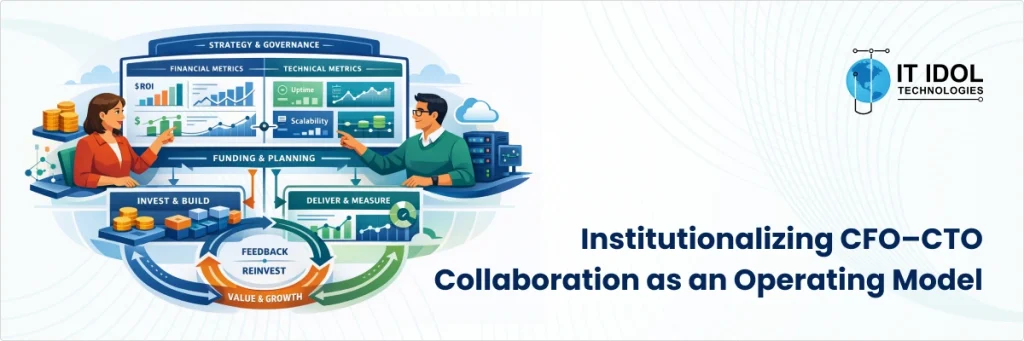
Institutionalizing CFO-CTO Collaboration as an Operating Model
Alignment between finance and technology cannot depend on individual chemistry. In some organizations, collaboration works because the CFO and CTO happen to share trust and mutual respect. In others, friction persists despite structural interdependence.
Leadership changes then reset the dynamic, and the digital ROI discipline weakens. If digital capital now represents a structural component of enterprise competitiveness, collaboration must be institutionalized. It has to survive executive turnover, market volatility, and shifting strategic priorities.
This requires embedding joint accountability into operating models, talent development, and enterprise culture.
From Relationship-Based Alignment to System-Based Alignment
Many enterprises underestimate how fragile informal alignment can be.
When collaboration is personality-driven:
ROI frameworks become inconsistently applied
Reporting formats shift with leadership preference
Capital prioritization debates re-emerge each budgeting cycle
Measurement rigor fluctuates
To prevent regression, collaboration needs defined mechanisms.
These may include:
Standing joint investment committees
Shared digital capital dashboards
Co-authored board reports
Structured post-investment reviews
When governance processes formally require joint participation, collaboration becomes procedural rather than optional.
This reduces dependency on individual negotiation skills.
Embedding Digital ROI into Leadership Routines
Institutionalization is reinforced when digital ROI is discussed consistently in executive routines.
For example:
Quarterly business reviews should include explicit digital value realization updates.
Annual strategy off-sites should evaluate digital capital allocation efficiency.
Risk committees should review technology-driven risk exposure shifts.
If digital transformation is discussed only during project approvals, it remains episodic. If it becomes part of recurring executive dialogue, it shapes enterprise thinking. CFOs and CTOs play a signaling role here. When they jointly present performance updates, the organization internalizes that digital investments are enterprise-wide responsibilities.
Talent Cross-Pollination
Long-term alignment strengthens when talent development bridges finance and technology.
This does not imply converting technologists into accountants or finance professionals into engineers. It means fostering enough mutual literacy to reduce interpretive gaps.
Possible approaches include:
Finance analysts embedded in technology programs
Technology leaders participating in capital planning workshops
Joint training sessions on cost modeling and system architecture
Rotational roles between digital strategy and financial planning teams
Over time, this cross-exposure creates leaders who think beyond functional silos.
Organizations that cultivate such hybrid fluency experience fewer adversarial ROI debates. Discussions become analytical rather than territorial.
Redesigning Performance Management
Cultural change requires incentive alignment.
If finance teams are rewarded primarily for expense reduction, and technology teams for delivery speed, shared digital ROI accountability weakens.
Performance management systems can reinforce collaboration by incorporating:
Benefit realization metrics tied to digital programs
Shared accountability for cost variance management
Enterprise-level digital capital efficiency targets
These metrics should be realistic and carefully defined. Overly aggressive financial targets may discourage necessary innovation. Overly vague strategic targets dilute accountability.
Balanced scorecards that integrate cost discipline, value realization, and innovation quality create healthier incentives.
Creating Transparency Without Bureaucracy
One risk in formalizing collaboration is excessive bureaucracy.
Heavy reporting layers, complex approval gates, and rigid financial templates can slow innovation. Technology teams may perceive finance as an obstacle rather than a partner.
Institutionalization should aim for transparency and clarity, not procedural overload.
Effective practices include:
Real-time digital performance dashboards are accessible to both functions
Clearly defined escalation thresholds rather than constant approvals
Lightweight documentation focused on assumptions and expected outcomes
The objective is to reduce surprise, not increase paperwork.
When information flows openly and assumptions are visible, friction decreases.
Managing Short-Term Pressure Without Sacrificing Long-Term Capability
One of the most difficult tensions CFOs face is balancing quarterly performance expectations with long-term digital investment. Earnings pressure may tempt leadership to defer modernization or reduce transformation budgets. Yet delaying foundational investment often increases long-term cost and risk.
CTO advocacy alone may not overcome short-term financial constraints. CFO advocacy alone may not capture architectural urgency.
Joint analysis helps navigate trade-offs.
For example:
Quantify incremental risk accumulation from postponing modernization
Model cost escalation associated with deferred upgrades
Evaluate opportunity loss from delayed capability enablement
By presenting these analyses together, CFOs and CTOs strengthen the case for disciplined continuity rather than reactive cuts.
Markets respond more favorably to a coherent strategy than to erratic cost trimming.
Digital ROI as a Continuous Feedback Loop
Institutionalization also requires recognizing that ROI measurement is iterative. Initial projections will rarely be perfect. Adoption rates may differ from expectations. Market conditions may shift. Technology costs may evolve. Instead of treating ROI variance as failure, mature enterprises treat it as calibration input.
Feedback loops should examine:
Accuracy of original assumptions
Changes in external variables
Behavioral adoption barriers
Data quality issues affecting measurement
Over time, this learning improves forecasting precision.
CFO-CTO collaboration thus evolves from defensive oversight to predictive intelligence.
Digital capital deployment becomes progressively more strategic.
The Competitive Implication
The conversation about digital ROI is not purely internal.
Enterprises that measure digital value rigorously allocate capital more intelligently. They scale successful initiatives faster. They terminate underperforming programs earlier. They maintain stronger cost discipline without suppressing innovation.
Over multiple investment cycles, this compounds. Competitors that lack structured collaboration often oscillate between overinvestment and retrenchment. Strategic consistency suffers. Capability maturity stagnates. The difference may not be visible in a single quarter. Over five to seven years, it becomes decisive.
Digital transformation is cumulative. So is digital misallocation.
When Collaboration Becomes a Strategic Advantage
At advanced maturity levels, CFO–CTO collaboration transcends measurement.
It influences acquisition strategy. It shapes ecosystem partnerships. It informs capital structure decisions when digital investments require sustained funding. It guides divestment from obsolete platforms.
Capital plans reflect architectural realities early.
Risk models incorporate system vulnerability intelligence.
Innovation pipelines are evaluated through disciplined stage gates.
Digital investment becomes neither unchecked ambition nor constrained austerity.
It becomes a structured strategic execution.
Closing Perspective
Digital transformation has entered a phase where enthusiasm alone no longer suffices. Boards expect measurable impact. Investors expect disciplined capital allocation. Markets reward resilience and adaptability. CFOs guard capital integrity. CTOs shape digital capability. In isolation, each function sees only part of the enterprise equation. Collaboration is not about merging roles. It is about integrating perspectives.
When finance understands system architecture and technology understands capital logic, digital ROI shifts from contested narrative to shared evidence.
That shift is foundational.
It determines whether digital spending accumulates into a durable competitive advantage or dissolves into fragmented initiatives. In a capital-constrained, technology-dependent economy, enterprises that align financial discipline with architectural foresight will not simply measure digital ROI more effectively.
They will build it more reliably.
FAQ’s
1. Why is CFO-CTO collaboration critical for digital ROI?
Digital investments influence both capital allocation and system architecture. CFOs ensure financial discipline and risk modeling, while CTOs ensure technical feasibility and scalability. Without alignment, ROI assumptions lack credibility or realism.
2. Why do traditional ROI models fail for digital transformation?
Digital programs generate distributed and long-term value, often across multiple functions. Linear “cost versus revenue” calculations miss risk reduction, decision acceleration, and optionality benefits that shape enterprise performance.
3. How can intangible digital assets be measured financially?
Through structured cause-and-effect mapping, expected value modeling, and scenario analysis. Improvements in uptime, decision speed, or risk posture can be translated into financial impact using probability-weighted frameworks.
4. What role does risk mitigation play in digital ROI?
Risk mitigation reduces potential downside exposure, such as cyber breaches, compliance penalties, or operational disruption. CFOs can quantify expected loss reductions, making risk-adjusted ROI more visible and defensible.
5. How should AI investments be evaluated?
AI initiatives require lifecycle modeling, including scaling costs, governance requirements, and adoption risk. ROI should reflect probabilistic outcomes rather than single-point forecasts.
6. What is capability-based investment versus project-based funding?
Capability-based investment evaluates digital initiatives as interconnected systems that create enterprise-level outcomes. It prevents undervaluing strategic platforms that may not show isolated short-term returns.
7. How can organizations avoid over- or under-attributing digital benefits?
By using pilot comparisons, sensitivity analysis, and incremental contribution estimates rather than absolute claims. Transparent modeling builds credibility even when attribution is complex.
8. How does governance impact digital ROI realization?
Clear decision rights, escalation thresholds, and recurring joint reviews prevent drift. Governance ensures value realization is monitored beyond initial implementation milestones.
9. What cultural barriers hinder CFO–CTO alignment?
Different incentive structures, communication styles, and measurement expectations can create friction. Cross-functional literacy and shared performance metrics reduce these gaps over time.
10. How does sustained collaboration create competitive advantage?
Enterprises that align finance and technology allocate capital more intelligently, terminate underperforming initiatives earlier, and scale high-impact capabilities faster. Over multiple cycles, this compounds into stronger strategic resilience.
Parth Inamdar is a Content Writer at IT IDOL Technologies, specializing in AI, ML, data engineering, and digital product development. With 5+ years in tech content, he turns complex systems into clear, actionable insights. At IT IDOL, he also contributes to content strategy—aligning narratives with business goals and emerging trends. Off the clock, he enjoys exploring prompt engineering and systems design.