Self-diagnosing vehicles shift maintenance from a cost center to a strategic control system
Predictive accuracy matters less than organizational response speed and incentives
ROI is constrained more by operating models than AI capability
Data ownership, liability, and decision rights become board-level concerns
The competitive edge comes from orchestration, not algorithms
Leaders must design for decision latency, not just failure prediction
The Car That Knows It’s About to Fail And Why That Makes Leaders Uncomfortable
Most enterprise leaders say they want fewer surprises. Yet when vehicles start predicting their own failures days or weeks before anything breaks, organizations often hesitate. Not because the technology doesn’t work, but because it exposes how unprepared operating models really are.
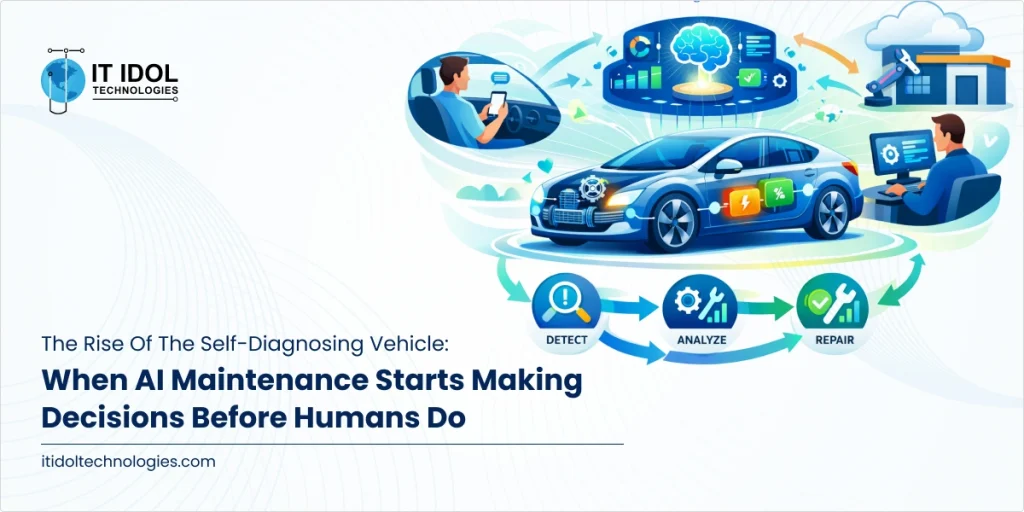
Self-diagnosing vehicles promise something deceptively simple: maintenance before breakdown. Sensors, machine learning models, and telemetry streams identify degradation patterns and flag issues early. In theory, this reduces downtime, lowers maintenance costs, and extends asset life. In practice, it collides with entrenched assumptions about accountability, budgeting, and control.
The uncomfortable truth is that breakdowns are easy to govern. A vehicle fails, a process triggers, and responsibility is clear. Predictive alerts are messier. They arrive probabilistically. They demand judgment. They force trade-offs between acting too early and acting too late. And they often surface at the worst possible time, mid-quarter, mid-route, mid-contract.
Leadership thinking around AI maintenance is still incomplete. Many frame it as a technical upgrade layered onto existing fleet operations. That framing misses the deeper shift underway. Self-diagnosing vehicles don’t just predict failures; they compress decision windows, redistribute authority, and challenge how enterprises define value realization.
This is not about whether AI models can detect anomalies. That debate is largely settled. McKinsey has reported that predictive maintenance can reduce machine downtime by 30-50% and maintenance costs by 10-40% when applied effectively, including in mobility and transportation-heavy industries. The real question is whether organizations can act on those predictions without breaking their own governance structures.
As vehicles become more autonomous in diagnosis, leaders must confront a harder issue: when machines know more about asset health than humans, who is actually in charge?
From Scheduled Maintenance to Probabilistic Intervention
Traditional vehicle maintenance is deterministic. Service intervals are fixed. Inspections are manual. Failures are treated as exceptions. This predictability is comforting, even if inefficient.
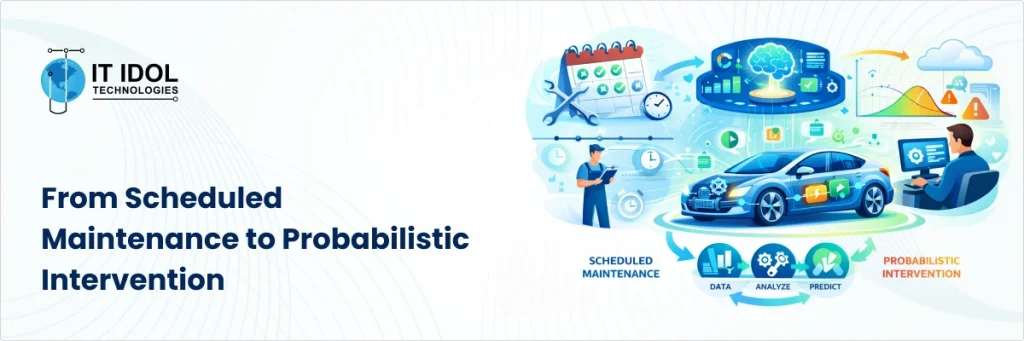
Self-diagnosing vehicles invert this logic. Maintenance becomes probabilistic. Instead of asking “Is it time to service this vehicle?” the question becomes “How confident are we that this component will fail within a given horizon?” That confidence score is rarely absolute. It lives in thresholds, confidence bands, and risk tolerances.
For engineering teams, this is familiar territory. For finance and operations leaders, it is not. Budgeting processes are built around known schedules and historical averages. Predictive maintenance introduces variability that is hard to forecast cleanly. Act too early, and costs spike without a visible justification. Act too late, and the system appears no better than reactive maintenance.
This is where many initiatives stall. The AI model flags a potential issue. The alert enters a workflow designed for certainty, not probability. Approvals slow down. The vehicle keeps running. When it eventually fails, trust in the system erodes even if the model was technically correct.
The strategic implication is subtle but critical. The value of self-diagnosing vehicles depends less on model accuracy and more on the organization’s willingness to operationalize uncertainty. Leaders must decide how much probabilistic risk they are willing to absorb in exchange for fewer catastrophic failures.
That decision is not technical. It is cultural and financial.
Cost Structures Don’t Fail Incentives Do
One of the most persistent myths around AI maintenance is that ROI is primarily driven by technology performance. In reality, ROI is constrained by incentive alignment.
Consider a fleet operator where maintenance budgets sit with one team, downtime penalties hit another, and customer satisfaction metrics belong to a third. A self-diagnosing vehicle flags an issue that may cause failure in three weeks. Acting now increases maintenance spend this quarter. Waiting risks downtime next quarter. No single leader owns the full outcome.
In steering committee meetings, this shows up as “let’s monitor it” decisions. Not because leaders are negligent, but because the incentive structure rewards deferral. AI doesn’t change that. It amplifies it.
BCG has highlighted that advanced maintenance programs often underdeliver because organizational silos prevent end-to-end value capture, particularly in asset-heavy industries. The same dynamic applies here, but with higher stakes.
Self-diagnosing vehicles force a reckoning. Either incentives are realigned around lifecycle outcomes, or predictive insights become noise. Enterprises that succeed tend to shift from cost-center accounting to asset performance ownership. Maintenance, uptime, and customer impact are treated as a single system, not separate metrics.
This is uncomfortable work. It requires CFOs to tolerate short-term cost volatility in exchange for long-term stability. It requires CTOs to accept that technical success without organizational change is still failure.
Decision Latency Is the Hidden Bottleneck
Much has been written about data latency in connected vehicles. Less attention is paid to decision latency, the time between insight and action.
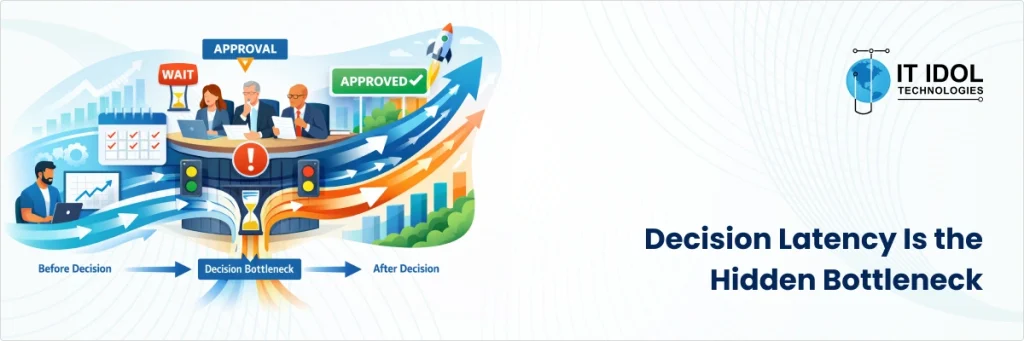
Self-diagnosing vehicles operate in near real time. Enterprise decision processes do not. Approval chains, vendor coordination, parts availability, and labor scheduling all introduce delays. By the time a decision is made, the prediction window may have shifted.
This mismatch erodes trust in the system. Operators see alerts that cannot be acted on promptly. Over time, they learn to ignore them. The AI is blamed, but the bottleneck is human.
Gartner has repeatedly emphasized that AI-driven operations fail when decision rights are unclear or overly centralized, particularly in regulated or safety-critical environments. Vehicles that diagnose themselves demand clearer escalation paths and predefined action thresholds.
Leaders must decide in advance: at what confidence level does the system act autonomously? When is human approval required? Who is accountable if the system intervenes too early or too late?
Avoiding these questions doesn’t preserve control. It creates ambiguity, and ambiguity is operational risk.
Data Ownership and the Quiet Shift in Power
Self-diagnosing vehicles generate enormous volumes of granular operational data. Who owns that data is no longer a legal footnote; it is a strategic lever.
OEMs, fleet operators, insurers, and regulators all have interests in diagnostic insights. If an OEM’s AI model predicts a failure that a fleet operator ignores, who is liable? If a third-party platform aggregates diagnostic data across fleets, who captures the learning advantage?
The World Economic Forum has flagged data governance in connected mobility as a critical unresolved issue, particularly as vehicles become more autonomous in decision-making. Self-diagnosis accelerates this tension.
Enterprises that treat diagnostic data as purely operational miss the point. This data informs product design, warranty strategies, insurance pricing, and even resale value. Control over it shapes competitive positioning.
Strategically, leaders must decide whether self-diagnosing capability is a feature they consume or a platform they build upon. The former offers speed. The latter offers leverage, but demands governance maturity most organizations lack today.
Talent Constraints Are More Limiting Than Algorithms
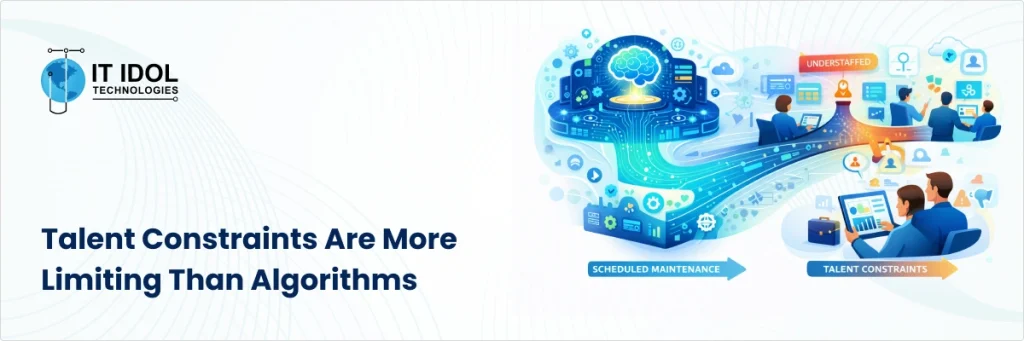
There is no shortage of AI models capable of detecting anomalies in vehicle systems. There is a shortage of people who can translate those anomalies into operational decisions at scale.
Self-diagnosing vehicles require hybrid talent: individuals who understand mechanical systems, data science outputs, and operational realities. These profiles are rare and expensive. Training them takes time.
IEEE research has noted that one of the main barriers to deploying intelligent maintenance systems is not sensor availability or model performance, but the lack of interdisciplinary expertise to operationalize insights.
Enterprises often underestimate this constraint. They invest heavily in technology, then discover that frontline teams do not trust or understand the outputs. Or worse, they understand them but lack the authority to act.
The strategic implication is clear. Scaling self-diagnosing vehicles is a workforce transformation challenge disguised as a technology initiative. Leaders who ignore this end up with impressive dashboards and unchanged outcomes.
Platform Thinking Versus Tactical Wins
There is a temptation to deploy self-diagnosing capabilities tactically: one fleet, one component, one use case. These pilots often succeed. Scaling them is harder.
Each additional vehicle type, operating environment, or regulatory regime introduces complexity. Models must be retrained. Thresholds adjusted. Processes localized. Without a platform approach, complexity grows faster than value.
Deloitte has observed that predictive maintenance programs struggle to scale when built as isolated solutions rather than integrated platforms with shared data and governance layers.
Platform thinking forces uncomfortable trade-offs. Standardization versus local optimization. Speed versus control. Short-term ROI versus long-term adaptability.
Leaders must decide whether self-diagnosing vehicles are an efficiency play or a strategic capability. The former can be delegated. The latter cannot.
Risk, Liability, and the New Failure Modes
Self-diagnosing vehicles reduces certain risks while introducing new ones. False positives lead to unnecessary interventions. False negatives lead to overconfidence. More subtly, automation bias can cause humans to defer judgment even when context suggests otherwise.
Regulators are watching closely. As AI systems take on more diagnostic authority, questions of liability intensify. If an AI recommends continued operation and a failure occurs, who is responsible? The model provider? The operator? The executive who approved the system?
Government and regulatory bodies have begun addressing AI accountability in safety-critical systems, but guidance remains fragmented. Enterprises deploying self-diagnosing vehicles must navigate this uncertainty proactively.
Risk management cannot be bolted on after deployment. It must be designed into decision thresholds, audit trails, and override mechanisms. This requires collaboration between legal, engineering, and operations teams that rarely work closely today.
Competitive Differentiation Is Quiet and Hard to Copy
When self-diagnosing vehicles work well, they are invisible. Vehicles don’t break down. Customers don’t complain. Costs stabilize. There is no dramatic before-and-after story.
This makes competitive differentiation subtle. Rivals may not realize what they are missing until gaps widen. By then, catching up is difficult, not because of technology, but because of accumulated learning embedded in processes and culture.
Statista data shows that unplanned vehicle downtime remains one of the largest cost drivers in fleet-intensive industries, often exceeding 10% of total operating costs. Reducing this quietly compounds the advantage over time.
The leaders who benefit most are those who treat self-diagnosis as a learning system. Every avoided failure feeds back into design, procurement, and operations. Over the years, this creates resilience that cannot be replicated quickly.
Closing: The Real Shift Is Not Predictive, It’s Cognitive
Self-diagnosing vehicles are not just about preventing breakdowns. They are about changing how organizations think about uncertainty, control, and responsibility.
The mental shift required is subtle but profound. Leaders must move from managing events to managing probabilities. From enforcing processes to designing decision rights. From asking “Did the system work?” to asking “Did we act when it mattered?”
This is uncomfortable territory. It exposes misaligned incentives, slow governance, and brittle operating models. But it also offers a path to quieter, more durable advantage.
The organizations that succeed will not be those with the most advanced models. They will be those willing to let machines surface inconvenient truths and redesign themselves to respond.
In that sense, the rise of the self-diagnosing vehicle is less about AI maintenance and more about organizational maturity. The vehicles are ready. The question is whether leadership is.
FAQ’s
1. How accurate do self-diagnosing vehicle systems need to be to deliver value?
High accuracy helps, but timely action and clear thresholds matter more than marginal model improvements.
2. Who should make decisions triggered by predictive maintenance alerts?
Ownership must align with asset performance outcomes, not isolated functional metrics.
3. How should CFOs think about ROI for self-diagnosing vehicles?
Expect cost variability upfront and focus on lifecycle stability rather than quarterly savings.
4. Do these systems reduce maintenance teams’ roles?
No, they shift roles toward judgment, coordination, and exception handling.
5. What are the biggest risks leaders underestimate?
Decision latency, incentive misalignment, and automation bias outweigh technical risks.
6. Can smaller fleets justify this investment?
Only if deployed as part of a shared platform or ecosystem, not standalone pilots.
7. How does this affect relationships with OEMs?
Data ownership and liability discussions become strategic, not contractual formalities.
8. Are regulators ready for AI-driven diagnostics?
Partially. Enterprises must design defensible governance ahead of clear regulation.
9. What talent profiles become critical?
Hybrid operators who understand mechanics, data outputs, and operational trade-offs.
10. What is the long-term competitive advantage?
Accumulated learning and faster organizational response, not the AI models themselves.
Parth Inamdar is a Content Writer at IT IDOL Technologies, specializing in AI, ML, data engineering, and digital product development. With 5+ years in tech content, he turns complex systems into clear, actionable insights. At IT IDOL, he also contributes to content strategy—aligning narratives with business goals and emerging trends. Off the clock, he enjoys exploring prompt engineering and systems design.