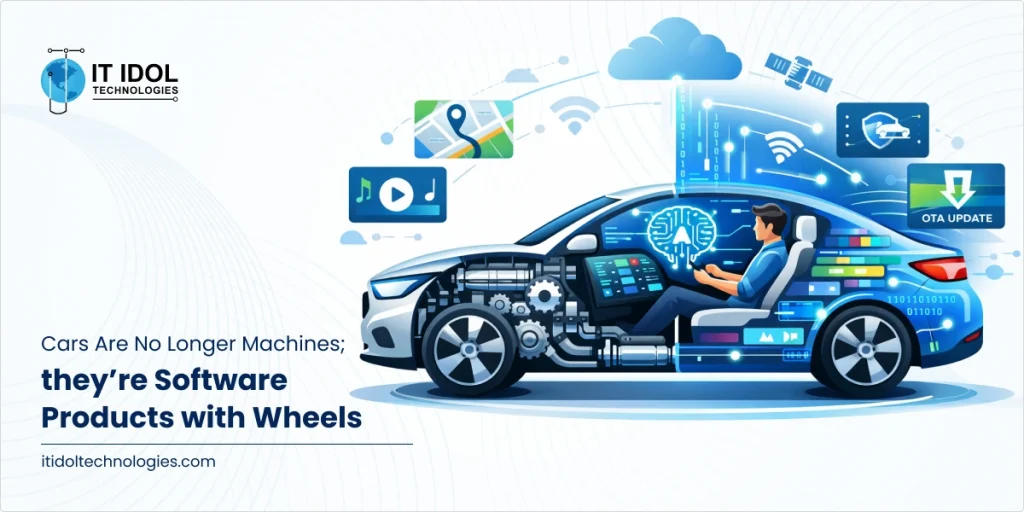
Modern vehicles are increasingly defined by their software platforms and services, rather than mechanical parts, reshaping where value accrues and risk is concentrated.
Automotive software markets are expanding rapidly, with projections showing exponential growth into the next decade and beyond.
Cars now face software governance challenges similar to those of large enterprise systems; update regimes, security, and architecture choices matter deeply.
Traditional OEM incentives, structures, and talent models are misaligned with competitive software-driven rivals, raising execution risk.
Shifts from hardware margins to recurring software value require a realistic cost-benefit calculus, not wishful ROI models.
Leaders must reframe vehicles as long-lifecycle, distributed, continuously updated digital platforms with implications for finance, talent, and organizational design.
The Mental Pivot: Why Cars as Software Products Change the Strategic Landscape
When enterprise leaders think about cars, they often default to industrial metaphors: engines, drivetrains, fuel systems, safety cages. These images are rooted in decades of manufacturing-centric thinking. Yet the economic and operational reality of vehicles is shifting toward software-centric products, where lines of code, update pipelines, data services, and integrated platforms increasingly define value, risk, and differentiation.
This isn’t a future possibility. It’s evident in market forecasts: the software-defined vehicle segment is projected to grow from hundreds of billions to trillions of dollars in the decade ahead, with compound annual growth rates often exceeding 25%. Even conservative estimates show rapid expansion in automotive software spend across safety, connectivity, and feature services.
This shift from mechanical engineering to digital engineering isn’t merely incremental; it’s structural. Cars still have engines, brakes, and chassis. But the center of gravity for customer experience, recurring revenue, safety validation, and long-term platform competitiveness now resides in software. That reframes strategic imperatives for CTOs, CFOs, and enterprise architects alike.
In this article, we unpack what this mental pivot means for enterprise leadership, the trade-offs, incentive misalignments, governance implications, and the organizational choices that determine whether an enterprise thrives or stumbles in a world where vehicles behave as continually evolving software products.
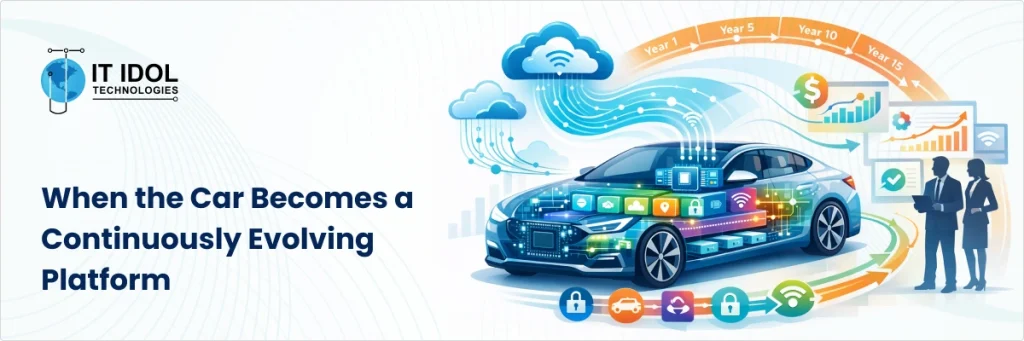
When the Car Becomes a Continuously Evolving Platform
The Invisible Architecture Under the Hood
Today’s vehicles do not operate like isolated machines built once and shipped. They resemble distributed, real-time computing systems with networked sensors, centralized computing clusters, and multiple layers of software managing everything from braking logic to user interface latency budgets.
From a strategic standpoint, this changes two things profoundly:
1.Lifecycle Orientation: Software is never “done.” Firmware, safety algorithms, connectivity stacks, and user features are updated throughout the vehicle’s life, sometimes years after purchase. This introduces an ongoing operational dimension that looks much more like managing a cloud service than a one-time hardware buy.
2. Value Capture Models: Traditional vehicle sales recognize revenue up front. Software introduces recurring value streams, subscriptions, feature unlocks, and connected data monetization that do not align with legacy financial models. CFOs and product owners need to rethink depreciation, revenue recognition, and cost amortization across what may be a 10-15 year product lifespan.
Moreover, the software architectures themselves are evolving: centralized compute domains are replacing dozens of discrete controllers; over-the-air (OTA) update capability is becoming a baseline requirement rather than a luxury. The implications here are not speculative; they’re reflected in market data and vendor strategies around the world.
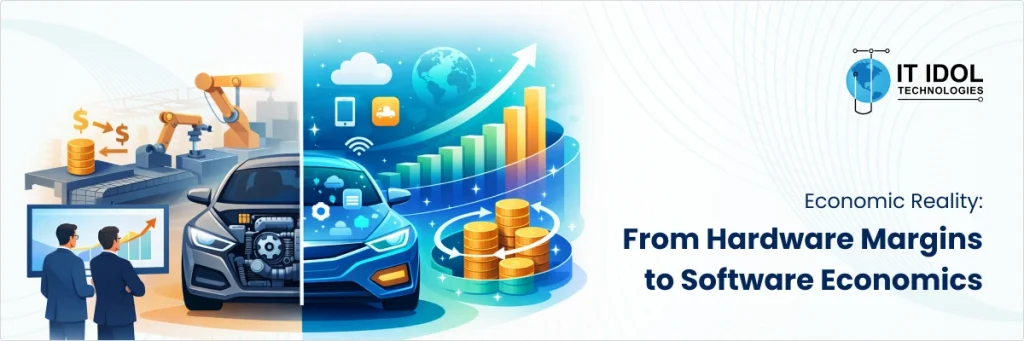
Economic Reality: From Hardware Margins to Software Economics
Market Size Signals
The economic footprint of automotive software is now substantial:
Software-defined vehicle markets are forecast to skyrocket into the trillions, with multiple research firms projecting valuations north of $1.5 trillion to $2.4 trillion in the coming years.
Broader automotive software markets, including embedded systems and related services, are expected to continue strong growth into mid-decade.
For technology and financial leaders, this means several things:
Line-of-business trade-offs: Spend that used to go to mechanical sourcing and assembly is now migrating toward software platforms, data infrastructure, security stacks, and integration tooling. CFOs must model this not as cost center bloat but as fundamental shifts in cost structure.
Margins and monetization: Hardware margins tend to compress over time due to manufacturing scale and competitive pricing. Software, particularly services tied to data or user experience, can carry higher margin profiles. But realizing those margins requires operational sophistication and governance that many OEMs have yet to master.
Such forecasts should be interpreted with nuance. They do not mean that mechanical components vanish, but that software and services are becoming the central levers of competitive advantage. Leaders who underestimate this are likely to misallocate capital and talent.
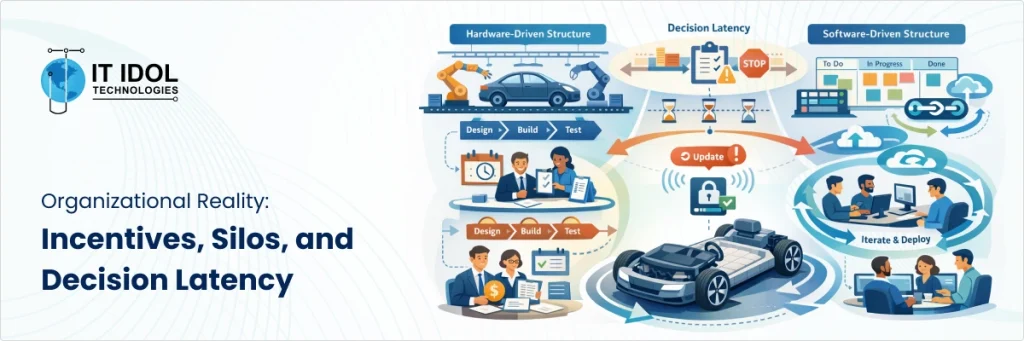
Organizational Reality: Incentives, Silos, and Decision Latency
Who Owns the Software?
One of the most tangible barriers in legacy enterprises is organizational incentive structures:
Mechanical and electrical engineering teams typically operate on fixed project cycles linked to production schedules.
Software teams operate on iterative cycles closer to SaaS delivery models, with continuous integration, testing, and deployment cadences.
These rhythms rarely align without intentional governance. Leaders often underestimate how deeply existing budget cycles, performance metrics, and incentive structures are tied to hardware rollouts rather than software agility.
The result? Decision latency. When a critical security patch or OTA update is needed, approvals get tangled in calendars designed for annual refresh cycles, not real-time risk mitigation.
For example:
Engineering leadership may hesitate to authorize rapid deployment of OTA updates due to compliance anxiety.
Finance may resist capitalizing on software capabilities that can’t be directly tied to discrete revenue events.
These dynamics create friction not because teams lack talent, but because organizational design has not kept pace with the architectural shift catalyzed by software-centric vehicles.
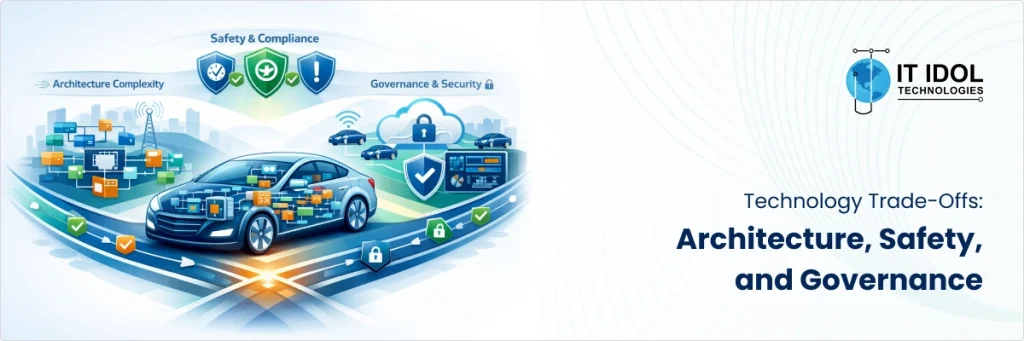
Technology Trade-Offs: Architecture, Safety, and Governance
Software Complexity and Risk
With hundreds of millions of lines of code running on a networked platform that controls safety-critical functionality, the stakes are not incremental; they are existential.
Software complexity drives:
Higher integration costs.
Increased testing and verification overhead.
Potential regulatory scrutiny focused on safety and cybersecurity.
Greater attack surface for threat actors.
From an enterprise architecture perspective, this demands explicit governance models that reconcile rapid feature delivery with deterministic safety obligations. This is not a problem solved by generic “agile” adoption; it requires domain-specific risk frameworks that understand automotive regulatory regimes and real-time operational liabilities.
In addition, OTA mechanisms, while powerful for agility, expand security responsibilities. Each vehicle on the road becomes a remote endpoint needing authentication, patch validation, telemetry analysis, and compliance tracking.
These are not abstract concerns. They are tangible decision levers requiring budget, talent investment, and coordinated policy development.
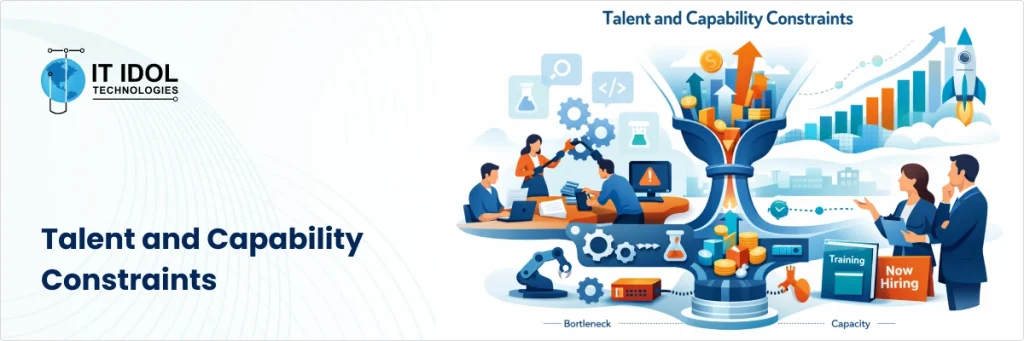
Talent and Capability Constraints
Where Expertise Is Today
There’s no shortage of software talent in the market. The real constraint is relevant automotive software expertise that understands both embedded systems and large-scale distributed computing.
Enterprise leaders need to recognize:
Talent pipelines focused on consumer mobile or web apps are not sufficient on their own. The safety, real-time processing, and hardware interface demands of automotive systems are unique.
Traditional automotive engineering teams often lack deep software development practices such as automated testing, telemetry-driven quality, and continuous delivery governance.
External partnerships (with cloud providers, OS vendors, and middleware specialists) can accelerate capabilities, but they introduce dependency risk and require strong vendor governance.
The workforce profile needed for success blends software engineering rigor with a deep understanding of controlled physical systems, and these professionals are rare.
This talent dimension has a cascading effect on operating model design, time-to-market, and risk management practices.
Competitive Consequences: Who Wins and Who Loses
Early Movers vs Legacy Friction
Companies with software DNA, whether emerging mobility firms, regional players with strong digital units, or OEMs that have aggressively restructured around software platforms, are better positioned to capture long-term value. In contrast, organizations that treat software as an afterthought face a structural disadvantage.
Competitive differentiation emerges from:
Ability to iterate on features and safety improvements after the vehicle leaves the factory.
Monetization of data, connected services, and software subscriptions.
Reduced total cost of ownership for fleet operators through predictive maintenance and data-led optimization.
These advantages are not merely technical; they are economic and organizational.
Enterprises that cling to traditional timelines where every capability is booked as a capital expense and amortized over years are likely to see slower growth relative to those that treat vehicles as living platforms with ongoing revenue opportunities.
Yet it’s equally risky to overstate the ease of this transformation. Many firms find themselves in a middle ground: legacy engineering practices juxtaposed with aspirational software unit goals. This hybrid state often yields inefficiencies, missed milestones, and unresolved governance challenges.
Reframing the Enterprise Decision Lens
If vehicles are fundamentally software products with wheels evolving continuously throughout their lifetime, then leaders must adjust how they think about value, risk, and operations:
Value measurement shifts: From discrete product sale revenue to lifetime software and service monetization.
Risk assessment expands: Including cybersecurity, OTA governance, data privacy obligations, and safety certification cycles.
Organizational design transforms: Beyond traditional mechanical engineering cultures to blended digital-physical delivery models.
Finance and operating models evolve: Prioritizing recurring revenue streams and long-term software platform investment.
This is not a binary choice between hardware and software. It’s a rebalancing of strategic emphasis recognizing that the long-term competitive frontier in the automotive world is defined by software capabilities, even as mechanical excellence remains necessary.
Closing Section: A New Lens for Car Leadership
Cars are no longer static machines assembled once and shipped. They are living, evolving software platforms that demand continuous governance, operational maturity, and strategic investment. This shift reframes traditional leadership questions: not “Will we build software?” but “How do we operationalize, govern, and extract value from software throughout a multi-year lifecycle?”
Leaders who adopt this lens will find themselves better aligned with market economics, enterprise risk profiles, and organizational incentives needed to compete in tomorrow’s mobility landscape. Those who cling to outdated mechanical metaphors risk misallocating capital, talent, and strategic focus on outcomes that no enterprise can afford in an era where software defines the product more than the vehicle that carries it.
FAQ’s
1. What does “software-defined vehicle” mean?
A car where key features, performance, and services are controlled, updated, and monetized through software platforms rather than fixed hardware alone.
2. Why does this matter for enterprise strategy?
Because software shifts where business value and operational risk reside from manufacturing cycles to continual delivery and governance.
3. Are vehicles truly generating recurring revenue?
Some OEMs now monetize software features and connected services post-sale, moving beyond one-time hardware revenue.
4. How big is the automotive software market?
Estimates vary, but forecasts place software-defined vehicle markets in the multi-trillion dollar range over the coming decade.
5. What are the main risks with vehicle software?
Cybersecurity, OTA update governance, safety validation, regulatory compliance, and complexity management are core risks.
6. Does this trend affect traditional OEMs?
Yes, legacy structures often clash with the agility and continuous development demands of software-centric vehicles.
7. What talent gaps should leaders expect?
A shortage of professionals blending embedded systems expertise with scalable software engineering practices.
8. How should finance teams rethink vehicle economics?
By accounting for future software revenue streams, OPEX patterns for updates, and long product lifecycles.
9. Is hardware engineering still important?
Absolutely, mechanical systems remain essential, but they no longer dominate the value equation.
10. What’s the biggest strategic shift for leaders?
Moving from project-based, one-time deliverables to product-centric thinking with ongoing operational, security, and governance considerations.
Parth Inamdar is a Content Writer at IT IDOL Technologies, specializing in AI, ML, data engineering, and digital product development. With 5+ years in tech content, he turns complex systems into clear, actionable insights. At IT IDOL, he also contributes to content strategy—aligning narratives with business goals and emerging trends. Off the clock, he enjoys exploring prompt engineering and systems design.