OTC parcel acceptance is operational infrastructure, not a simple POS feature
Fragmented hardware and workflows become scalability bottlenecks at volume
Purpose-built architecture improves reliability, compliance, and staff productivity
Real-time hardware integration eliminates manual errors and rework
Observability and environment control are essential for retail systems at scale
Parcel services have become a critical revenue and footfall driver for modern retail. From convenience stores to high-street outlets, Over-The-Counter (OTC) parcel acceptance is no longer an add-on; it’s a core operational function. Yet, as parcel volumes rise and service expectations tighten, many retailers discover that their existing systems were never designed for this level of complexity.
The challenge is not just booking a parcel. It’s the orchestration of hardware, workflows, service-provider integrations, and retail staff usability, all happening in real time at the counter. When any of these components fail to align, the result is operational drag, customer frustration, and hidden costs that scale with volume.
This is where purpose-built OTC parcel platforms, designed with hardware integration and retail realities in mind, begin to show measurable value.
The Core Operational Problem: Too Many Moving Parts, Not Enough Integration
At the counter, parcel acceptance looks deceptively simple. In practice, it involves a tightly coupled sequence of steps:
Capturing accurate parcel weight
Selecting the correct shipping service
Generating compliant labels
Printing reliably on retail-grade hardware
Booking parcels with carriers like Royal Mail
Handling stamps and ancillary sales
Logging transactions for audit and reconciliation
In many retail environments, these steps are fragmented across tools, manual inputs, or semi-integrated systems. Weight is read manually. Labels are printed via loosely coupled drivers. Booking happens through separate portals. Each handoff introduces friction and risk.
As parcel volumes grow, these inefficiencies compound. Staff spend more time correcting errors than serving customers. Hardware inconsistencies create support overhead. IT teams struggle to maintain stability across environments. What starts as a manageable process becomes a scalability bottleneck.
Why Generic POS and Parcel Tools Fall Short
Most traditional POS systems are optimized for transactions, not logistics. Parcel workflows demand a different design philosophy:
Real-time hardware communication, not post-hoc data entry
Asynchronous processing, to avoid UI freezes during hardware reads or API calls
Strict service-provider compliance, especially with carriers like Royal Mail
Operational resilience, even in constrained retail environments
Generic tools often treat hardware as an afterthought. In reality, scales, printers, and scanners are first-class citizens in OTC parcel workflows. Any solution that does not account for their behavior under real-world conditions, Bluetooth instability, USB serial variations, and device timeouts will fail under load.
Designing for the Retail Counter, Not the Demo Environment
A scalable OTC parcel platform must be designed for how retail actually works:
Staff with limited technical training
High throughput during peak hours
Mixed hardware estates across locations
Frequent environment switches between QA, pre-production, and live systems
This is where architecture and UX decisions become business decisions.
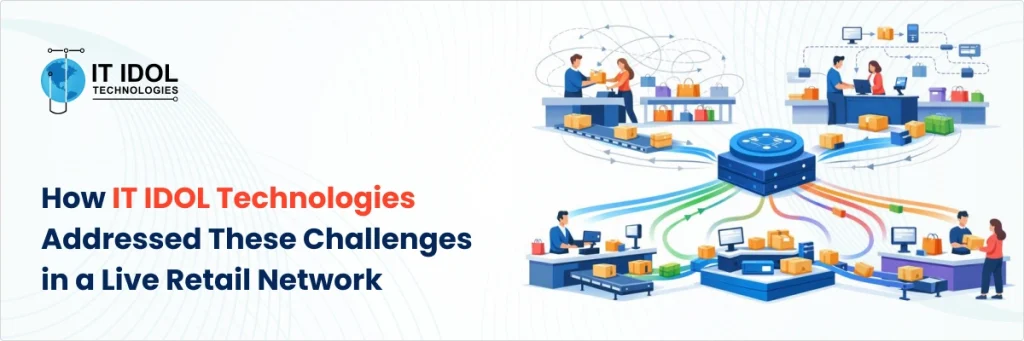
How IT IDOL Technologies Addressed These Challenges in a Live Retail Network
When modernizing OTC parcel operations, the objective wasn’t incremental improvement, it was operational reliability at scale. The solution had to work across thousands of retail locations, support diverse hardware, and integrate tightly with Royal Mail services, all while remaining intuitive for counter staff.
The result was PP.Parcels.OTCApp, a native Android application purpose-built for OTC parcel services and stamp sales.
Rather than layering features onto an existing POS, the application was designed from the ground up around parcel acceptance as a primary workflow.
Architecture Built for Stability and Change
At the foundation, the application uses MVVM (Model-View-ViewModel) architecture, enabling a clean separation between UI, business logic, and data handling. This choice wasn’t academic; it allowed the system to evolve as parcel services and hardware requirements changed.
Dependency management through Dagger Hilt ensured that components such as networking, logging, and hardware services could be injected, tested, and replaced independently. For enterprise retail systems, this translates directly into lower maintenance costs and safer updates.
To handle the inherently asynchronous nature of parcel workflows reading weights, generating labels, and calling carrier APIs the app leverages Kotlin Coroutines and Flow. This ensures that UI responsiveness is maintained even when hardware devices or network calls introduce latency.
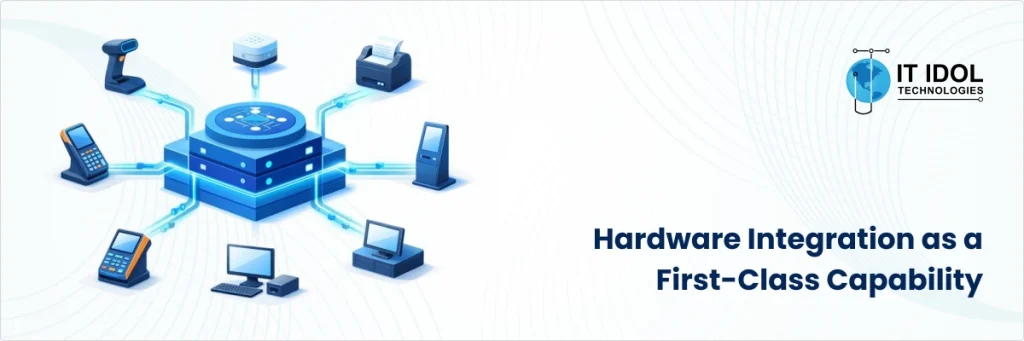
Hardware Integration as a First-Class Capability
One of the most critical success factors was treating hardware integration as core product functionality, not peripheral support.
Real-Time Weight Capture
The application integrates directly with USB scales, including Avery scales, using usb-serial-for-android and internal scale libraries. Weight data is read in real time, eliminating manual entry and reducing acceptance errors at the counter.
This alone removes a major source of downstream issues: incorrect pricing, rejected parcels, and reconciliation discrepancies.
Reliable Label Printing
Label printing is handled via Zebra ZSDK for Bluetooth printers and the Sunmi printer library for compatible devices. The system generates labels immediately after booking, with QR codes created using ZXing for tracking and verification.
By tightly coupling booking confirmation with printing, the solution ensures consistency between digital records and physical labels, an often-overlooked failure point in parcel workflows.
Carrier Integration Without Operational Friction
Royal Mail integration was not treated as a simple API connection. The parcel booking flow was designed to align with service requirements, ensuring that:
Service selection is accurate
Booking requests are validated before submission
Labels and tracking data are generated in compliant formats
This reduces the operational burden on retail staff and minimizes post-acceptance exceptions that typically require manual intervention.
Beyond Parcels: Supporting Retail Revenue Streams
OTC parcel services rarely operate in isolation. Stamp sales and inventory management are often handled at the same counter, by the same staff.
The Stamps module within Parcels.OTCApp allows retailers to manage stamp sales and inventory alongside parcel workflows. This unified approach reduces context switching and simplifies training, improving overall counter efficiency.
UI Designed for Real Retail Environments
A notable aspect of the solution is the dual-orientation UI design.
Both portrait and landscape modes are fully supported, with landscape offering a distinct layout optimized for high-volume operations. This is not a cosmetic feature it directly impacts speed and usability in busy retail settings where counter space, device mounting, and staff preference vary.
By adapting the UI to operational context rather than forcing a single layout, the application improves adoption and reduces friction at the point of use.
Enterprise-Grade Operations and Observability
Retail parcel systems must operate continuously, often with limited local IT support. To ensure resilience and visibility:
SonarQube and JaCoCo enforce code quality and test coverage
Azure Pipelines supports consistent CI/CD across environments
OTA updates via AppCenter enable controlled rollouts
PPLogSDK and Splunk integration ensure centralized logging and monitoring
Multi-environment support, Preprod, QA, and Production, with secure secrets management, allows changes to be tested safely before reaching live retail locations.
The Business Impact: What Changes When OTC Works Properly
The impact of a fully integrated OTC parcel platform is tangible:
Faster parcel acceptance through automated weighing and printing
Reduced errors and rework caused by manual inputs
Improved compliance with Royal Mail processes
Lower operational overhead from hardware-related failures
Better staff productivity at the counter
More importantly, the system scaled with demand without degrading performance or usability, something legacy approaches struggle to achieve.
What CIOs and Retail IT Leaders Should Take Away
The PP.Parcels.OTCApp engagement highlights several broader lessons for retail and logistics leaders:
1. OTC parcel workflows are infrastructure, not features
Treat them as mission-critical systems with appropriate architectural rigour.
If scales and printers aren’t reliable, nothing else matters.
3.UX decisions have operational consequences
Orientation, layout, and flow design directly affect throughput.
4. Observability is non-negotiable at scale
Logging, crash reporting, and environment control prevent small issues from becoming systemic failures.
Conclusion
Retail parcel management breaks down when systems are stitched together rather than designed as a whole. The complexity of OTC operations demands platforms that integrate hardware, workflows, and service providers into a single, reliable experience.
By delivering PP.Parcels.OTCApp, IT IDOL Technologies demonstrated how a purpose-built, hardware-aware Android application can transform OTC parcel services from a daily operational challenge into a scalable, dependable capability.
For retailers and logistics providers navigating rising parcel volumes and tighter service expectations, the message is clear: integration is not optional; it is the product.
FAQ’s
1. What problem was being faced with OTC parcel operations?
Existing OTC workflows relied on fragmented tools and manual steps. As parcel volumes grew, this caused errors, delays, and rising operational overhead at retail counters.
2. Why aren’t traditional POS systems suitable for OTC parcel workflows?
Most POS systems are designed for transactions, not logistics. They lack real-time hardware integration, asynchronous processing, and carrier-compliant workflows required for parcel acceptance.
3. What makes OTC parcel operations technically complex?
OTC parcel acceptance involves coordinated hardware communication, carrier integrations, label generation, compliance checks, and staff usability, all in real time at the counter.
4. How did PP.Parcels.OTCApp improve counter efficiency?
The application automated weight capture, service selection, booking, and label printing. This reduced manual input, sped up transactions, and lowered error rates for retail staff.
5. Why was native Android chosen for the solution?
Native Android allowed deep integration with retail hardware such as USB scales and Bluetooth printers, ensuring performance, stability, and device-level control in real environments.
6. How did hardware integration impact business outcomes?
Treating hardware as a first-class capability eliminated common failure points like incorrect weights, printing errors, and reconciliation issues that typically scale with volume.
7. What role did architecture play in scalability?
MVVM architecture, dependency injection, and asynchronous processing enabled safe updates, improved maintainability, and consistent performance across large retail networks.
8. How was Royal Mail integration handled differently?
Royal Mail workflows were embedded into the parcel flow itself, ensuring service selection, validation, booking, and label generation met compliance requirements by design.
9. Why is observability critical in retail parcel systems?
With limited on-site IT support, centralized logging, crash reporting, and controlled rollouts prevent small issues from becoming widespread operational failures.
10. What should CIOs and retail IT leaders learn from this case?
OTC parcel platforms must be designed as integrated systems. Hardware reliability, UX decisions, and operational visibility directly determine scalability and business performance.