Dedicated teams exist to reduce enterprise decision latency, not just to increase delivery speed.
Acceleration comes from isolating execution from shared-capacity friction while keeping platform guardrails intact.
The real constraint is rarely technology; it is governance, funding logic, and incentives.
Enterprises fail when dedicated teams become exceptions instead of a repeatable operating model.
Sustainable acceleration requires leaders to trade short-term control for long-term learning velocity.
Speed is Not Missing; Coherence is
Large enterprises are not short on ambition. They are also not short on investment. What they lack, increasingly, is coherence between intent and execution.
In boardrooms and steering committees, leaders talk about speed, responsiveness, and adaptability as strategic imperatives. Yet the mechanisms they rely on centralized prioritization, shared delivery pools, and annual funding cycles were designed for stability, not momentum.
The result is a persistent contradiction: enterprises demand acceleration while reinforcing structures that slow decisions down.
Dedicated teams emerge in this context not as a trend, but as a structural response to organizational drag. They are often introduced quietly, sometimes defensively. A critical initiative is falling behind.
A business unit is frustrated. A competitor is moving faster. Leadership authorizes a ring-fenced team, shields it from normal allocation processes, and gives it a mandate to “just get it done.”
What happens next determines whether dedicated teams become a durable advantage or an expensive anomaly.
At their best, dedicated teams reduce decision latency, compress feedback loops, and create visible progress where shared models stall.
At their worst, they create fragmentation, resentment, and cost without lasting capability.
Understanding why the outcomes diverge requires stepping away from delivery mechanics and examining how large enterprises actually operate under pressure.
The Real Bottleneck in Enterprise Execution
Most enterprise leaders assume execution slows because teams are overloaded or skills are scarce. In reality, the more common bottleneck is distributed decision-making.
In large organizations, ownership is fragmented by design. Business units own outcomes. IT owns platforms. Security owns risk. Finance owns spending. Architecture owns standards. Each function is rational in isolation.
Together, they create a delay. Shared delivery models amplify this effect. Teams juggle multiple initiatives. Priorities shift weekly. Decisions escalate because no single group has full authority. Even small trade-offs require alignment across functions with competing incentives.
Over time, velocity decays. Not because people are ineffective, but because every decision carries a coordination cost.
Dedicated teams are an attempt to rebalance this equation. By assigning a stable team to a bounded mission, enterprises collapse multiple decision paths into a single execution boundary. Trade-offs are resolved within the team rather than negotiated externally.
Shared delivery models persist for good reasons. They maximize utilization. They enable knowledge sharing. They provide flexibility in resource allocation. At a moderate scale, these benefits outweigh the costs.
Problems emerge as complexity grows.
As portfolios expand, shared teams spend more time context-switching than executing. Backlogs become political artifacts. Long-term work is constantly interrupted by urgent requests. Engineers optimize for responsiveness rather than outcomes.
The hidden cost is not inefficiency, but decision churn. Work restarts repeatedly. Assumptions are revisited. Momentum resets.
Dedicated teams trade utilization efficiency for continuity. Work progresses even when priorities elsewhere change. Learning accumulates instead of being lost between sprints.
This trade-off becomes attractive when:
The initiative is revenue-adjacent or customer-facing
Time-to-learning matters more than resource efficiency
The cost of delay exceeds the cost of redundancy
Enterprises that fail to articulate these conditions upfront often deploy dedicated teams inconsistently and then struggle to defend them.
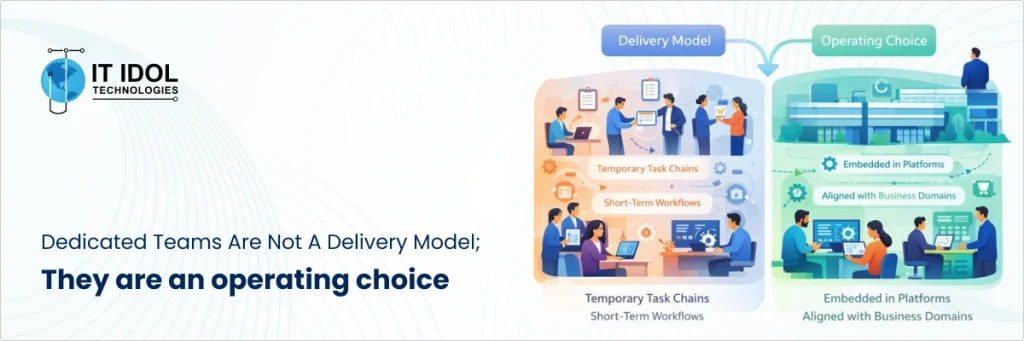
Dedicated Teams are not a Delivery Model; They are an Operating Choice
One of the most common mistakes is treating dedicated teams as a delivery construct rather than an operating model intervention.
A team can be dedicated in name and still constrained by shared governance, centralized funding approvals, or architectural ambiguity. In those cases, the benefits evaporate quickly.
What differentiates effective dedicated teams is not isolation from the organization, but clarity of mandate.
Effective teams have:
Explicit business outcomes they own
Authority to make day-to-day trade-offs
Stable funding for a defined horizon
Clear integration points with shared platforms
Without these conditions, dedicated teams become little more than rebranded project teams.
From a finance perspective, dedicated teams often look inefficient. Monthly burn is visible. Idle time is measurable. Utilization drops below theoretical maxima. But this visibility reveals something important: the true cost of indecision.
In shared models, costs are diffused. Projects stretch. Teams wait. Work is reprioritized without closure. Spend continues without progress. Dedicated teams make costs explicit and time-bound.
Leaders can see exactly what an initiative consumes and what it produces. This clarity supports better portfolio decisions, even when individual initiatives appear expensive.
The mistake many enterprises make is demanding traditional ROI metrics too early. Dedicated teams generate value through learning, not just delivery. Their early returns show up as:
Faster validation of assumptions
Earlier identification of constraints
Reduced rework downstream
These benefits compound, but only if leaders are willing to recognize them as legitimate returns.
Why Sourcing Decisions Matter Less than Incentive Design
Large enterprises deploy dedicated teams in multiple forms: internal, external, and hybrid. Outcomes vary widely, but not for the reasons most leaders expect.
The decisive factor is not who employs the team, but how success is defined. When teams are measured on activity, they optimize for throughput.
When they are measured on outcomes, they optimize for impact. Traditional vendor contracts rarely support the latter.
Hybrid teams introduce additional complexity. Cultural mismatches surface quickly. Internal staff may feel displaced. External teams may lack context. These tensions do not resolve themselves.
Perhaps the most underappreciated aspect of dedicated teams is their diagnostic value. They surface organizational constraints that strategy documents often ignore.
They make governance friction visible. They expose where incentives are misaligned. When dedicated teams struggle, it is rarely because the team is ineffective. It is because the surrounding system cannot absorb speed.
This is uncomfortable, but valuable. Enterprises that learn from these signals improve their operating models.
Those who suppress them cycle through teams without progress. Dedicated teams do not create dysfunction. They reveal it.
Platform Ambition Meets Execution Reality
The Platform Paradox: Dedicated Teams Must Navigate
Every large enterprise claims to be building platforms. Fewer are honest about how those platforms actually behave under delivery pressure.
Platforms promise reuse, consistency, and scale. Dedicated teams promise speed, focus, and momentum. When these promises collide, leaders often frame the conflict as a failure of discipline: teams are moving too fast, or platforms are too rigid.
In reality, the tension is structural.
Platforms centralize decisions to protect coherence. Dedicated teams decentralize decisions to protect flow. Both are rational responses to different risks. Problems arise when enterprises fail to define where central authority ends and team autonomy begins.
Without that clarity, dedicated teams either stall waiting for approvals or bypass platforms entirely. In both cases, acceleration is short-lived.
Why Platforms Slow Teams Down, and Why That’s Not Accidental
Platforms’ slow deliveryis because they are designed to. They encode standards, controls, and assumptions intended to protect the enterprise over time. Security baselines, data models, integration patterns, and cost controls exist for good reasons.
The mistake leaders make is assuming that these controls are equally relevant in every context.
When platforms apply the same level of rigor to exploratory work as they do to regulated production systems, decision latency explodes.
Dedicated teams feel constrained not because they reject standards, but because the standards are miscalibrated to the stage of work.
This differentiation rarely exists formally. Instead, it lives in the heads of senior architects and platform leads, which makes it inaccessible to teams under delivery pressure.
Dedicated teams accelerate fragmentation only when platform intent is implicit rather than explicit.
Cloud and Automation: Enablers, Not Accelerators by Default
Cloud platforms are often cited as the reason enterprises can move faster. In practice, cloud only accelerates organizations that have already addressed operating model friction.
Without automation, self-service, and clear guardrails, the cloud simply moves bottlenecks elsewhere. Teams wait for account provisioning instead of hardware. They debate cost allocation instead of capacity planning. The medium changes. The delay does not.
Dedicated teams benefit from the cloud when it provides:
Fast environment provisioning
Clear cost boundaries
Standardized deployment paths
Observable operational behavior
These capabilities reduce dependency on central teams without removing oversight. They allow teams to act within constraints rather than negotiate them repeatedly.
Enterprises that invest in cloud infrastructure but not in platform usability often see dedicated teams bypass central platforms entirely. This is not rebellion. It is a rational response to friction.
Architectural Guardrails: Freedom Through Constraint
One of the most effective ways enterprises support dedicated teams is by investing in clear architectural guardrails.
Guardrails significantly differ from standards. Standards describe what is preferred. Guardrails describe what is allowed and why.
Effective guardrails are:
Few in number
Explicitly tied to risk
Enforced automatically where possible
Exception-friendly but not exception-free
They allow teams to move quickly without constant approval while preserving enterprise coherence.
Where guardrails are vague, teams waste time interpreting intent. Where they are excessive, teams route around them. In both cases, learning slows.
Dedicated teams thrive when architecture is treated as a product, not a rulebook.
Fragmentation is a Leadership Failure, Not a Team Failure
When leaders complain that dedicated teams create fragmentation, they are often describing the consequences of unclear platform strategy.
Fragmentation emerges when:
Platforms lack clear ownership
Roadmaps are aspirational rather than executable
Trade-offs are avoided rather than resolved
Exceptions are punished rather than managed
In such environments, dedicated teams optimize locally because no one is optimizing globally in a way they can trust.
This is why some enterprises see dedicated teams as destabilizing while others see them as catalysts. The difference lies not in team behavior, but in platform leadership maturity.
Dedicated teams do not undermine platforms. Weak platforms undermine themselves.
The Sequencing Problem Most Enterprises Ignore
A critical but rarely discussed issue is when dedicated teams should be deployed.
Enterprises often introduce them either too early or too late.
Too early, and teams amplify chaos. Foundational systems are unstable. Integration paths are unclear. Teams spend more time compensating for missing infrastructure than delivering value.
Too late, and teams struggle to regain momentum. Operating models have calcified. Decision rights are entrenched. Cultural resistance is higher.
Dedicated teams are most effective when:
Core platforms are stable but evolving
Automation exists, but is uneven
Governance structures are under strain
Market or internal pressure demands faster learning
This middle phase is uncomfortable. It is also where acceleration matters most.
Leaders who treat dedicated teams as a permanent end state miss their real value. They are a transitional mechanism, a way to move the enterprise from rigid coordination to adaptive flow.
How Dedicated Teams Change the Role of Central Functions
As dedicated teams proliferate, central teams often feel threatened. Their influence appears to diminish. Their approval power erodes.
In mature enterprises, the opposite happens.
Central functions shift from decision-makers to capability providers. They invest in:
Better platforms
Clearer guidance
Stronger automation
Faster exception handling
Their success is measured not by control exercised, but by friction removed.
This shift is difficult. It requires new skills and new incentives. It also requires leaders to defend central teams when their value becomes less visible.
Dedicated teams expose whether central functions are optimized for control or for enablement. Only one of those scales.
Acceleration without Coherence is Just Speed
The most dangerous outcome is not slow delivery. It is fast delivery that creates long-term drag.
Dedicated teams that move quickly without platform alignment generate technical debt, cost volatility, and integration risk. Dedicated teams that move slowly under excessive constraint generate frustration and disengagement.
The balance lies in intentional constraint.
Acceleration becomes sustainable only when enterprises decide explicitly what they are willing to trade in the short term to protect long-term capability.
Dedicated teams force that decision into the open.
Governance, Money, and People: Where Acceleration is Won or Lost
Governance Does Not Disappear; It Changes Shape
When dedicated teams are introduced, governance is often blamed for slowing them down. The instinctive response is to “lighten” controls or bypass formal oversight altogether. That approach rarely ends well.
Traditional enterprise governance optimizes for predictability. Decisions are front-loaded. Risk is assessed before work begins. Approval is binary. This works reasonably well when requirements are stable and change is incremental.
Dedicated teams operate in a different reality. Learning unfolds during execution. Assumptions evolve. Risk changes shape over time. Governance that insists on certainty upfront either blocks progress or becomes irrelevant.
High-performing enterprises shift governance to focus on:
Direction rather than prescription
Trajectory rather than checkpoints
Risk visibility rather than risk avoidance
This means leaders ask different questions. Not “Is this fully defined?” but “What did we learn since the last review?” Not “Did you follow the standard?” but “What trade-off did you make, and why?”
Where this shift does not happen, dedicated teams spend more time preparing justification than delivering outcomes.
In shared models, everything appears partially funded and perpetually in progress. It is difficult to stop initiatives because capacity is diffuse and accountability is blurred. Dedicated teams make allocation explicit.
A team is either funded or it is not. An initiative either progresses or stalls visibly. This clarity exposes weak bets quickly.
For senior leaders, this is both valuable and unsettling. It removes the illusion that all priorities can move forward simultaneously.
Enterprises that benefit from dedicated teams treat them as portfolio instruments, not delivery units. Each team represents a bet with a clear hypothesis:
What outcome are we pursuing?
What assumptions must hold?
How long are we willing to invest before reassessing?
Funding decisions become reversible. Stopping work becomes a signal of discipline, not failure.
Where leaders cling to annual funding cycles and sunk-cost logic, dedicated teams become politically difficult to unwind, and acceleration stalls.
ROI Realism: Why Finance Scepticism is Often Justified
CFO scepticism toward dedicated teams is not irrational. Many initiatives promise speed and deliver complexity. The issue is not financial rigor, but misapplied metrics.
Enterprises that align finance with acceleration adjust how success is evaluated:
Early stages emphasize learning milestones, not financial return
Mid stages assess trajectory against strategic intent
Later stages measure impact, scalability, and sustainability
This staged approach requires trust and transparency. Teams must surface bad news early. Leaders must resist the urge to demand certainty where none exists.
When finance insists on premature ROI, teams optimize for optics rather than insight. Acceleration becomes performative.
Talent: The Constraint That Never Disappears
Dedicated teams consume talent. At scale, this becomes a hard limit.
Enterprises quickly discover they cannot dedicate teams to everything. Choices must be made. Strategic initiatives receive focus. Others slow down or stop.
This forces prioritization in a way shared models often avoid. It also introduces a risk: talent concentration.
When the most capable people gravitate toward dedicated teams, shared platforms can stagnate. Institutional knowledge becomes uneven. Career paths narrow.
Leading enterprises mitigate this through deliberate capability diffusion:
Rotating staff in and out of dedicated teams
Codifying learnings into shared practices
Investing in internal communities of practice
Rewarding platform contribution, not just delivery speed
Without these mechanisms, dedicated teams create a two-speed organization that undermines long-term resilience.
Incentives Quietly Shape Acceleration Outcomes
Perhaps the most overlooked factor is incentives.
Enterprises often declare that speed matters, but reward behaviors that reinforce caution. Leaders ask teams to move fast, then penalize them for deviating from plans. They celebrate innovation rhetorically, but promote those who avoid visible risk.
Dedicated teams amplify these contradictions.
When incentives reward activity rather than outcomes, teams deliver volume without impact. When incentives reward certainty rather than learning, teams hide uncertainty until it is too late.
Acceleration becomes sustainable only when:
Leaders visibly support prudent risk-taking
Learning is valued alongside delivery
Teams are not punished for informed course correction
This is less about formal performance management and more about what leaders tolerate and reward in practice.
Why Do Some Organisations Abandon Dedicated Teams
Many enterprises try dedicated teams once and retreat.
The stated reasons vary: cost, complexity, and cultural mismatch. The underlying cause is often the same. Dedicated teams surfaced tensions that leadership was unwilling to resolve.
They exposed slow decision-making. They highlighted weak platform foundations. They challenged entrenched power structures.
Rather than address these issues, organizations revert to familiar models. The symptoms disappear. The underlying constraints remain.
Dedicated teams are not fragile. Organizational denial is.
Acceleration Requires Coherence, Not Heroics
By this stage, a pattern should be clear.
Dedicated teams do not create acceleration by working harder or smarter in isolation. They create acceleration by forcing coherence between strategy, governance, platforms, finance, and incentives.
Where that coherence exists, teams move quickly and safely. Where it does not, teams either stall or create long-term drag.
The lesson is not that dedicated teams are universally right. They must reveal whether an enterprise is structurally capable of moving faster.
When Acceleration Sticks and When it Quietly Collapses
The Predictable Failure Modes Leaders Underestimate
By the time dedicated teams are labeled a failure, the causes are usually well established.
Teams were launched with urgency but without clarity. Sponsorship was visible at kickoff and absent thereafter.
Governance rituals existed, but decision rights remained ambiguous. Integration with core platforms was deferred in the name of speed. Costs accumulated faster than confidence.
None of this is surprising.
Dedicated teams amplify whatever already exists in the organization. If priorities are unstable, teams thrash. If ownership is symbolic, teams escalate endlessly.
If platforms are brittle, teams work around them. Acceleration collapses not because the model is flawed, but because the surrounding system cannot sustain it.
The most dangerous failure mode is not an obvious dysfunction. It is apparent that masks long-term drag.
Teams deliver quickly. Leaders celebrate velocity. But architectural shortcuts accumulate. Operational costs rise quietly. Integration complexity increases.
Six months later, the organization is moving faster and becoming harder to change.
This is why some enterprises associate dedicated teams with chaos. What they are observing is not speed, but unpriced trade-offs.
Second-order Consequences: Few Organizations Plan for
Dedicated teams change how power flows through the organization. Decision-making shifts closer to execution. Central functions lose gatekeeping authority. Business units gain visibility into technical trade-offs.
These shifts have consequences. Some leaders feel exposed. Others feel sidelined. Established escalation paths weaken. Informal influence becomes more visible than formal roles.
Organizations that fail to acknowledge these dynamics often experience subtle resistance. Standards are enforced selectively. Dependencies are delayed. Teams are starved of support without overt obstruction.
Acceleration stalls not through confrontation, but through quiet friction.
Enterprises that sustain dedicated teams anticipate these second-order effects. They reset expectations explicitly. They redefine the role of central teams. They invest in leadership alignment, not just delivery mechanics.
Acceleration is as much a political exercise as a technical one.
Competitive Differentiation Emerges from Learning, Not Velocity
The most mature enterprises eventually stop talking about speed altogether. What differentiates them is not how fast they deliver features, but how quickly they convert execution into insight.
Dedicated teams matter because they compress feedback loops. They surface customer signals earlier. They reveal operational constraints before they calcify.
This learning advantage compounds.
Competitors can copy tools, hire talent, and adopt frameworks. They struggle to copy organizations that learn faster than they do.
Dedicated teams create the conditions for this advantage, but only when learning is absorbed beyond the team. When insights remain local, acceleration benefits dissipate.
This is why leading enterprises invest as much in knowledge diffusion as in delivery capacity. They treat dedicated teams as sensing mechanisms, not just production units.
The Leadership Mindset Acceleration Demands
Sustainable acceleration requires leaders to abandon comforting illusions.
The illusion that all initiatives can progress simultaneously. The illusion that certainty can precede action. The illusion that control and speed can be maximized at the same time.
Dedicated teams force leaders to confront trade-offs explicitly. They make prioritization unavoidable. They surface the cost of indecision.
They reveal where governance protects comfort rather than outcomes. Leaders who succeed with dedicated teams do not micromanage them. Nor do they romanticize autonomy.
They provide direction, protect boundaries, and intervene decisively when structural issues surface.
Most importantly, they treat acceleration as an organizational capability, not a delivery tactic.
Why Dedicated Teams are a Test, Not a Solution
In the end, dedicated teams are less interesting than what they reveal.
They test whether an enterprise can:
Allocate capital decisively
Grant authority with accountability
Balance platform coherence with execution speed
Learn faster than it delivers
Some organizations pass this test and embed acceleration into how they operate. Others retreat to familiar models, convinced that speed is incompatible with scale.
The difference is not ambition. It is a willingness to confront structural reality. Dedicated teams do not make enterprises fast.
They make enterprises honest about what slows them down. And for those prepared to act on that honesty, acceleration stops being episodic and starts becoming durable.
Shared models optimize utilization, not speed. Dedicated teams reduce coordination overhead and decision latency, which are the real bottlenecks at enterprise scale.
Dedicated teams persist beyond projects. They own outcomes over time, not just delivery milestones, enabling faster learning and compounding execution gains.
Leaders must move from optimizing control and predictability to optimizing learning speed and decision quality across the enterprise.
Deval Rathod
Founder & CEO
|
Deval Rathod is the Founder and CEO of IT IDOL Technologies, a custom software development company. With over a decade of experience in software engineering, solution architecture, and technology leadership, she has worked across custom software development, enterprise applications, AI & ML, and digital transformation. Her expertise includes guiding technology teams, designing scalable software solutions, and helping businesses evaluate and implement emerging technologies. She contributes insights on software engineering, artificial intelligence, enterprise technology, and digital transformation.