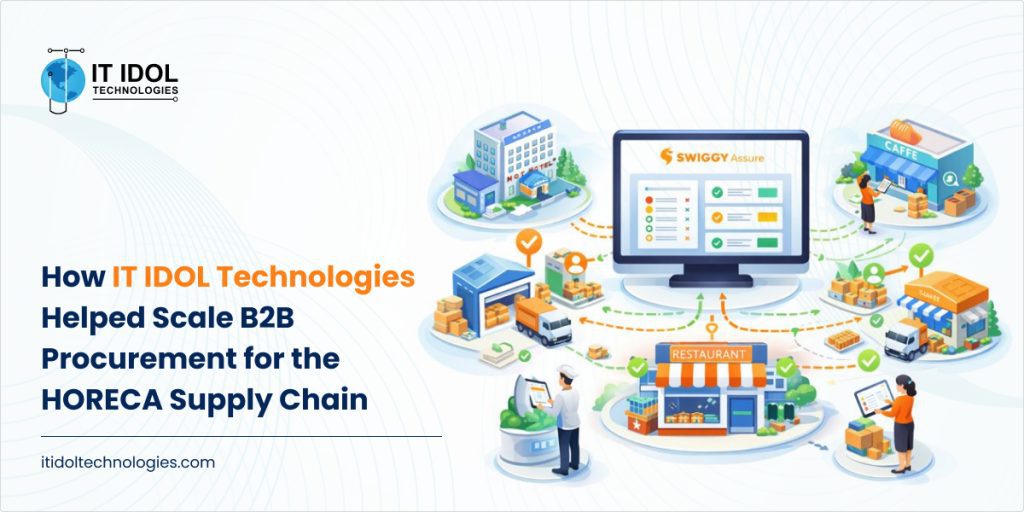
A rapidly growing B2B procurement platform addresses the operational complexity of food sourcing for hotels, restaurants, and caterers.
Scaling required backend systems optimized for reliability rather than consumer-style traffic growth.
High-frequency ordering, perishable inventory, and logistics coordination shaped architectural decisions.
IT IDOL Technologies contributed to building a cloud-native, low-latency backend foundation that enabled predictable performance at city scale.
In food service operations, procurement is not a background function. It determines whether kitchens open on time, menus remain consistent, and margins stay predictable. Unlike consumer marketplaces, B2B food procurement operates under tight operational constraints where reliability matters more than browsing experience or promotional incentives.
A dedicated B2B procurement platform was built to address this challenge for hotels, restaurants, and caterers by connecting them directly with local suppliers and integrating fulfillment within the same workflow. As adoption increased across a major metropolitan market, the challenge shifted from marketplace access to system resilience and operational continuity.
Scaling B2B procurement is not about handling more users; it is about handling more responsibility per transaction. Every order represents a real-world operational dependency. A backend delay does not inconvenience a user; it disrupts a kitchen.
IT IDOL Technologies played a key role in strengthening the backend architecture to support this transition from growth to dependable scale.
The Nature of the Problem: B2B Scale Is Not B2C Scale
B2B ordering behavior differs fundamentally from consumer purchasing patterns. Restaurants place frequent, recurring orders based on predictable consumption cycles. Quantities are higher, delivery windows are narrow, and substitutions have operational consequences.
As platform usage expanded, backend systems had to support:
High-frequency ordering without duplication or race conditions
Accurate, fast-changing inventory across multiple local suppliers
Tight logistics coordination for early-morning and same-day deliveries
Traditional e-commerce architectures, optimized for discovery and checkout flows, struggle in this context. The system required determinism, consistency, and fault tolerance not just throughput.
IT IDOL Technologies helped realign backend architecture around these operational priorities.
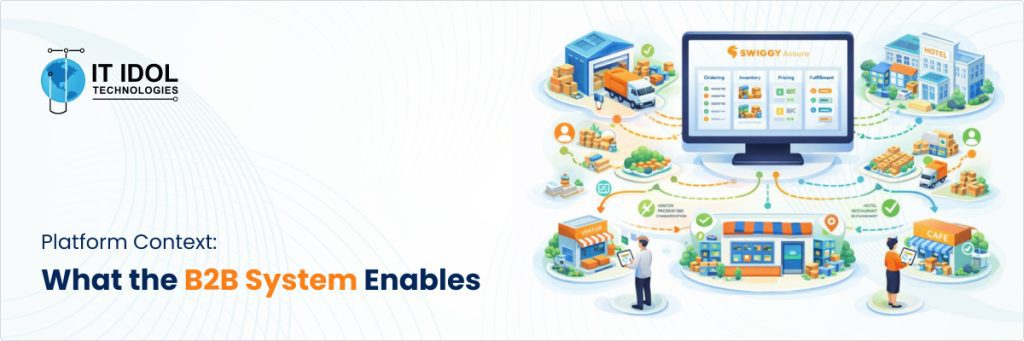
Platform Context: What the B2B System Enables
The platform enables HORECA businesses to procure vegetables, fruits, dairy products, pulses, and packaged goods from local suppliers through a unified interface. The core promise is operational simplicity: consolidated sourcing, transparent availability, and dependable delivery.
Fulfillment is managed through an integrated logistics partner, bringing delivery execution directly into the procurement lifecycle. This creates a tightly coupled operational model where backend services must synchronize supplier availability, order processing, and dispatch coordination without latency or inconsistency.
IT IDOL Technologies focused on ensuring that these dependencies remained synchronized under load.
Why Backend Architecture Became the Critical Constraint
At scale, backend limitations surface in subtle but costly ways:
Inventory mismatches cause last-minute substitutions
Slow confirmations disrupt kitchen planning
Logistics misalignment results in delayed deliveries
To prevent these failures, backend architecture had to achieve three outcomes simultaneously:
1. Consistent order processing during peak ordering windows
2. Accurate inventory representation for perishable goods
3. System stability even when downstream logistics systems experience delays
IT IDOL Technologies approached this by prioritizing resilience over convenience in architectural design.
Backend Technology Foundation
The backend stack was designed around performance predictability and operational clarity.
Java and Go services handled high-throughput workloads with stable latency.
Spring Boot enabled a modular service architecture for controlled evolution.
AWS provided elastic infrastructure to absorb demand fluctuations.
DynamoDB supported low-latency access to order and inventory data with horizontal scalability.
The focus was not on experimental tooling but on selecting technologies that behave reliably under sustained operational pressure.
IT IDOL Technologies ensured these components were integrated within a cohesive, fault-tolerant system architecture.
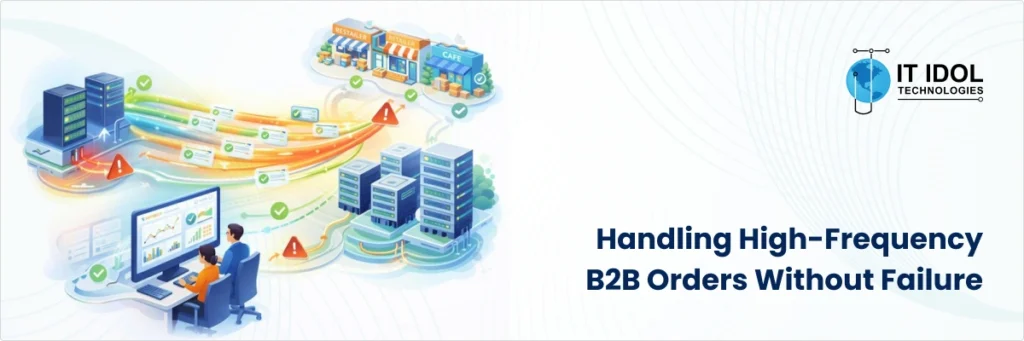
Handling High-Frequency B2B Orders Without Failure
Restaurants reorder frequently, adjust quantities, and expect immediate confirmation. Backend services were structured to ensure:
Idempotent order creation to prevent duplication during retries
Explicit and traceable order state transitions
Asynchronous fulfillment workflows are decoupled from order placement
This design allowed the system to handle bursts of concurrent activity without locking resources or introducing cascading delays. IT IDOL Technologies optimized these flows to maintain transactional integrity even under peak demand.
Inventory Accuracy in a Fresh Goods Supply Chain
Inventory in food procurement changes hourly. Backend services were built to support near real-time updates and supplier-specific availability constraints. Data models minimized centralized bottlenecks while maintaining consistency where required.
By refining data access patterns and reducing unnecessary cross-service dependencies, IT IDOL Technologies helped maintain responsive inventory behavior even as supplier and SKU counts scaled.
Logistics Coordination Without Tight Coupling
Because fulfillment is deeply integrated into procurement workflows, backend systems had to tolerate logistics delays and partial failures. Instead of tightly binding ordering to delivery execution, workflows were designed with asynchronous state handling and clearly defined lifecycle stages.
This separation reduced operational risk and improved delivery reliability across the city-scale deployment.
IT IDOL Technologies implemented this decoupled architecture to ensure resilience across interdependent systems.
Building for Stability, Not Just Growth
In B2B procurement, downtime is not a minor inconvenience; it directly affects business operations.
The backend architecture emphasized:
Stateless services
Fault-tolerant data access
Cloud-native deployment patterns
Horizontal scalability with rapid recovery
These decisions ensured that growth did not compromise predictability. IT IDOL Technologies helped embed stability as a design principle rather than a reactive measure.
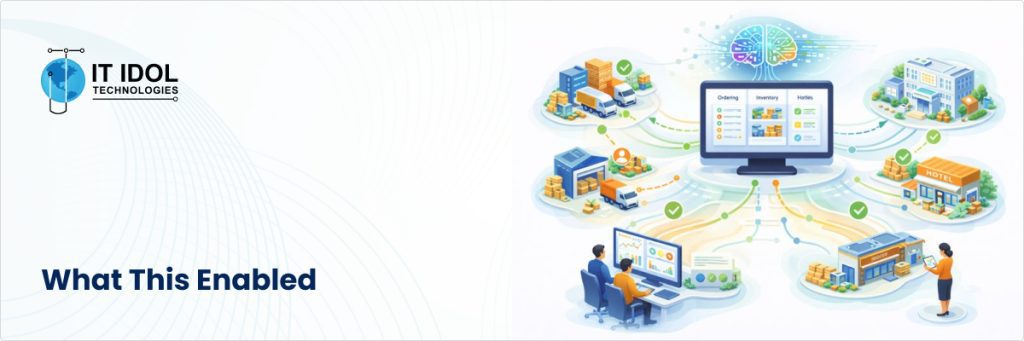
What This Enabled
With a resilient backend foundation in place, the platform supported expanding adoption across the HORECA ecosystem while maintaining operational reliability. Order consistency improved, inventory-related disruptions decreased, and supplier-logistics coordination strengthened.
Backend engineering evolved from a support function into a direct contributor to service quality and trust.
Reliability Is the Real Product in B2B Platforms
The evolution of this procurement platform highlights a core principle of operational marketplaces. User interfaces and pricing attract customers, but backend reliability retains them. In food service procurement, every transaction carries real-world consequences.
Scalable backend systems are not merely infrastructure; they are the product itself. By strengthening architectural resilience, IT IDOL Technologies enabled a B2B platform to scale without compromising the operational continuity of the businesses it serves.
FAQ’s
1. What is a B2B HORECA procurement platform?
It is a digital system that allows hotels, restaurants, and caterers to source kitchen essentials directly from suppliers with integrated logistics support.
2. How is B2B procurement different from B2C food delivery?
B2B procurement involves repeat high-volume orders, strict delivery schedules, and strong operational dependency, making reliability more critical than convenience.
3. Why is backend reliability critical in HORECA platforms?
Backend failures can delay kitchen operations, disrupt service hours, and directly impact revenue.
4. What challenges arise when scaling B2B supply chains?
Common challenges include supplier coordination, inventory accuracy, logistics synchronization, and maintaining stability during peak ordering windows.
5. How does IT IDOL Technologies support platform scalability?
Through resilient backend architecture, API optimization, asynchronous workflows, and cloud-native infrastructure design.
6. Why is inventory synchronization complex in food procurement?
The platform uses near real-time inventory updates and supplier-specific constraints to reflect availability accFresh goods availability changes frequently, requiring near real-time updates without compromising system performance.
7. What technologies support scalable B2B backend systems?
Common stacks include Java, Go, Spring Boot, AWS infrastructure, and scalable NoSQL databases like DynamoDB.
8. How are high-frequency orders handled reliably?
Using idempotent order processing, explicit state management, and asynchronous fulfillment workflows.
9. Why must logistics integration be decoupled?
Decoupling prevents delays or partial failures in delivery systems from disrupting order processing.
10. What is the key takeaway for B2B platform builders?
In operational supply chains, backend reliability is the foundation of trust, scalability, and long-term platform success.