Artificial Intelligence (AI) promises a lot: automation, efficiency gains, predictive power, and competitive advantage. Yet, despite the hype and investments, many AI initiatives fail to deliver meaningful value.
Organizations struggle to move beyond pilot proofs-of-concept (PoCs), projects are abandoned mid-way, or deployed systems degrade quickly or remain unused.
Understanding why AI projects fail and how to prevent that is essential for any company planning to leverage AI.
In this article, we’ll unpack the root causes of failure, analyze empirical data and real-world case studies, and provide strategic, actionable guidance to improve the odds of success.
What the Data Says: AI Failure Rates and the Scale of the Problem
Before we dive into causes and remedies, it helps to appreciate just how common failure is. Several recent studies and industry surveys show a high failure rate for AI projects:
One source estimates that 70 %–85 % of AI projects either fail, are abandoned, or never reach full-scale production deployment.
A survey of enterprise AI projects between 2023–2025 concluded that 70 % of projects get blocked by data infrastructure issues, while 35 % stall in production due to governance failures.
Some high-profile reports claim up to 95 % of generative AI pilots fail to produce measurable business results, with only 5 % achieving rapid revenue growth or productivity gains.
These numbers underline a stark reality: failure is more common than success when it comes to enterprise AI, often due not to the technology itself, but the surrounding organizational, strategic, and operational context.
Root Causes: Why AI Projects Collapse
Based on research, industry analyses, and practitioners’ experiences, the causes of AI project failure are multifaceted. Below are the most recurrent and impactful reasons, along with concrete examples and how they manifest in real projects.
1. Undefined or Misaligned Business Objectives
Problem: Many AI initiatives begin not with a business need, but with enthusiasm for AI technology itself. Without well-defined goals, KPIs, or ROI metrics, projects lack focus and purpose.
Some organizations attempt AI “because everyone else is doing it,” not because there is a concrete problem to solve. This phenomenon, sometimes likened to “AI as a checkbox,” often sets projects up to drift or stagnate.
With no clear success criteria (e.g., reduce call-center resolution time by 30%, increase sales conversions by 15 %, detect fraud with 95 % precision), teams find it hard to measure or justify value. As one review notes, lack of clear objectives is a top-level failure reason.
Impact: Projects become unfocused, resources are wasted, and eventually, leadership loses interest. AI becomes a “nice to have” rather than a strategic driver.
Takeaway: Always begin AI initiatives with a well-defined business problem and measurable success criteria. Ask: What business outcome do we expect? How will we know if AI is delivering value?
2. Poor Data Quality, Governance & Infrastructure
Problem: AI models need high-quality, well-governed data. Many organizations underestimate the complexity, effort, and infrastructure needed. Common data-related pitfalls include:
Lack of data governance (versioning, lineage tracking, data quality enforcement)
Inadequate pipelines for ingestion, transformation, and maintenance
This “garbage in, garbage out” reality undermines even the most advanced AI models.
For example, a survey of enterprises found that data infrastructure issues alone block 70 % of AI projects from moving forward.
Impact: Models trained on poor or insufficient data produce inaccurate, biased, or unreliable outputs. Upon deployment, their performance degrades or fails to meet expectations, sometimes dramatically so.
Takeaway: Invest early and thoroughly in data infrastructure and governance. Ensure data pipelines, cleaning, labelling, versioning, and ongoing maintenance are part of the project scope from day one, not afterthoughts.
3. Overemphasis on Technology & Underestimation of Implementation Complexity
Problem: Many organizations treat AI like traditional software, expecting out-of-the-box tools or models to magically solve problems. Instead, AI requires careful planning, customization, and deep integration.
Several common missteps:
Choosing AI models or tools before fully understanding whether they suit the business problem or data context.
Underestimating the effort to integrate AI into existing workflows, systems, and business processes.
Ignoring architectural considerations (scalability, monitoring, retraining, infrastructure) or building without architecture audits.
One recent enterprise analysis cited architecture decisions as the primary cause of failure in 70 % of failed AI projects.
Impact: AI pilots may work in isolated or controlled settings, but fail to scale, degrade in production, or create unsustainable costs. Without proper architecture, even the right model fails.
Takeaway: Approach AI as a strategic engineering project, prioritize architecture, integration, scalability, monitoring, retraining, and maintenance. Consider preventive architecture audits before full-scale implementation.
4. Unrealistic Expectations and Hype-driven Initiatives
Problem: The hype around AI, fueled by media, vendor marketing, and board-level pressure, encourages unrealistic expectations. Leaders may expect immediate returns, magical performance, or one-size-fits-all solutions.
Overestimating what AI can deliver, and underestimating the time, cost, and change management needed.
Pursuing AI merely to stay “innovative” or competitive, not because there’s a genuine, validated problem.
As one engineering leader summarized: “AI project failure is 99% about expectations, not technology.”
Impact: Disappointment, project abandonment, wasted budgets, and erosion of internal trust in AI. Over time, fear of failure can hinder future AI exploration.
Takeaway: Set realistic expectations. AI is not a silver bullet. Frame AI as a long-term investment requiring iteration, learning, and adaptation rather than instant payoff.
5. Talent Shortage and Organizational Capability Gaps
Problem: AI success depends on skilled data scientists, ML engineers, data engineers, DevOps/MLOps practitioners, and domain experts. Many companies lack this depth of talent internally.
Additionally, AI requires close collaboration across business, data, and engineering teams, a capacity many orgs lack.
Analyses and surveys consistently list talent shortage as a top barrier.
Furthermore, many organizations struggle with a lack of AI maturity: they have limited experience with AI, poorly defined processes for model deployment, retraining, monitoring, or cross-functional collaboration.
Impact: Poor model development, inadequate testing, lack of proper deployment strategies, and inability to sustain AI systems. Over time, such projects become technical debt or are abandoned.
Takeaway: Build or acquire AI-capable talent, and foster cross-functional collaboration. Consider partnering with specialized firms or investing in upskilling and MLOps capabilities.
6. Organizational Resistance, Change Management & Lack of Adoption
Problem: Even a technically successful AI solution can fail if people don’t use it. Organizations often underestimate the human and organizational aspects: change management, training, trust-building, and workflow redesign.
Employees may resist AI, fearing job displacement, distrusting results, or simply preferring legacy workflows.
Without training, proper onboarding, or clear communication of benefits, users might ignore AI outputs or revert to old ways.
Lack of user buy-in and feedback loops can stall or degrade adoption.
Impact: Low usage rates, underutilized systems, and failure to generate the intended business value, even when the AI system is working technically.
Takeaway: Integrate change management and user adoption into AI strategy. Communicate clearly, train teams, build trust, and design workflows that incorporate AI outputs meaningfully.
7. Underspecification, Model Robustness & Deployment Risks
Problem: Even when data, architecture, and processes are well-managed, machine-learning models can behave poorly in real-world environments. One overlooked risk: underspecification, where multiple models perform similarly on test data but behave differently in deployment.
Other deployment risks include: data drift, concept drift, lack of proper monitoring, missing retraining pipelines, or absence of fallback/error handling.
Impact: Deployed models may produce unreliable, biased, or incorrect outputs. Over time, performance degrades; trust diminishes; and the system becomes unusable or worse, harmful.
Takeaway: Account for robustness, monitoring, retraining, and fallback strategies from the outset. Build MLOps pipelines, track model performance, and treat deployment as an ongoing process, not a one-off event.
Why Some AI Projects Do Succeed, What They Get Right
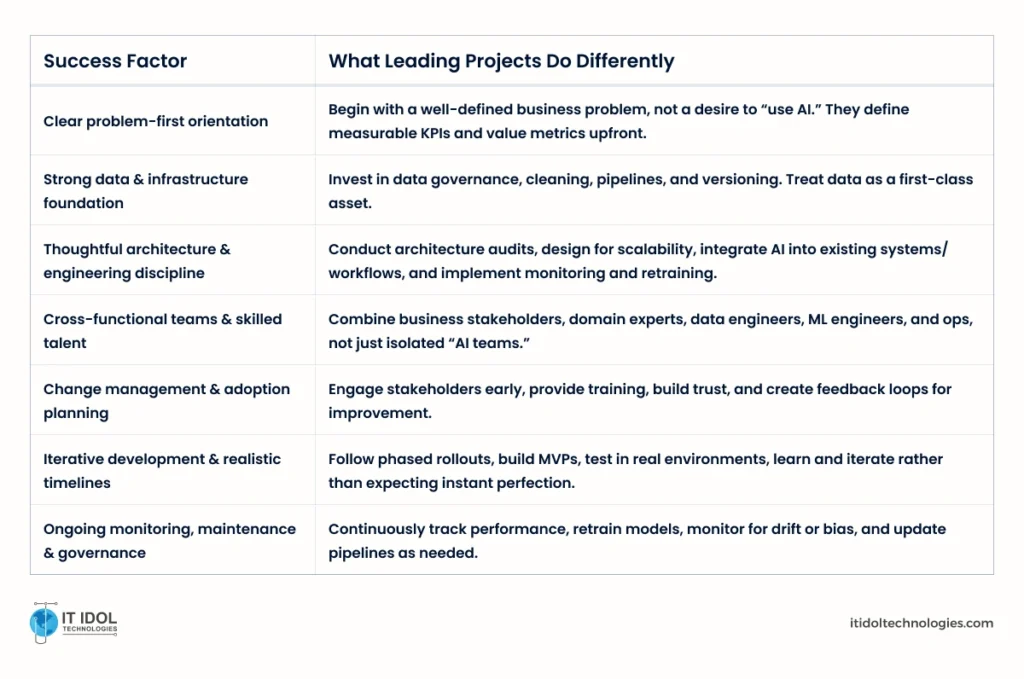
Understanding failure is critical, but there is also a silver lining. The small fraction of AI projects that succeed tend to follow certain patterns and practices. Based on literature and practitioner insights, here’s what distinguishes them:
In fact, one analysis noted that AI projects that underwent a preventive architecture audit had a ~95% success rate, compared to only 20% for those that jumped straight into development.
Additionally, frameworks such as aiSTROM, a strategic roadmap for AI adoption, recommend thorough evaluation across data strategy, team composition, cross-department positioning, compliance, KPIs, and continuous learning.
Strategic, Actionable Recommendations: How to Avoid Failure
Based on the patterns above, here’s a strategic playbook for organizations embarking on AI projects. These are practical steps, not abstract advice, aimed at maximizing chances of success.
1. Start with a Clear Business Problem and Success Criteria
Don’t start with “We want AI.” Instead, ask: What is the problem we want to solve? What business outcome or cost saving are we targeting?
Define SMART KPIs (Specific, Measurable, Achievable, Relevant, Time-bound). Examples: “Reduce invoice-processing time by 40% in 6 months,” or “Improve customer-service response time by 50% this quarter.”
Before allocating budget, ensure stakeholders across business, operations, and IT agree on the desired outcome. Document success criteria explicitly.
2. Invest in Data Strategy & Governance Before Anything Else
Conduct a data audit: assess data sources, formats, quality, completeness, labelling, and governance maturity.
Build or adopt data pipelines and governance frameworks (ingestion → cleaning → versioning → access control → lineage → auditing).
Ensure data privacy, compliance, and security requirements are met.
If your data isn’t ready, don’t build models yet.
3. Perform Architectural & Feasibility Assessment Early
Before writing any model code: conduct an architecture review/audit. Consider infrastructure requirements, scalability, integration with existing systems, deployment pipelines, monitoring, and retraining plans.
Choose models and tools aligned to the problem and data context, not simply the latest trendy AI.
Plan for deployment and operations (MLOps) from the beginning: logging, monitoring, performance tracking, error handling, and fallback mechanisms.
4. Build Cross-functional Teams & Upskill Where Needed
Form a team that combines domain experts, business stakeholders, data engineers, ML engineers, DevOps/MLOps, and change-management leads, not just technical specialists.
If internal talent is insufficient, consider strategic partnerships or outsourcing to experienced AI providers, but maintain involvement and ownership internally.
Invest in training and capacity-building: AI literacy for leadership and end-users; technical training for data/ML engineers.
5. Emphasize Change Management, Adoption & User Trust
Engage end-users and stakeholders early; communicate benefits, limitations, and changes in workflows.
Provide training, documentation, and support. Create feedback loops to collect user inputs, refine the AI system, and foster trust.
Align AI outputs with human decision-making, treat AI as an augmentation, not a replacement, to reduce resistance.
6. Use Iterative, Lean, and Outcome-driven Development
Don’t aim for a big-bang “perfect” AI solution. Instead, adopt the MVP (minimum viable product) approach: build small, deliver value quickly, learn, iterate.
Use methods like the philosophy behind AI-STROM or similar frameworks to evaluate AI projects across strategic, operational, and risk dimensions before full-scale commitment.
Evaluate results against the defined KPIs. If value isn’t realized, decide whether to iterate, pivot, or scrap; don’t push forward just because “we started already.”
7. Plan for Long-Term Maintenance & Monitoring
Build MLOps: monitoring for model drift, data changes, performance degradation, and bias. Do not treat deployment as the end.
Schedule regular retraining, auditing, and performance reviews. Maintain documentation, versioning, and transparency.
Embed governance, ethical, regulatory, and compliance into ongoing operations.
A Realistic Mindset: Why Success Takes Time
AI isn’t magic. It’s powerful but only when handled with discipline, discipline, and a realistic mindset. Success requires time, patience, and continuous effort.
It’s common for early prototypes or pilots to show promise, but the “last mile” (scaling, integration, adoption) is often where projects fail. As some researchers note, success comes when organizations clearly differentiate what AI should solve, what it can solve, and what it will solve and design accordingly.
Moreover, even with everything in place, models may behave unpredictably due to issues like underspecification, domain shift, data drift, or deployment environment differences. Robustness, monitoring, and adaptability are not optional extras; they are essential.
In short: AI is a journey, not a checkbox. It demands strategic thinking, operational discipline, organizational alignment, and a commitment to continuous improvement.
Conclusion
The promise of AI remains alluring. But as statistics and real-world experience show, most AI projects fail not because AI is flawed, but because organizations approach it with inadequate strategy, weak data, poor planning, and unrealistic expectations.
Yet, failure is not inevitable. Organizations that treat AI as a strategic, data-driven, disciplined initiative with clear objectives, solid foundations, capable teams, and long-term commitment significantly increase their chances of success.
If you are leading an AI effort, whether as a product manager, CTO, strategist, or business leader, start by asking: What problem are we solving? Do we have data? Do we have alignment across people, process, and technology? And let that guide whether and how to proceed.
Done right, AI can deliver real transformation. Done wrong, it risks becoming an expensive experiment that fizzles out.
TL;DR
Most AI projects (70–95 %) fail to deliver tangible business value, often never moving beyond pilot.
Key failure causes: unclear business objectives, poor data quality/governance, hype-driven expectations, lack of infrastructure, talent, and adoption gaps, and insufficient deployment planning.
Success tends to come when organizations treat AI as strategic: they align on business needs, build strong data foundations, invest in architecture and MLOps, and foster cross-functional teams and change management.
To improve odds of success: define clear KPIs, audit data and infrastructure early, adopt a lean iterative approach, plan for monitoring and maintenance, and embed AI deeply into workflows and organizational culture.
FAQ’s
1. Why do so many AI projects fail even when the technology seems mature?
Success depends not only on the AI model, but on data quality, infrastructure, integration, governance, and organizational readiness. Even mature models produce poor results when the underlying data is messy or workflows aren’t adapted.
2. Is AI failure more common than failure in traditional IT projects?
Yes, many reports suggest AI projects fail at a higher rate than traditional IT projects. AI’s additional complexity (data governance, model maintenance, integration, and monitoring) adds layers of risk and complexity beyond conventional software development.
3. If data quality is poor, is it better not to attempt AI at all?
Not necessarily, but you should address data readiness before building models. Invest in data cleaning, governance, and pipeline architecture first. Attempting AI on poor data is like building a house on sand: unsustainable.
4. Can small companies succeed with AI, or is it only feasible for large enterprises?
Smaller companies can succeed, often more easily, if they stay focused on specific problems, maintain lean development, and avoid unnecessary complexity. The key is clarity of problem, data readiness, and disciplined execution.
5. Should companies build AI in-house or outsource to specialized vendors?
There’s no one-size-fits-all answer. For organizations lacking talent or maturity, partnering with experienced vendors can improve the odds of success. However, maintain internal ownership, involve stakeholders, and ensure alignment with business needs.
6. Does a successful AI pilot guarantee long-term success?
No. Many pilots succeed in controlled environments but fail to scale due to infrastructure issues, lack of monitoring, data drift, or poor adoption. Treat production deployment as a separate phase requiring full planning.
7. How important is change management and user adoption in AI success?
Very important. Even a technically successful AI system can fail if end users don’t trust or adopt it. Training, communication, workflow redesign, and stakeholder engagement are critical.
8. What is underspecification, and why does it matter?
Underspecification refers to a situation where multiple ML models perform similarly on test/training data but behave differently in real-world conditions. It’s dangerous because deployment environments differ, and behaviours may diverge, leading to unpredictable or unreliable outcomes.
9. How can organizations monitor AI systems over time?
By building MLOps pipelines that include logging, performance monitoring, drift detection, retraining schedules, audits, and version control. Plan monitoring and maintenance from day one.
10. When should a company walk away from an AI project?
If, after initial discovery and data audit, you find data is insufficient or of poor quality, or if you cannot define clear business value or secure stakeholder buy-in. An AI project without these foundations is unlikely to succeed. It’s better to pause or redirect resources elsewhere.
Parth Inamdar is a Content Writer at IT IDOL Technologies, specializing in AI, ML, data engineering, and digital product development. With 5+ years in tech content, he turns complex systems into clear, actionable insights. At IT IDOL, he also contributes to content strategy—aligning narratives with business goals and emerging trends. Off the clock, he enjoys exploring prompt engineering and systems design.