Before jumping into the tools themselves, it helps to understand why choosing the right development tools is more critical than ever for eCommerce businesses.
Mobile commerce is now dominant. As of 2025, global mobile commerce (m-commerce) accounts for roughly 59% of all retail eCommerce sales, highlighting that smartphones and tablets are the primary devices for online shopping. (HostAdvice)
Global eCommerce is continuing to experience explosive growth. The global retail eCommerce market is projected to exceed US$6–7 trillion in 2025–2026. (Marketing LTB –)
Performance, UX, scalability, and security are all under pressure. With rising traffic (especially via mobile), global reach, and competition, stores need robust backends, fast frontends, seamless performance under load (e.g., sales events), and reliable testing/deployment pipelines.
Team complexity and agility matter. Large and mid-sized eCommerce operations often involve multiple developers, designers, QA engineers, and frequent updates, meaning toolchains that support collaboration, automation, modular development, and efficient testing are essential.
Given these pressures, eCommerce businesses in 2026 will benefit from a thoughtful stack of modern, proven dev tools, not just a platform, but a development ecosystem that supports scalable digital commerce solutions.
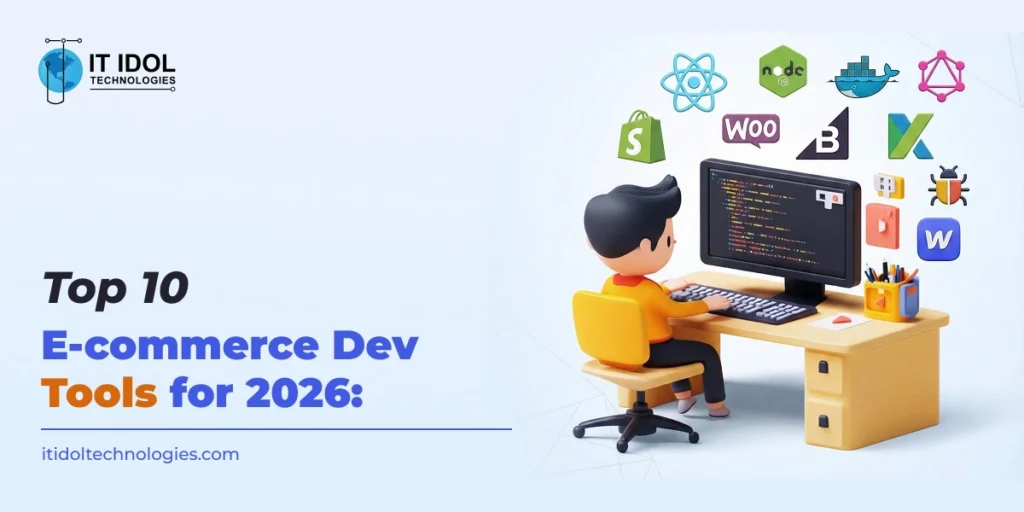
Top 10 eCommerce Development Tools for 2026
Here are tools that deliver value across different layers: frontend, backend, testing, deployment, data/API, and store platforms. I’ve grouped them by their primary role in the development lifecycle.
Core Development & Frontend Tools
1. React (or similar component-based JS frameworks)
React remains one of the most powerful tools for building dynamic, responsive, and modular eCommerce frontends. As highlighted in official eCommerce development recommendations, React supports component-based UIs, enabling shops to build reusable components like product cards, carousels, modals, and checkout flows crucial for fast-changing catalogs and frequent UI updates.
Why it’s critical for 2026
Reusable components make it easier to maintain large codebases across many pages (catalog, product detail, cart, checkout, account).
Performance & UX allow for client-side interactivity, fast page transitions, and dynamic user experiences (e.g., live filtering, AJAX-powered search), which matter when ~60% of users are on mobile. For businesses extending these experiences beyond the browser, mobile app development can further support mobile-first commerce strategies.
Scalability as shops grow, having a modular UI architecture speeds up development and reduces duplication.
Actionable takeaway: For any new store build or redesign in 2026, prefer a component-based frontend architecture (React, Vue, or similar) over monolithic templates, especially if you expect frequent UI changes or personalization.
2. Node.js (for server/backend or headless commerce setups)
Using JavaScript (JS) on both frontend and backend simplifies development, reduces context switching, and streamlines resource management. Node.js, with its vast ecosystem, remains a powerful choice for building scalable backend services, APIs, or headless-commerce microservices within larger custom software development projects. Many modern eCommerce architectures adopt a “headless” or “composable commerce” approach, separating backend logic, APIs, and frontend rendering to maximise flexibility and performance.
Why it’s critical for 2026
Unified language stack (JS/TS) easier for teams to collaborate, maintain code, and hire skilled developers.
Real-time & high-traffic readiness: Node.js handles concurrent connections well, which is valuable for inventory updates, live stock synchronization, real-time personalization, and high-traffic events (sales, product launches).
Headless / API-first architecture support for stores that want rapid UI updates or omnichannel frontends (mobile, PWA, app, web).
Actionable takeaway: If you’re building or migrating a mid-to-large-scale eCommerce store in 2026, strongly consider Node.js with a headless architecture, especially if you plan omnichannel sales or frequent frontend changes.
While these are not “dev tools” in the strictest sense, they remain among the most popular platforms worldwide due to their flexibility, large ecosystems, and ease of integration for developers and non-developers alike. According to industry comparisons, Shopify and WooCommerce remain top choices for SMBs and content-plus-commerce businesses, respectively.
Why will they remain relevant by 2026
Rapid store setup: For startups or SMBs, these platforms provide a solid foundation without reinventing the wheel, especially for businesses looking to capitalize on emerging U.S. eCommerce growth opportunities.
Extensive plugin/app ecosystems: Enable functionality like payments, shipping, analytics, and marketing without building from scratch.
Flexibility vs ease-of-use tradeoff: WooCommerce (if you use WordPress) offers deep customizability; Shopify offers managed hosting, speed, and reliability.
Actionable takeaway: Use Shopify or WooCommerce when speed to market, stable hosting, and plugin ecosystem matter more than building every feature from scratch, especially for small-to-medium businesses or when content (blog, CMS) and commerce need to integrate tightly.
4. BigCommerce (or other headless-friendly SaaS platforms)
For businesses that need scalability, multi-channel selling, and robust built-in features but don’t want the overhead of managing servers, BigCommerce remains a compelling option. It’s noted for strong SEO support, multi-channel integration (marketplaces, social commerce), and headless commerce support.
Why BigCommerce and similar make sense in 2026
Headless-ready SaaS: Combines managed backend + APIs with flexibility to plug in a custom frontend (React/Vue).
Scalability and enterprise-readiness: Handles larger catalogs, volume, multi-store/multi-currency, B2B/B2C needs.
Reduced maintenance overhead: The SaaS model means less concern about server maintenance, security patching, and scaling infrastructure.
Actionable takeaway: For growing or mid-sized merchants with scaling ambitions (multi-market, multi-channel, large inventories), consider a headless-friendly SaaS like BigCommerce to balance control, scalability, and ease of management while preparing for the next wave of digital commerce innovations.
Testing, QA & Automation Tools
Large, frequently updated eCommerce sites with many SKUs, dynamic UI, and high traffic must ensure reliability. This is where testing and automation tools matter.
5. Katalon Platform (Studio + TestOps) for comprehensive test automation
Katalon provides a broad suite: web, API, mobile, and desktop testing; supports both codeless and script-based approaches; integrates with CI/CD; and offers cloud-based parallel test execution and analytics.
Why it’s a strong pick for 2026
Unified testing across layers: Frontend (UI), backend/API, mobile critical for omnichannel commerce.
Scalable & maintainable test suites: Using design patterns like Page Object Model (POM) and modern workflows reduces fragility, even as the site evolves.
CI/CD integration & parallel execution: Enables automated regression tests before each deploy, reducing risk during frequent updates or sale events. Teams can take this further by incorporating AI-driven software testing into modern quality engineering workflows.
Actionable takeaway: If your eCommerce operation involves regular updates, new features, promotions, and UI tweaks, integrating an automated testing tool like Katalon helps catch regressions early and ensures a consistent shopping experience across devices.
6. BugBug (codeless browser-based test automation) for lean teams or rapid QA
For teams that may not have deep QA resources or scripting expertise, BugBug enables recording real user flows (browsing, search, add-to-cart, checkout) and replaying them across browsers/devices without writing code.
Why BugBug is especially relevant in 2026
Lower friction for QA: Great for small-to-medium teams, startups, or agencies building stores for clients without heavy testing budgets.
Fast onboarding: Minimal setup, testers, or even non-technical team members can record flows.
Cost-effective regression coverage: Ensures key flows (shopping, checkout) don’t break after updates essential for revenue-critical paths.
Actionable takeaway: Consider BugBug (or similar) when you need quick, reliable end-to-end testing of user flows ideal for lean teams, agencies, or frequent deployment cycles.
Infrastructure, Deployment & Data Tools
To handle growth, traffic spikes, and complex backend needs (inventory, payment, localization, analytics), the underlying infrastructure tooling is crucial.
7. Containerization / Environment Management, e.g., with Docker (or similar container/orchestration tools)
Although not new, container-based development and deployment remain critical to reliably scale and maintain e-commerce applications, especially headless or custom-built ones. Docker enables consistent environments across dev, staging, and production. Many modern e-commerce dev tool guides highlight containerization as essential.
Why Docker (or container-based deployments) matter more than ever
Consistency across environments: Avoid “works on my machine” problems.
Scalability & auto-scaling readiness: Makes it easier to scale backend services (inventory, APIs) up or down, and handle high loads during sales events.
Ease of collaboration and CI/CD: Teams can isolate services, manage dependencies, version control infra, and deploy reliably.
Actionable takeaway: Build and deploy your eCommerce backend using containerization; it’s a foundation for scalable, reliable, maintainable architecture and broader application modernization, especially for shops expecting high growth or traffic volatility.
8. API-centric Data Handling / Querying – e.g., using GraphQL
For eCommerce stores with large catalogs, multi-region support, dynamic content, and headless frontends, using efficient and flexible API querying is essential. GraphQL lets you build precise, efficient queries (fetch only what’s needed), reducing data transfer and improving performance. Many modern eCommerce stacks increasingly adopt GraphQL for data fetching.
Why GraphQL makes sense for 2026 eCommerce
Efficient data fetching: Minimizes overfetching/underfetching, great for product catalogs, filtering, and faceted search.
Flexibility for complex storefronts: Useful for features like localization, multi-currency, user personalization, dynamic pricing, and inventory status in real time.
Better performance for mobile & headless setups: Lower payloads, faster load times, smoother UX for mobile-heavy shoppers.
Actionable takeaway: If you expect to serve many different frontends (web, mobile app, PWA) or build custom storefronts, design your backend around GraphQL (or equivalent API-first approach).
Design, Prototyping & UX Tools
For eCommerce success, smooth UX, UX-to-dev handoff, and rapid prototyping can make or break conversions, especially when users are mobile-first.
9. Visual Design / Prototyping Tools such as Webflow (or similar)
Tools like Webflow, especially its modern capabilities such as visual editors + code export / AI-integrated canvas, are increasingly relevant even for commerce sites.
As of 2025, Webflow is used by a segment of the top 10 million websites, and its newer architecture supports AI agents and automation to streamline design-to-development workflows.
Why design-first or visual tools matter in 2026
Faster design-to-launch cycles: For small-to-medium shops or MVPs, Webflow (or similar) enables launching stores quickly without heavy engineering overhead.
Better designer–developer collaboration: Changes in UI/design can flow faster into production, helpful when iteration is frequent.
Lower barrier for content-led shops: Great if your eCommerce store also depends heavily on content, marketing pages, and blogs, common for D2C brands.
Actionable takeaway: For startups, D2C brands, or small-to-mid merchants prioritizing speed and content-driven commerce, use a visual-first tool like Webflow, especially in early stages, and plan to integrate it with backend/API when you scale.
While there isn’t a single “tool” with a corporate name here, it’s important to emphasize that modern eCommerce development must combine: functional testing (via Katalon / BugBug), performance optimization (reducing JS bloat, optimizing images), security/privacy compliance, and automated deployment, collectively forming the backbone of reliable, scalable, and trustworthy eCommerce systems.
Insights from academic research reinforce this: for example, eliminating unused/superfluous JavaScript resources can cut page load times significantly, which directly impacts user experience and conversion rates.
Also, privacy and security audits remain critical, as online stores handle users’ personal data, payment information, and sensitive information. A dual approach with automated tools + manual evaluation is recommended.
Why this holistic approach matters
Performance = conversion: Faster pages, optimized assets, and clean code improve UX and reduce bounce/cart abandonment rates, especially because many shoppers are on mobile.
Reliability under load: Stress testing, auto-scaling backend, containerization, and monitoring avoid downtime during peak traffic (sales, promotions).
Regulation & trust: With data privacy regulations tightening globally, proper security, authentication, and compliance reduce risk and build customer trust.
Actionable takeaway: Build a QA/performance/security pipeline as part of your standard product engineering process; don’t treat testing as an afterthought. Automate what you can, but also schedule regular manual audits for UX, performance, and compliance.
Choosing the Right Mix: Which Tools for Which Business Type
Not every e-commerce business needs all of the above tools. The choice depends heavily on your business size, growth ambitions, technical skills, and resources. Below is a rough decision matrix to help you decide.
Business Type / Goal
Recommended Tools / Stack
Small / early-stage store, limited budget, quick go-to-market
Shopify or WooCommerce + Webflow (or similar) for frontend/design + BugBug for basic QA/testing
Growing D2C brand, expecting scaling, content-heavy site
Headless setup: Node.js backend + GraphQL + React frontend; plus Docker for deployment; Katalon or BugBug for testing; performance + security hygiene practices
Mid-size/enterprise, large catalog, multiple markets, high traffic
Headless SaaS (BigCommerce) or custom backend; Node.js + GraphQL; React frontends (web + mobile); Docker/Kubernetes; full QA pipeline with Katalon; automated CI/CD; performance/security tools; QA & compliance reviews
Frequent updates, marketing experiments, fast UI changes
Key Principle: Think of dev tooling not as a one-time decision but as an ecosystem. Use a combination of tools, frontend framework, backend stack, testing, deployment, design/UX tailored to your growth plan and workload.
Mixing “quick-build” platforms with scalable infrastructure and automation gives you agility now, and room to grow later.
Emerging Considerations for 2026 & Beyond
As you pick tools for 2026, here are some trends and future-proofing strategies worth building into your roadmap:
Mobile-first & mobile performance optimization: Given the dominance of mobile commerce, ensure any frontend is optimized for mobile (fast load, responsive, lightweight JS, optimized images, lazy loading, etc.).
Headless & composable architecture adoption: Enables flexibility: swapping storefronts, integrating apps/marketplaces, building custom UIs for different channels (web, app, social, PWA).
Automation + continuous testing + CI/CD: As stores scale and update frequently (promotions, UI changes, features), automated pipelines reduce the risk of bugs or downtime.
Privacy, compliance & security focus: As regulations tighten globally and consumers become more aware, invest in secure payment processing, data protection, cookie handling, authentication, and auditing.
API-first design + data-driven personalization: Use flexible APIs (GraphQL or REST) to enable personalization, multi-currency, localization, dynamic pricing, inventory sync, and omnichannel data flows.
Modular & maintainable codebase: Use component-based UI, containerization, modular backend, and clean architecture to make maintenance, updates, and scaling easier long-term.
Conclusion
By 2026, the bar for eCommerce development is higher than ever. It’s not enough to just launch a store; success demands scalability, performance, flexibility, reliability, and a seamless user experience across devices (especially mobile). The 10 tools (and practices) discussed above, from React and Node.js to BigCommerce, Katalon, BugBug, Docker, GraphQL, Webflow, and performance/security hygiene, together form a robust, modern “eCommerce development stack.”
Selecting the right combination depends on where you are as a business. But as a rule of thumb: if you expect growth, frequent updates, or high traffic, lean into headless architecture + containerization + automated testing and deployment + performance & security practices. If you’re starting small or testing an idea, SaaS platforms + visual design + lightweight QA can get you off the ground quickly.
Ultimately, adopting a strategic, well-rounded, modern dev toolchain can turn your eCommerce store from a fragile site to a scalable, reliable, conversion-optimized engine ready to capitalize on the digital commerce innovations shaping 2026.
No. The choice depends on your business size, requirements, and team. Small or early-stage stores often begin with simpler setups (e.g., WooCommerce + Webflow + basic QA). Larger or scaling stores benefit most from a full stack (frontend framework, backend + API, containerization, automated testing, performance & security practices).
Headless commerce decouples the frontend (UI) from the backend (logic, data, APIs). This separation lets developers build custom frontends (web, mobile app, PWA, social commerce) while using a common backend. This flexibility supports omnichannel growth, faster UI updates, and better performance critical when mobile traffic dominates.
Automated testing ensures that critical user flows (search, add-to-cart, checkout) remain functional after updates, new features, or during sale events. For growing stores with frequent deployments, automated testing saves time, reduces regression bugs, maintains quality, and protects revenue.
Yes, especially for mid-size or larger stores. Containers create consistent environments across development, staging, and production — eliminating “works on my machine” issues. They also enable scalable, resilient deployments — important during load spikes (e.g., sales, promotions)
Often, yes. For early-stage or content-driven stores, Webflow (or similar visual builders) can provide a quick, cost-efficient way to launch a store with minimal engineering effort. As the business grows, you can later migrate to a more scalable backend or integrate APIs.
GraphQL allows clients to request only the data they need (no under- or over-fetching), which reduces payload size, improves performance, and gives flexibility for complex data needs (e.g., product filtering, localization, personalization). This is especially valuable for stores with large catalogs, dynamic UIs, and multiple frontends (web, mobile, app, PWA, etc.).
Absolutely. Open-source platforms remain highly relevant especially for those who want deep customization, full control, or integration with existing systems. The choice depends on business needs: open-source for flexibility and control; SaaS for ease, speed, and managed infrastructure.
Crucial. With around 59% of global eCommerce retail sales coming from mobile devices and growing smartphone penetration globally, mobile UX, responsive design, fast load times, and optimized checkout are non-negotiable for conversions.
Focus on a headless architecture (backend + API-first), containerized deployment, automated testing and CI/CD, performant and modular frontend (React or similar), and scalable platform (headless-friendly SaaS or custom backend). Also invest in security, compliance, and performance monitoring to support growth and global reach.
Deval Rathod
Founder & CEO
|
Deval Rathod is the Founder and CEO of IT IDOL Technologies, a custom software development company. With over a decade of experience in software engineering, solution architecture, and technology leadership, she has worked across custom software development, enterprise applications, AI & ML, and digital transformation. Her expertise includes guiding technology teams, designing scalable software solutions, and helping businesses evaluate and implement emerging technologies. She contributes insights on software engineering, artificial intelligence, enterprise technology, and digital transformation.