In 2025, the stakes for enterprise e-commerce platforms couldn’t be higher. As digital commerce continues to scale, boardrooms and executive suites are no longer simply asking whether their e-store works: they demand it be secure, resilient, and trusted.
At the same time, the technological runway is shifting rapidly. Headless architectures, AI-driven personalization, composable stacks, and real-time orchestration are not just nice-to-haves, but existential levers for competitive advantage.
Amid this turbulent environment, Adobe Commerce (formerly Magento) remains a critical player. For many large enterprises managing complex catalogs, global operations, multi-storefronts, and B2B workflows, Adobe Commerce is more than a legacy platform; it’s a strategic foundation.
Yet, sustaining and evolving that foundation requires more than incremental upgrades. It demands a transformation rooted in trust and expertise.
This article examines how, in 2025, organizations can harness Adobe Commerce not just as a transactional engine, but as a trusted, expert-grade enterprise e-commerce system, one that scales securely, drives intelligence, and aligns deeply with business strategy.
It’s written for CXOs, strategists, innovation leaders, and enterprise architects who are seeking to future-proof their commerce infrastructure through trust, governance, and strategic agility.
The Enterprise E-Commerce Landscape Is More Demanding Than Ever
Enterprise e-commerce is no longer just about offering a storefront. According to Cascadia Capital, the global e-commerce platforms market is projected to grow at a 12.7% CAGR, reaching nearly US$9.9 billion by 2027, reflecting surging demand from large, complex merchants to deploy scalable, feature-rich platforms.
At the same time, digital trust has become a board-level issue. In a survey by Digicert, 100% of enterprises reported that digital trust is important to their customers, with 91% saying their customers rate it as extremely important.
That level of concern is not abstract: data breaches, downtime, and transactional fraud directly erode revenue, reputation, and long-term customer loyalty.
Meanwhile, Adobe Commerce’s own footprint shows that thousands of enterprises continue to trust it. As of Q4 2024, estimates suggest around 131,491 live Magento–Adobe Commerce websites globally.
Electriq reports even higher totals, citing over 240,000 Magento-based sites, including both open source and Commerce editions. This is not a fading platform, but it’s one under increasing pressure from newer, more composable competition.
The Strategic Tension: Innovation vs. Risk
For enterprises running Adobe Commerce, the urgency is twofold:
1. Modernization Pressure
Many such enterprises face rising expectations: headless commerce, AI personalization, and real-time orchestration. But transitioning to these models without undermining reliability, security, or data governance is non-trivial.
2. Trust and Risk Management
The enterprise must maintain a fortress-level posture on trust. Adobe Commerce’s architecture must withstand modern threat vectors, provide data isolation, and support rigorous governance or risk costly breaches or compliance failures.
Thus, the imperative is clear: to remain relevant, large organizations must elevate Adobe Commerce from a transactional backbone into a trust-centric, intelligent commerce engine combining operational excellence with strategic depth.
The Strategic Thesis: Trust-Enabled Enterprise Commerce
At its heart, the transformation of Adobe Commerce in 2025 centers around a strategic thesis:
Enterprises must reimagine Adobe Commerce as a trust-enabled, intelligent commerce foundation integrating strong governance, predictive capabilities, and orchestration to drive enterprise resilience, agility, and competitive differentiation.
This strategic idea rests on three interlocking dimensions:
1. Trust – ensuring security, data integrity, compliance, and digital trust are foundational.
2. Expertise – embedding domain intelligence, architectural discipline, and analytics into commerce operations.
3. Orchestration – combining real-time execution, composable services, and adaptive workflows for commerce that responds, learns, and scales.
Let’s unpack how this thesis manifests.
The Evolution of Trust Architecture in Commerce
Historically, Magento (now Adobe Commerce) was architected to be flexible and extensible first. Over time, Adobe has layered in enterprise-grade security and data separation.
The Adobe Commerce Security, Privacy, and Architecture Guide describes how customer data is segregated using logically separate identifiers and role-based access controls, ensuring no unintentional cross-tenant visibility.
Furthermore, Adobe’s architecture supports both multi-tenant and single-tenant paradigms in its PaaS offering, giving enterprises the choice of isolation vs. shared infrastructure.
These capabilities reflect an evolution where trust is not an afterthought; it’s engineered in.
AI and Predictive Capabilities Becoming Core
Beyond trust, expertise in the form of intelligence is now table stakes. Adobe Commerce integrates with Adobe Sensei, Adobe’s AI/ML framework, to deliver predictive merchandising, automated product recommendations, and smarter personalization.
These capabilities are no longer experimental; for enterprise customers, they are essential for maintaining conversion velocity, relevance, and cross-sell/upsell momentum.
On the architectural front, many enterprises are also embracing headless commerce, decoupling the backend from the frontend to make digital experiences more agile, composable, and embeddable.
As headless architectures mature, real-time data, orchestration, and AI-driven intelligence converge to make commerce not just reactive, but proactively adaptive.
Orchestration Enables Resilience and Scale
Enterprises increasingly require commerce that can span multiple channels, regions, and business units while maintaining consistent data governance and trust.
Orchestration frameworks built on Adobe Commerce (or around it) allow real-time coordination between CMS, order management, inventory, and external systems. Businesses can deploy workflows that proactively respond to risk, inventory shifts, customer behavior, or compliance events.
Strategically, leaders can view Adobe Commerce as more than a storefront engine; it becomes an orchestration hub that enables trust-aware, intelligent commerce at enterprise scale.
Strategic Insight
Through this lens, Adobe Commerce in 2025 is not a legacy monolith, but a trust-first, intelligence-driven architecture.
For leaders, the opportunity is to double down on building governance, embedding intelligence, and architecting for orchestration, turning their commerce investment into a true strategic differentiator.
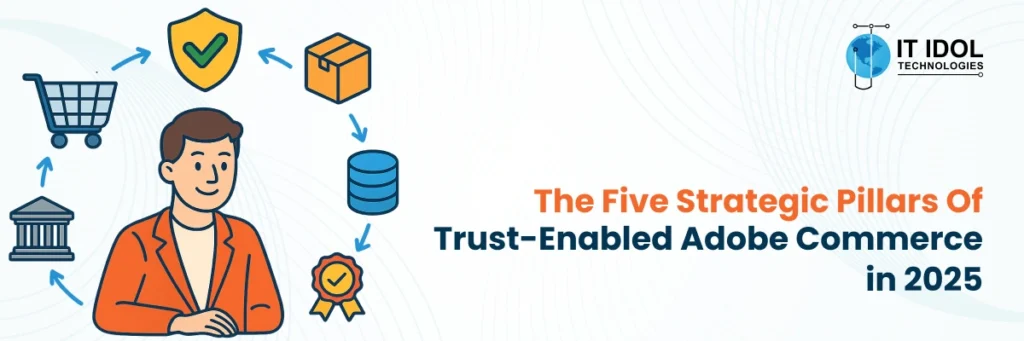
The Five Strategic Pillars of Trust-Enabled Adobe Commerce in 2025
Adobe Commerce’s transformation into a trust-driven, enterprise-grade commerce engine hinges on five core dimensions.
These pillars are not technical checklists; they represent the strategic scaffolding that determines whether an enterprise can scale Adobe Commerce with resilience, intelligence, and governance.
Pillar 1 – The Foundational Shift: Trust-Centric Commerce Architecture
Framing Question
How can enterprises evolve Adobe Commerce from a flexible transactional engine into a trust-first, security-anchored digital commerce backbone?
The Strategic Tension
Enterprises must balance innovation with risk. Modern commerce strategies, headless, AI-driven, and composable, expand both capability and complexity. Without a trust-first foundation, these innovations introduce systemic vulnerabilities.
Digital trust has become a competitive differentiator.
A global Digicert survey reports that 91% of enterprises say customers rate digital trust as “extremely important.”
Breaches are rising in cost and frequency.
IBM’s Cost of a Data Breach Report notes breaches now average $4.45 million globally, the highest on record.
For Adobe Commerce, this means security, governance, and architectural rigor cannot be bolt-ons; they must be non-negotiable foundations.
What This Looks Like in Adobe Commerce
Strong identity and access controls governed via RBAC
Data isolation via separate logical identifiers for every tenant
PaaS models that support both multi-tenant and single-tenant isolation
Built-in WAF, DDoS mitigation, and hardened infrastructure via Adobe Commerce Cloud
Vault-based secure secrets management
These elements reposition Adobe Commerce as a trusted platform, not just an application.
Case Reflection
A global B2B manufacturer running 40+ regional stores moved to Adobe Commerce Cloud to consolidate security controls.
The shift reduced their attack surface, centralized governance, and eliminated fragmented hosting architectures that previously created risk blind spots.
Strategic Takeaway
Trust is a strategic moat.
Enterprise leaders who embed trust logic directly into Adobe Commerce’s architecture gain resilience, regulatory confidence, and customer confidence, the currency of long-term growth.
Pillar 2 – Data, Architecture, and Governance: Building the Enterprise Spine
Framing Question
How do enterprises redesign their Adobe Commerce architecture so that data integrity, governance, and interoperability become strategic accelerators instead of blockers?
The Strategic Tension
Every enterprise wants speed, yet complex data landscapes, legacy integrations, and governance gaps slow execution. Adobe Commerce often sits at the center of this tension.
Poor Data Quality Costs (Gartner)
According to Gartner, poor data quality costs organizations at least US$12.9 million per year on average.
Data Governance & Performance
Forrester argues that data governance is the key differentiator for analytics maturity: fewer than 10% of enterprises are “advanced” in insights-driven capabilities, and strong governance helps unlock analytical success.
These statistics underscore how deeply commerce performance is tied to data clarity, governance, and architecture.
Key Architectural Imperatives
API-first integrations to eliminate patchwork middleware
Unified product and inventory data models to reduce catalog inconsistencies
Governance frameworks (roles, workflow approvals, data lineage)
Audit-ready logs and security baselines for compliance and investigations
Event-driven architecture to enable real-time visibility
With Adobe Commerce at the core, the goal is to create an “enterprise spine,” a system of record that stabilizes the broader ecosystem.
Real-World Reflection
A global distributor reduced catalog inconsistencies by 78% after consolidating their PIM–Magento setup under a unified governance model. This allowed them to scale omnichannel operations without constant firefighting.
Strategic Takeaway
Governance is growth infrastructure.
Commerce leaders who standardize data and architecture create faster releases, fewer errors, and cleaner omnichannel execution.
Pillar 3 – Intelligence Layer: Predictive, Adaptive, and AI-Driven Commerce
Framing Question
How can enterprises transform Adobe Commerce from a rule-based system into a predictive, intelligent engine that adapts in real time?
The Strategic Tension
Enterprises want personalization, but they fear black-box AI. They want automation, but demand explainability. They want predictive commerce, but need guardrails.
Gartner predicts that by 2026, 60% of commerce platforms will use AI for real-time dynamic pricing and product recommendations.
This signals a shift: intelligence will define the next wave of enterprise commerce competitiveness.
Adobe Commerce’s Intelligence Stack
Adobe Sensei for automated recommendations
Predictive search and merchandising
Behavioral segmentation
Dynamic content rendering
AI-assisted catalog management
Together, they create a “predictive commerce layer” that responds to signals, behaviors, and context, reducing manual effort while elevating conversion KPIs.
Case Reflection
A luxury retailer integrated Sensei-powered recommendation models and reported a 21% lift in average order value within six months with no manual merchandising overhead.
Strategic Takeaway
Intelligence is the new merchandising.
Leaders must integrate AI not as an add-on, but as a core capability governing experience, discovery, and decisioning.
Pillar 4 – End-to-End Orchestration: Real-Time Execution at Scale
Framing Question
How do enterprises achieve frictionless, real-time commerce across stores, channels, regions, and backend systems?
The Strategic Tension
Adobe Commerce excels at transactions, but enterprises today require orchestration, not just “transactions.” They need real-time syncing across OMS, ERP, PIM, fulfillment, marketing automation, and customer data platforms.
Deloitte reports that organizations using real-time data orchestration see 4–6x faster decision cycles.
For global merchants, orchestration is not operational, it’s strategic.
Architectural Enablers
Event-driven integrations via Adobe I/O Events
Headless frontends (React, Vue, Svelte)
Composable services integrated via API mesh
Centralized order workflows across OMS + Commerce + ERP
Orchestration is where Adobe Commerce shifts from “storefront system” to “enterprise commerce hub.
Case Reflection
A cross-border fashion retailer implemented an event-driven Adobe Commerce, OMS architecture that reduced order errors by 40% and eliminated 90% of manual reconciliation tasks.
Strategic Takeaway
Orchestration is competitive velocity.
Enterprises that orchestrate commerce end-to-end outperform peers in speed, accuracy, and customer satisfaction.
Pillar 5 – Measurement, ROI, and Growth Integration
Framing Question
How can leaders prove the ROI of Adobe Commerce modernization and integrate measurement into growth strategy?
The Strategic Tension
Commerce investments are often justified on “feature upgrades” rather than strategic outcomes. CFOs and CXOs increasingly demand measurable returns tied to:
Conversion
Margin
Efficiency
Customer lifetime value
Risk reduction
In McKinsey’s report Customer experience: Creating value through transforming customer journeys, they note that organizations typically realize5–10% revenue growth and 15–25% cost reduction within 2–3 years when they redesign customer journeys holistically.
Governance metrics (integration failures, data correctness)
Real-World Reflection
A multinational industrial supplier tied their commerce KPIs to operational savings, showing $3.2M annual ROI driven by reduced manual order processing alone.
Strategic Takeaway
Measurement turns Adobe Commerce from a cost center into a growth engine.
Without measurement, modernization becomes guesswork. With measurement, it becomes a predictable growth model.
Future Outlook (The Next 3–5 Years of Adobe Commerce in the Enterprise)
Adobe Commerce’s relevance in the enterprise ecosystem is being reshaped by macro forces across AI, security, composable architecture, and customer expectations. The next 3–5 years will not be defined by incremental enhancements but by deeper structural shifts.
Below are the major trends enterprise leaders should anticipate and prepare for.
1. AI Will Become Embedded, Not Optional
Most enterprises still treat AI/ML as “add-ons.” By 2027, this shifts dramatically.
Gartner predicts 60% of commerce platforms will deploy AI for real-time pricing and recommendations.
Adobe’s tight integration with Sensei means AI will push deeper into:
AI will shift from reactive to anticipatory, making Adobe Commerce experiences feel more human, contextual, and effortless.
2. Composable Architecture Will Become the Default Enterprise Model
The move to headless and composable commerce is accelerating. This trend is reinforced by:
Faster frontend cycles
API-first ecosystems
Need for rapid experimentation
Microservices replacing monolithic extensions
Adobe Commerce will increasingly serve as the transactional, secure, governed core, while frontends and auxiliary services become modular.
Enterprises maintaining monolithic implementations will fall behind both in agility and in cost efficiency.
3. Trust Will Become a Board-Level KPI
Data breaches, compliance risks, and system outages are now existential threats.
IBM reports that the average breach cost is now $4.45M globally, the highest ever measured.
Commerce systems will be redesigned around:
Secure-by-design patterns
Zero-trust architectures
Automated compliance
End-to-end encryption
Real-time threat detection
Adobe Commerce Cloud’s tight control of infrastructure will play a more central role for enterprises with complex governance needs.
4. Enterprise Commerce Will Merge with Marketing, Experience, and Data Platforms
The future of enterprise commerce is convergence.
Adobe Commerce will increasingly operate as part of an integrated ecosystem, including:
Adobe Experience Platform
Adobe Journey Optimizer
Adobe Real-Time CDP
Adobe Target
Adobe Marketo Engage
Companies will move from “channels” to experience fabrics where identity, content, data, and commerce converge instantly and seamlessly.
5. API-Led Orchestration Will Replace Traditional Integrations
File drops, cron jobs, and nightly syncs will be obsolete.
Real-time orchestration will be powered by:
Adobe I/O
Event-driven triggers
GraphQL-based storefronts
Commerce API Mesh
Workflow automation tools
Enterprises unable to shift to real-time orchestration will continue to face latency, errors, and fragmentation that compound operational inefficiencies.
6. Commerce Will Become a Core Part of Sustainability and Responsible Tech
Enterprise buyers, especially in B2B, are increasingly evaluating vendors on sustainability and ethical governance. Leaders will demand:
Lower carbon infrastructure
Transparent supply chains
Reduced returns
Responsible AI
Accessible digital experiences
Adobe Commerce’s adaptability allows enterprises to embed these commitments at the level of architecture, policy, and experience design.
Strategic Implication for Leaders
The future of Adobe Commerce is composable, intelligent, governed, and trust-first.
Organizations that delay modernization risk losing both market competitiveness and customer trust.
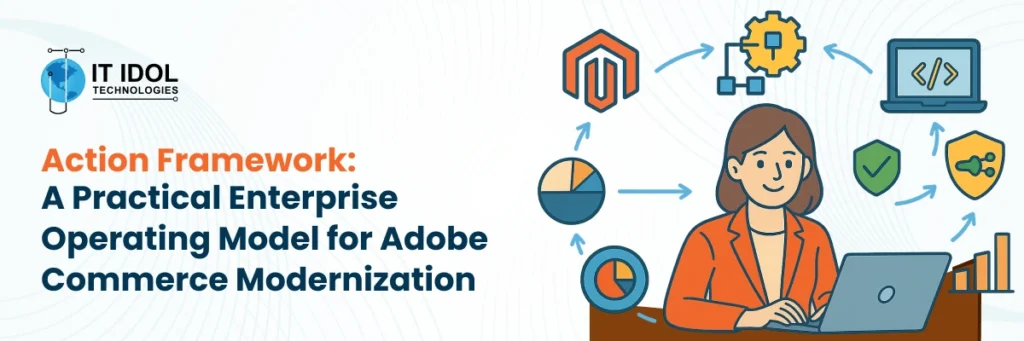
Action Framework: A Practical Enterprise Operating Model for Adobe Commerce Modernization
To help leaders translate strategy into execution, here is a 5-Step Operating Model designed specifically for Adobe Commerce transformation in large organizations.
Step 1 – Build a Trust-First Foundation
Objective
Create a secure, compliant, and governed core before scaling any advanced capabilities.
How to Execute
Conduct an architecture and security audit
Implement zero-trust access policies
Strengthen RBAC and admin governance
Standardize content workflows and approval paths
Move toward Adobe Commerce Cloud for managed security and PaaS controls
Deploy automated backups, monitoring, and real-time threat detection
Outcome
A hardened, resilient commerce backbone ready for modernization.
Step 2 – Standardize Data & Architecture into an Enterprise Spine
Objective
Ensure clean, governed, interoperable data flows across systems.
How to Execute
Consolidate product and inventory data in a unified PIM/ERP model
Move integrations to API-first patterns
Improve data lineage and meta-governance
Create enterprise-wide taxonomy and attribute standards
Deploy event-driven integrations
Outcome
Reduced complexity, fewer errors, and faster omnichannel scaling.
Step 3 – Layer Intelligence Through AI and Real-Time Decisioning
Objective
Turn Adobe Commerce into an adaptive, predictive growth engine.
How to Execute
Implement Adobe Sensei recommendations
Add predictive search and intent-based discovery
Automate catalog tagging and enrichment
Deploy AI-driven merchandising
Use machine learning to identify fraud and anomalies
Integrate CDPs for real-time identity personalization
Outcome
Higher conversions, improved engagement, and decision automation at scale.
Deploy microservices for promotions, cart logic, and search
Create a modular extension and deployment model
Outcome
Faster releases, evolving UX, and adaptable experience layers.
Step 5 – Operationalize Measurement & Enterprise ROI
Objective
Shift Adobe Commerce from a cost center to a measurable growth engine.
How to Execute
Define a KPI dashboard (conversion, speed, trust, operations)
Implement journey analytics across channels
Measure AI ROI vs. manual merchandising
Connect performance metrics to financial outcomes
Run quarterly governance and architecture reviews
Outcome
A predictable, measurable commerce operating model aligned with enterprise priorities.
Leadership & Human Dimension
Technology modernizes only as fast as the organizational mindset allows. Adobe Commerce transformation is as much about people and leadership as architecture and code.
Below are the core human elements leaders must navigate.
1. Shifting from Feature Thinking to Systems Thinking
Enterprise teams often focus on:
“What features are we adding?”
“What extension should we install?”
The 2025 enterprise conversation must shift toward:
“What system are we strengthening?”
“Is our architecture resilient?”
“Does this change increase or decrease trust?”
Leaders must elevate dialogue from tactical to systemic.
2. Reducing Fear of Change Through Governance and Transparency
Commerce teams often hesitate to adopt headless or AI because of fear of disruption, complexity, or loss of control.
This dual-track execution requires strong PMO structures and architectural discipline.
4. Building a Culture of Continuous Commerce Excellence
Commerce is not a one-off project; it’s a living capability.
Leaders must cultivate a culture where:
Data is respected
Security is owned, not delegated
Experimentation is encouraged
Insights drive decisions
Customer experience is everyone’s responsibility
The strongest Adobe Commerce organizations build culture before technology.
5. Leading with Trust
Trust accelerates everything from vendor relationships to customer loyalty.
Leaders must:
Make trust a KPI
Invest in governance
Communicate risk clearly
Ensure transparency across teams
Embed responsible AI practices
When trust is a leadership value, it becomes an organizational habit.
Conclusion
Adobe Commerce is no longer “just a platform” it’s a strategic engine that carries the weight of customer trust, enterprise governance, and digital growth.
In 2025 and beyond, the enterprises that will win are those that:
Treat trust as architecture
Treat data as infrastructure
Treat intelligence as a core capability
Treat orchestration as a competitive muscle
Treat measurement as strategic truth
Treat leadership as the foundation of transformation
Adobe Commerce’s future is not defined by its past. Its relevance is shaped by the leaders who reinvent it with rigor, intelligence, and trust.
The opportunity is clear:
Organizations that modernize Adobe Commerce with a trust-first, intelligence-driven approach will create commerce systems that are not only high-performing but future-proof.
FAQ’s
1. What makes Adobe Commerce a trusted platform for enterprise e-commerce in 2025?
Adobe Commerce offers advanced security, scalable cloud infrastructure, AI-driven personalization, and deep analytics, making it reliable for high-volume enterprise operations.
2. How has Adobe Commerce evolved compared to previous Magento versions?
The 2025 platform focuses on composable commerce, headless flexibility, Adobe Sensei AI integration, and improved cloud performance to support modern digital experiences.
3. Why is Adobe Commerce ideal for businesses scaling globally?
It supports multi-site, multi-language, multi-currency, and regional compliance out of the box, crucial for enterprises managing complex international storefronts.
4. How does AI enhance customer experience on Adobe Commerce?
Adobe Sensei recommends products, predicts customer intent, optimizes search results, and personalizes content dynamically across channels.
5. Does Adobe Commerce support headless and composable architecture?
Yes. The platform now offers robust APIs, PWA Studio, and modular services that enable fully decoupled experiences and rapid innovation.
6. What security enhancements does Adobe Commerce offer in 2025?
It includes automated patching, advanced bot protection, real-time threat detection, PCI compliance support, and secure cloud hosting.
7. How does Adobe Commerce improve operational efficiency for enterprises?
Centralized inventory management, automated workflows, AI-assisted merchandising, and built-in B2B features streamline complex operations.
8. Is Adobe Commerce suitable for B2B and B2C brands?
Yes. Adobe Commerce supports both models with dedicated B2B buying workflows, corporate accounts, and highly customizable B2C experiences.
9. How does Adobe Commerce integrate with Adobe Experience Cloud?
It seamlessly connects with Adobe Analytics, Adobe Target, AEM, and Adobe Journey Optimizer for unified data, content, and customer-journey management.
10. What differentiates Adobe Commerce from other enterprise e-commerce platforms?
Its blend of open-source flexibility, enterprise-grade security, global scalability, and Adobe’s AI/analytics ecosystem sets it apart from competitors.